

Fire protection engineering is the application of science and engineering principles to protect people, property, and the environment from destructive fire. Formally recognized as a distinct design discipline by the Whole Building Design Guide, the field goes far beyond installing sprinklers or fire extinguishers. It demands a systems-level understanding of how fire behaves, how buildings respond, and how occupants evacuate safely. Whether you are a student choosing a specialty, a professional expanding your scope, or a researcher mapping the field, this guide delivers the foundational knowledge you need.
What is fire protection engineering and why does it matter?
Fire protection engineering is defined as the application of science and engineering principles to design safeguards that prevent, control, and mitigate fires for life safety and environmental protection. The discipline covers both fire prevention, stopping fires from starting, and fire mitigation, limiting damage once a fire begins. These twin objectives make it one of the most consequential specialties in the built environment.
The field matters because fire remains one of the leading causes of structural loss and civilian casualties in the United States. The National Fire Protection Association (NFPA) tracks thousands of structure fires annually, and the consequences extend beyond property damage to include fatalities, environmental contamination, and economic disruption. Fire protection engineering exists specifically to reduce those outcomes through deliberate, code-compliant design.
What separates fire protection engineering from general building safety is its integration of multiple scientific domains. Combustion chemistry, fluid dynamics, structural behavior under heat, and human psychology during evacuation all feed into a single design process. The result is not a collection of isolated safety features but a coordinated system where each component reinforces the others.
What roles and responsibilities do fire protection engineers perform?
The role of a fire protection engineer spans technical design, regulatory compliance, and cross-disciplinary coordination. Entry-level practitioners at firms like AECOM produce detailed fire safety code analyses paired with system designs that satisfy authorities having jurisdiction, including local fire departments and building departments. That combination of technical output and regulatory knowledge defines the profession at every career stage.
Core responsibilities include the following:
- Fire suppression system design. Engineers size and lay out wet-pipe, dry-pipe, and pre-action sprinkler systems based on occupancy type, hazard classification, and NFPA 13 requirements.
- Fire alarm and detection system design. This includes selecting and placing smoke detectors, heat detectors, pull stations, and notification appliances in compliance with NFPA 72.
- Life safety code analysis. Engineers interpret the International Building Code (IBC), NFPA 101, and local amendments to determine egress requirements, occupancy loads, and travel distances.
- Construction document production. Fire protection engineers create drawings and specifications that contractors use to install systems correctly and that inspectors use to verify compliance.
- Fire risk assessment. Engineers evaluate existing buildings or proposed designs to identify hazards, quantify risk, and recommend mitigation measures.
- Collaboration with project teams. Coordination with architects, structural engineers, mechanical engineers, and local agencies such as the NYC Department of Buildings and FDNY is standard practice on complex projects.
Pro Tip: If you are entering the field, focus on mastering NFPA 13 and NFPA 101 before any other codes. These two documents govern the majority of fire protection design decisions you will encounter in commercial and institutional projects.
Fire protection engineers also contribute to fire prevention strategies within fire departments, providing proactive expertise in fire behavior, building codes, and public education. That preventive dimension, often overlooked in academic descriptions of the field, reduces fire incidents before they require emergency response.
What key fire engineering principles underpin fire protection engineering?
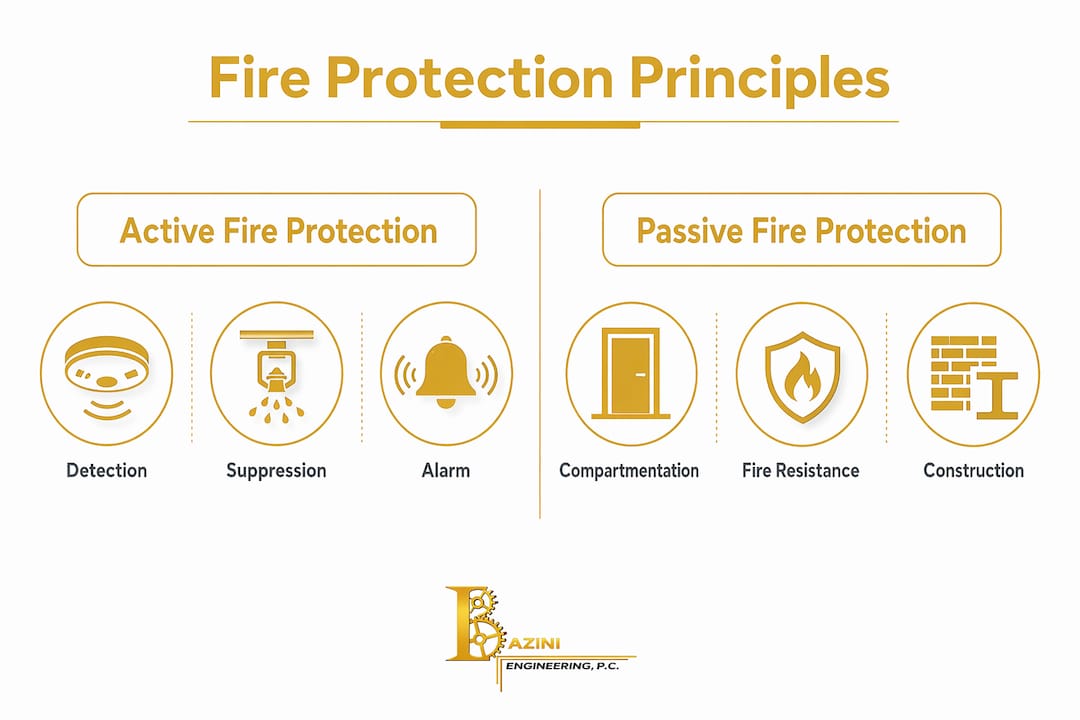
Fire engineering principles fall into four interconnected categories: fire science, active protection, passive protection, and human factors. Understanding each category separately is useful, but the real skill in fire protection engineering lies in applying them together.
Fire science and understanding fire dynamics forms the foundation. Engineers must understand combustion chemistry, heat release rates, flame spread, and smoke production. A fire in a warehouse storing polyurethane foam behaves very differently from a fire in a concrete office building, and design decisions must reflect those differences. Computational tools like Fire Dynamics Simulator (FDS), developed by the National Institute of Standards and Technology (NIST), allow engineers to model fire behavior before a building is constructed.
Active fire protection systems respond to a fire event in real time:
- Automatic sprinkler systems suppress or control fire growth at the point of origin
- Smoke detectors and heat detectors trigger alarms and initiate suppression sequences
- Fire alarm control panels coordinate notification, elevator recall, and HVAC shutdown
- Gaseous suppression systems, such as FM-200 or CO2 systems, protect sensitive equipment rooms where water damage is unacceptable
Passive fire protection slows fire spread through the building's own construction:
- Fire-rated walls, floors, and doors compartmentalize a building, limiting fire to its zone of origin
- Firestopping materials seal penetrations in rated assemblies where pipes, conduits, and ducts pass through
- Smoke control systems, including pressurized stairwells and smoke exhaust fans, maintain tenable conditions in egress paths
Human factors address how people actually behave during a fire emergency. Research consistently shows that occupants do not immediately evacuate when an alarm sounds. They investigate, gather belongings, and alert others. Fire protection engineers account for this delay in egress modeling, using tools like Pathfinder or STEPS to simulate evacuation and verify that exit capacity meets demand before conditions become untenable.
The table below compares active and passive fire protection approaches:
| Attribute | Active fire protection | Passive fire protection |
|---|---|---|
| Trigger | Responds to a fire event | Always present, no trigger needed |
| Examples | Sprinklers, alarms, suppression | Fire-rated walls, firestopping, smoke barriers |
| Maintenance requirement | Regular inspection and testing | Periodic inspection for integrity |
| Primary function | Suppress or detect fire | Contain fire and maintain structure |
Systems Thinking and System Dynamics are advancing fire safety engineering by enabling modeling of nonlinear, time-dependent fire hazards and human behaviors for robust safety planning. This approach treats a building's fire protection measures as an integrated system rather than a checklist of components, which produces more reliable outcomes in complex or high-occupancy structures.
How do fire protection systems work together to prevent and mitigate fire hazards?
Fire protection systems achieve safety through coordination, not through any single component working in isolation. Effective fire protection balances detection, suppression, smoke control, and egress to create safe environments, demanding system-level coordination. When one system activates, it triggers responses across the others, and engineers must design those interactions deliberately.
Consider a fire event in a high-rise office building. A smoke detector on the affected floor signals the fire alarm control panel. The panel initiates a staged evacuation, sounding alarms on the fire floor and the floors immediately above and below. Simultaneously, the HVAC system switches to smoke control mode, pressurizing stairwells and exhausting smoke from the fire floor. Sprinklers activate at the fire's location, suppressing growth. Elevators recall to the lobby. Each of these actions is pre-programmed and coordinated through the building's fire alarm system, which serves as the central nervous system of the entire fire protection strategy.
Pro Tip: During design, always confirm that the fire alarm system's sequence of operations is documented in a matrix and reviewed by the authority having jurisdiction before construction begins. Sequence-of-operations conflicts are among the most common causes of failed inspections on complex projects.
Code requirements from NFPA, the IBC, and local amendments govern minimum performance thresholds for each system type. For buildings in jurisdictions like New York City, the NYC Fire Code and Local Law requirements add another layer of specificity. Compliance with warehouse aisle width standards and similar spatial requirements also affects sprinkler coverage patterns and egress path widths in industrial occupancies, illustrating how fire protection design intersects with operational planning.
Fire protection design also addresses occupancy-specific hazards. A hospital requires smoke compartmentation to enable defend-in-place strategies for patients who cannot self-evacuate. A data center requires clean-agent suppression to protect servers without water damage. A parking garage requires open-air ventilation analysis to determine whether mechanical smoke control is necessary. Each occupancy type demands a tailored approach grounded in the same core principles.
What career pathways exist in fire protection engineering?
Careers in fire protection engineering are accessible through several educational and professional routes, and demand for qualified engineers continues to grow as building codes become more complex and building types more varied.
The primary educational pathway is a bachelor's degree in fire protection engineering from an ABET-accredited program. The University of Maryland's Fire Protection Engineering department is one of the most recognized programs in the United States, with a mission centered on reducing fire losses through education, research, and outreach. Worcester Polytechnic Institute (WPI) offers another well-regarded undergraduate and graduate program. Students in these programs study fire dynamics, suppression system design, structural fire protection, and human behavior in fire.
Key milestones in a fire protection engineering career include:
- Engineer Intern (EI) designation after passing the Fundamentals of Engineering (FE) exam, typically taken near graduation
- Professional Engineer (PE) licensure after accumulating four years of supervised experience and passing the PE exam in fire protection engineering
- Certified Fire Protection Specialist (CFPS) credential from NFPA, which is recognized across consulting, government, and insurance sectors
- NICET certification for fire alarm and sprinkler system technicians, relevant for those working in a more technical installation or inspection role
Career sectors include private consulting firms, fire departments, federal agencies such as the U.S. Fire Administration (USFA), insurance underwriters, and research institutions. Emerging specialties within the field include performance-based fire engineering, wildland-urban interface fire protection, and fire safety for lithium-ion battery storage facilities. Each of these areas requires engineers to apply foundational fire engineering principles to new and evolving hazard profiles.
Key takeaways
Fire protection engineering is a systems discipline that integrates fire science, active and passive protection, and human behavior analysis to protect life, property, and the environment from fire.
| Point | Details |
|---|---|
| Core definition | Fire protection engineering applies science and engineering to prevent, control, and mitigate fire hazards. |
| Active vs. passive systems | Active systems respond to fire events; passive systems contain fire through building construction. |
| Systems coordination | Detection, suppression, smoke control, and egress must work together, not independently. |
| Career entry | ABET-accredited degrees, the FE exam, and PE licensure are the standard professional milestones. |
| Code compliance | NFPA 13, NFPA 72, NFPA 101, and the IBC govern most fire protection design decisions in the U.S. |
Why fire protection engineering deserves more credit than it gets
I have worked alongside fire protection engineers on projects ranging from mid-rise residential buildings in Brooklyn to large institutional facilities, and the pattern I keep seeing is the same. Fire protection gets treated as a late-stage add-on rather than a foundational design input. Architects finalize floor plans, structural engineers complete their drawings, and then someone asks, "Did anyone check the egress travel distances?" That sequence produces problems that are expensive to fix and sometimes impossible to resolve without redesigning significant portions of the building.
The engineers who do this work well think about fire from the first schematic. They ask how smoke will move through a space before the HVAC layout is finalized. They flag occupancy classification issues before the building footprint is locked. That proactive posture is what separates competent fire protection design from code-minimum compliance.
The field is also more intellectually demanding than most people outside it realize. Modeling fire behavior in an atrium, designing a smoke control system for a transit station, or analyzing egress for a stadium requires the same rigor as any structural or mechanical engineering challenge. The growing use of performance-based design, where engineers demonstrate safety through analysis rather than prescriptive code compliance, makes the work even more technically sophisticated.
My honest view is that fire protection engineering should be integrated into every major building project from day one, not consulted after the fact. The cost of getting it right early is a fraction of the cost of correcting it later, and the stakes, measured in lives, are higher than in almost any other engineering specialty.
— Joseph
Work with fire protection engineers who know the codes

Baziniengineering provides fire protection engineering services across New York City, Long Island, and Westchester County, covering sprinkler system design, fire alarm systems, life safety code analysis, and coordination with the NYC Department of Buildings and FDNY. The firm's MEP/FP team integrates fire protection into the full building design process from the earliest project stages, which is exactly the approach this article advocates. If you are working on a commercial, institutional, or residential project and need code-compliant fire protection design delivered on schedule, Baziniengineering is the firm to contact. You can also explore sustainable MEP design examples to see how integrated engineering approaches translate into real project outcomes.
FAQ
What is fire protection engineering in simple terms?
Fire protection engineering is the discipline that applies scientific and engineering principles to design systems and strategies that prevent fires from starting, limit their spread, and protect occupants during evacuation. It covers everything from sprinkler systems to egress analysis and building code compliance.
How is fire protection engineering different from firefighting?
Fire protection engineers design the systems and buildings that reduce fire risk before an emergency occurs, while firefighters respond to active fire events. The two roles are complementary: better fire protection engineering means fewer and less severe incidents that firefighters must manage.
What codes govern fire protection engineering in the U.S.?
The primary codes are NFPA 13 for sprinkler systems, NFPA 72 for fire alarm systems, NFPA 101 for life safety, and the International Building Code for overall building requirements. Local jurisdictions, including New York City, often adopt additional amendments that engineers must follow.
What degree do you need for a career in fire protection engineering?
Most fire protection engineers hold a bachelor's degree in fire protection engineering from an ABET-accredited program, such as those offered by the University of Maryland or Worcester Polytechnic Institute. PE licensure requires an additional four years of supervised experience after graduation.
What is the difference between active and passive fire protection?
Active fire protection systems, such as sprinklers and alarms, respond when a fire occurs. Passive fire protection, such as fire-rated walls and firestopping, is built into the structure and works continuously without any trigger, containing fire and maintaining structural integrity during an emergency.