

MEP engineering, short for mechanical, electrical, and plumbing engineering (often including fire protection), is one of the most budget-sensitive phases of any building project. A budget MEP engineering project gone wrong doesn’t just hurt your bottom line. It triggers change orders, delays permits, and creates friction with contractors that ripples through your entire schedule. The good news is that cost overruns in MEP are almost always preventable with the right preparation, the right tools, and an honest understanding of what drives costs in the first place. This guide walks you through exactly that.
Table of Contents
Key Takeaways
| Point | Details |
|---|---|
| Define scope before budgeting | System type, building use, and local compliance requirements must be locked in before any cost estimate is reliable. |
| Use BIM for estimation | BIM-enabled quantity takeoffs reduce estimation time dramatically and support continuous budget updates. |
| Apply value engineering early | Value engineering delivers the most savings when applied during schematic design, not after construction documents are issued. |
| Track budgets against milestones | Linking cost reviews to design milestones prevents surprises and keeps contingencies from evaporating silently. |
| Avoid generic cost-per-square-foot estimates | Location-specific labor and compliance costs vary significantly and will make generic averages dangerously inaccurate. |
Budget MEP engineering project: what to know first
Before you can build a reliable budget for any MEP engineering project, you need to understand what you are actually budgeting for. MEP systems are not a single line item. They are four distinct trades, each with its own cost drivers, subcontractors, lead times, and code requirements.
The four trades you are coordinating are:
-
Mechanical: HVAC systems including air handling units, ductwork, exhaust fans, boilers and controls
-
Electrical: Power distribution, lighting, emergency systems, and low-voltage infrastructure
-
Plumbing: Domestic water, sanitary drainage, gas piping, and fixtures
-
Fire protection: Sprinkler systems, standpipes, and fire alarm systems
Each of these systems responds differently to building type and occupancy. A residential apartment building has very different MEP complexity than a medical office or a data center. The building type shapes every cost assumption you make.
Accurate MEP budgeting depends on location-specific labor rates, current material pricing, and local compliance mandates. Using national averages without adjusting for your specific market is one of the most common and costly mistakes developers make. In New York City, for example, union labor rates and Department of Buildings filing requirements add costs that simply do not appear in a generic cost-per-square-foot table.
Contract pricing structure also matters more than most developers realize. Percentage-of-construction-cost fee models can expose you to budget risk in volatile markets where material costs fluctuate. Fixed-fee arrangements give you more predictability, while time-and-materials contracts work best when the scope is genuinely undefined. Choosing the wrong model for your project’s design maturity can create misaligned incentives between you and your engineer.
Pro Tip: Before requesting any MEP engineering fee proposal, prepare a one-page project summary that includes building type, gross square footage, occupancy classification, and known system requirements. Engineers who receive complete information give you more accurate and competitive proposals.
How to build your MEP project budget step by step
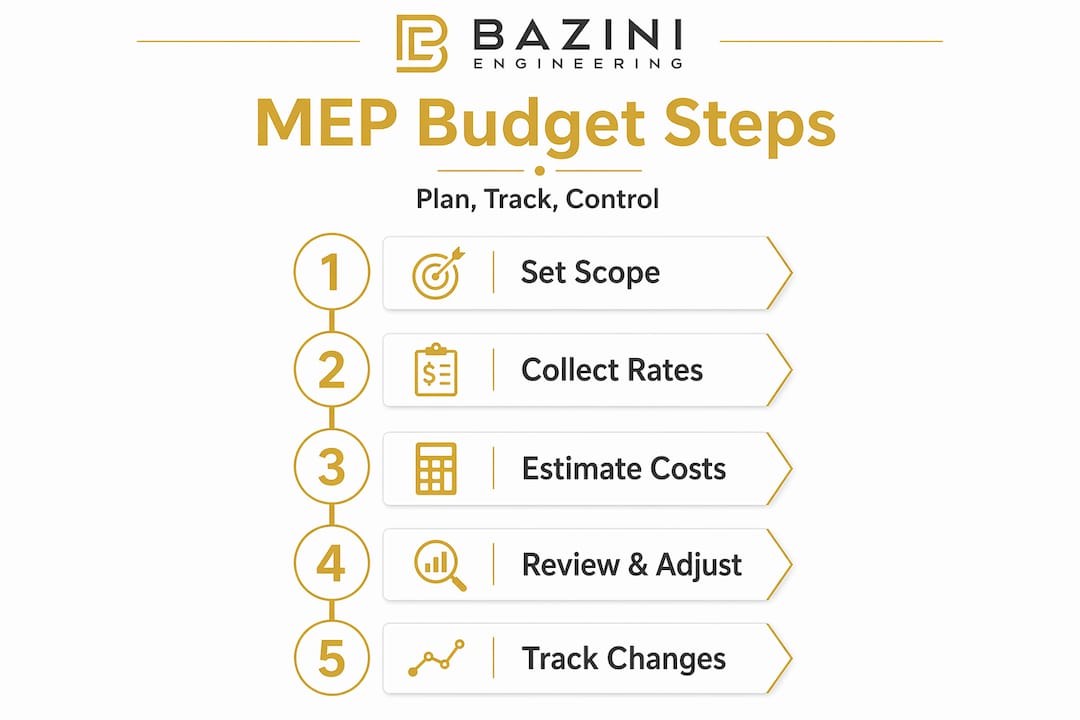
Budgeting MEP systems is not a one-time event. It is an iterative process that should evolve with your design. Here is how to approach it systematically.
-
Start with a detailed quantity takeoff. Use the most current drawings available, even if they are schematic. Measure duct lengths, pipe runs, panel counts, and fixture quantities. Rough numbers from early drawings are still more useful than assumptions.
-
Leverage BIM for quantity extraction. Revit quantity schedules can pull duct lengths, fitting counts, valve quantities, and equipment lists directly from the model geometry. What used to take an estimator several days can now be completed in under an hour. That speed lets you run multiple cost scenarios without blowing your pre-construction budget.
-
Apply unit costs from current, local sources. Plug your quantities into pricing databases that reflect your local market. RSMeans regional data, local subcontractor quotes, and recent bid tabs from comparable projects are all valid inputs. Blend them for a more defensible number.
-
Build in contingency based on design maturity. At schematic design, a 20 to 25 percent contingency is reasonable. At design development, you can tighten that to 10 to 15 percent. At construction documents, 5 to 10 percent is appropriate. Never eliminate contingency entirely.
-
Coordinate assumptions across all four trades. Mechanical and electrical systems share equipment rooms, ceiling space, and structural penetrations. If your mechanical engineer assumes a certain ceiling height for ductwork and your electrical engineer assumes the same space for cable trays, you have a coordination conflict that will cost money to resolve in the field.
-
Update your budget at every design milestone. Schematic design, design development, and construction documents each represent a meaningful increase in design resolution. Each milestone should trigger a budget reconciliation.
Pro Tip: Ask your MEP engineer to flag any system selection that carries significant cost variance at each design milestone. Knowing that a chilled water system costs 30 to 40 percent more than a VRF system upfront, but may save money over a 20-year lifecycle, is exactly the kind of information that changes decisions.
Value engineering for cost-effective MEP projects
Value engineering (VE) is a structured methodology for analyzing the function of systems and components relative to their cost. It is not about cutting corners. It is about making deliberate trade-offs with full information. VE reduces rework, change orders, and schedule volatility when applied systematically, particularly when the focus is lifecycle cost rather than upfront price alone.
For affordable MEP engineering outcomes, here is how to apply VE effectively:
-
Define value priorities before design begins. Are you optimizing for lowest construction cost, lowest operating cost, fastest schedule, or highest sustainability rating? You cannot optimize for all four simultaneously. Pick your hierarchy and communicate it to your design team.
-
Focus VE efforts on the highest-cost systems first. HVAC typically represents 40 to 50 percent of MEP construction cost on commercial projects. That is where a 10 percent reduction delivers the most dollar savings. Electrical systems are usually second. Plumbing and fire protection offer less VE leverage on most building types.
-
Compare alternatives with lifecycle cost analysis. A rooftop packaged unit costs less to install than a central air handling system, but the operating and maintenance costs over 20 years may tell a different story. Run the numbers before the design is locked.
-
Use VE to reduce coordination risk. Simpler systems with fewer components are not just cheaper to install. They are cheaper to coordinate, easier to commission, and less likely to generate change orders during construction.
Value engineering is most effective when it happens during schematic and design development phases. Once construction documents are issued, the cost of implementing changes increases by an order of magnitude. Every week you delay VE conversations is money left on the table.
Verifying and managing your MEP budget during execution
Getting your budget right at the start is only half the job. Keeping it right through design and construction is where most projects lose ground. Budget-friendly MEP solutions require active management, not just a good starting estimate.
The following table shows how budget verification practices should evolve across project phases:
| Project phase | Budget action | Key tool | Target accuracy |
|---|---|---|---|
| Schematic design | Parametric estimate | Cost database + BIM | ±25% |
| Design development | Detailed takeoff | BIM quantity schedules | ±15% |
| Construction documents | Line-item estimate | Subcontractor quotes | ±10% |
| Bidding | Bid reconciliation | Bid tab analysis | ±5% |
| Construction | Change order tracking | Cost management software | Ongoing |
5D BIM tools link design geometry directly to cost data, so when an engineer changes a duct routing or adds a piece of equipment, the cost model updates in near real time. Projects using continuous budget tracking through 5D BIM have seen procurement overruns reduced by up to 22 percent. That is a meaningful number on a project with a $2 million MEP budget.
Establish a formal budget review cadence. Monthly reviews during design and weekly reviews during construction are reasonable minimums. Each review should compare current estimate to original budget, identify the source of any variance, and document whether the change was scope-driven or market-driven.
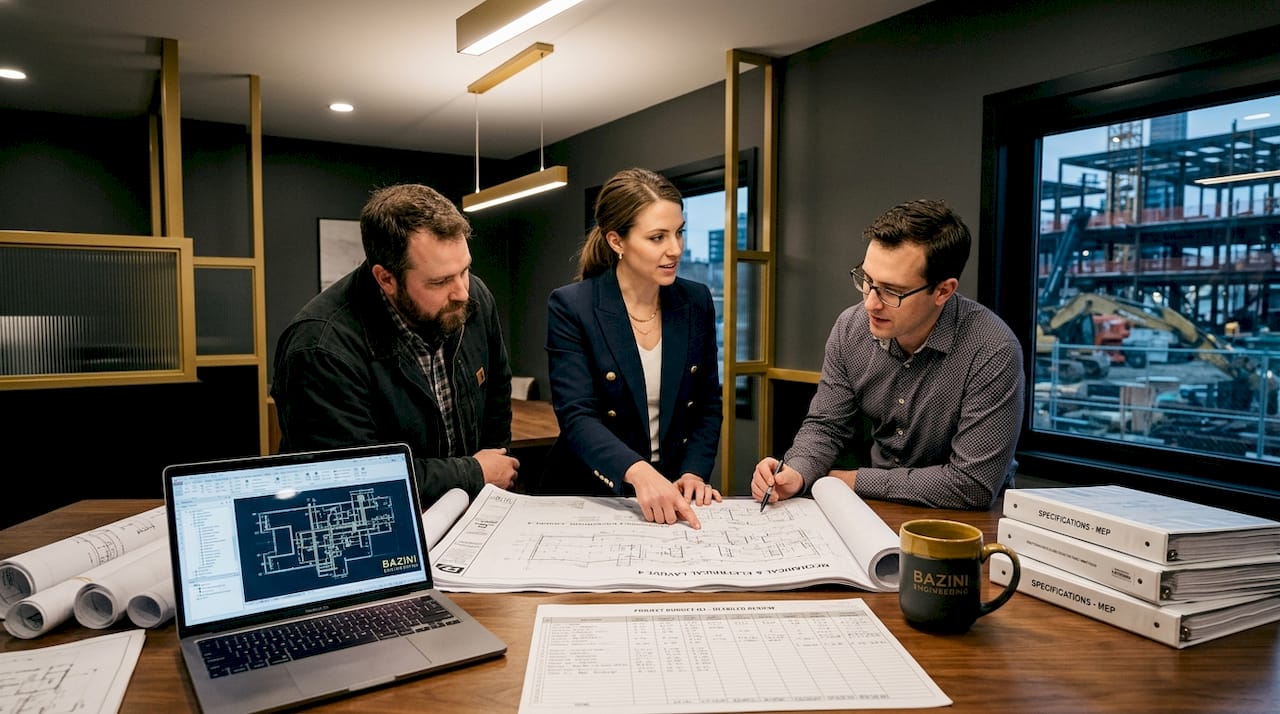
Close coordination between your project manager, MEP engineer, and general contractor is non-negotiable. When these three parties are not sharing cost information in real time, surprises accumulate until they become crises.
Pro Tip: Require your MEP engineer to submit a brief cost impact statement with every design revision. Even a one-paragraph note that says “this change adds approximately $15,000 to the electrical budget due to additional panel capacity” keeps everyone aligned and prevents sticker shock at bid time.
Common MEP budget mistakes and how to avoid them
Most MEP budget overruns trace back to a small set of recurring mistakes. Recognizing them early is the fastest way to protect your project.
-
Relying on cost-per-square-foot averages without system specificity. A $35 per square foot MEP allowance might be appropriate for a simple warehouse. It will be catastrophically low for a laboratory or a hospital. MEP estimating fees and construction costs vary from $350 for small HVAC scopes to over $22,000 for complex data center bundles. Generic numbers do not survive contact with real projects.
-
Ignoring local labor and material cost variation. Union jurisdictions, prevailing wage requirements, and regional material supply chains create cost differences that national averages cannot capture. Always ground your numbers in local market data.
-
Delaying value engineering until the design is nearly complete. By the time construction documents are 90 percent done, your options for meaningful cost reduction are severely limited. VE conversations belong in schematic design, not in the value engineering session your contractor requests after bids come in 20 percent over budget.
-
Underestimating compliance and code costs. Energy code compliance, fire alarm system requirements, and jurisdiction-specific filing fees add real dollars to MEP budgets. In New York City, coordination with the Department of Buildings and FDNY alone can add weeks to a schedule and thousands to engineering fees.
-
Failing to update estimates as the design evolves. A budget set at schematic design and never revised is not a budget. It is a wish. Outsourcing MEP tasks without coordinating early with a local licensed engineer adds another layer of risk, particularly around jurisdiction-specific approvals that can derail your schedule if not handled proactively.
My honest take on MEP cost management
I have reviewed enough MEP projects to see a clear pattern. The developers who stay on budget are not the ones with the most money. They are the ones who engage their MEP engineers and estimators before the design is set in stone.
The uncomfortable truth is that most budget overruns are not caused by bad contractors or rising material costs. They are caused by decisions made in the first 10 percent of the design process that nobody priced out at the time. A system selection made casually in a schematic design meeting can add $200,000 to a construction budget that nobody sees until bids come back.
What I have found actually works is treating the MEP budget as a living document from day one. Not a number you set and forget, but a number you actively defend through every design decision. Continuous costing updates feel like extra work until the moment they save you from a six-figure change order.
Value engineering in mission-critical systems deserves special attention. On a data center or a medical facility, the temptation to cut MEP costs is real, but the consequences of under-engineering those systems are severe. The right approach is not to spend less. It is to spend smarter, with lifecycle cost as the measuring stick.
Balancing speed, quality, and cost in the real world means making trade-offs with full information. That is what good MEP project cost management actually looks like.
— Joseph
Work with Baziniengineering on your next project

If you are managing a budget-conscious building project and need MEP engineering that actually holds to a number, Baziniengineering is built for exactly that. The firm integrates value engineering into every design phase, uses BIM-based quantity extraction for accurate estimates, and delivers PE-stamped drawings with the kind of local code knowledge that prevents expensive surprises at the Department of Buildings. Whether you need MEP engineering services for a commercial renovation, a new residential building, or a complex institutional project, Baziniengineering’s team works with your budget from day one, not around it. Request a consultation and find out what a cost-focused engineering partner actually looks like in practice.
FAQ
What is a typical MEP budget percentage of total construction cost?
MEP systems typically represent 20 to 40 percent of total construction cost, depending on building type and system complexity. Hospitals and laboratories sit at the high end; warehouses and simple residential buildings sit at the low end.
How do I reduce MEP costs without cutting quality?
Apply value engineering during schematic and design development phases, focusing on lifecycle cost comparisons rather than upfront price alone. Systematic VE reduces change orders and rework without sacrificing system performance.
When should I start budgeting for MEP on a new project?
Start at schematic design, even if the numbers carry a wide range. Early-stage estimates with documented assumptions are far more useful than waiting for complete drawings, because they inform system selection decisions before those decisions become expensive to reverse.
How accurate is a BIM-based MEP estimate?
A well-executed BIM quantity takeoff at design development can achieve accuracy within 10 to 15 percent. At construction documents, accuracy improves to within 5 to 10 percent, especially when paired with current local subcontractor pricing.
What contract type is best for an MEP engineering fee?
Fixed-fee contracts offer the most budget predictability for well-defined scopes. Time-and-materials contracts work when scope is genuinely uncertain. Percentage-of-construction-cost models carry more risk in volatile markets and should be evaluated carefully before signing.