

Hiring an MEP engineer for a commercial building means selecting a licensed professional responsible for designing and coordinating the mechanical, electrical, and plumbing systems that determine whether your building performs, complies, and gets built on time. The industry term for this role is the MEP Engineer of Record (EOR), a licensed Professional Engineer who signs and seals construction documents and assumes full professional responsibility for those systems. For property developers and project managers, understanding who this person is, what they must bring to the table, and how they fit into your contract structure is the difference between a smooth project and a costly rework. Baziniengineering has worked on commercial projects across New York City, Long Island, and Westchester County, and the patterns that separate successful projects from troubled ones almost always trace back to how the MEP engineer was selected and engaged.
How to hire an MEP engineer for a commercial building
The first qualification to verify is licensure. The MEP EOR must hold a Professional Engineer (PE) license in the state where the project is located. Without it, they cannot legally sign or seal the drawings required for permit submission. A PE license signals that the engineer has passed rigorous national examinations, met state-specific experience requirements, and accepted legal accountability for their designs. For commercial projects in New York, that accountability extends to coordination with the NYC Department of Buildings and, where fire protection is involved, the FDNY.
Beyond licensure, the degree background matters. MEP designers in commercial construction typically hold degrees in Mechanical Engineering, Electrical Engineering, or Architectural Engineering. A mechanical engineer handles HVAC and plumbing systems; an electrical engineer covers power distribution, lighting, and low-voltage systems. On larger projects, you may engage separate licensed engineers for each discipline under a single MEP firm, which is how Baziniengineering structures its teams.
Software proficiency is non-negotiable in 2026. Revit MEP and AutoCAD MEP are the baseline tools for commercial MEP design. BIM modeling capability matters because it allows your MEP engineer to coordinate spatially with the architectural and structural models before a single pipe is installed. An engineer who cannot produce BIM-coordinated drawings will cost you more in field conflicts than you save on their fee.

Pro Tip: Ask candidates to share a BIM coordination report from a previous commercial project. The density and resolution of clash detections they caught in the model tells you more about their process than any resume line.
Experience with large commercial or institutional projects is the final filter. An engineer who has designed systems for a 10,000-square-foot tenant fit-out is not automatically qualified for a 200,000-square-foot office tower. Ask specifically about projects of comparable size, occupancy type, and mechanical complexity.
How does contract structure affect MEP engineer liability?
The contractual client of the MEP engineer varies by project delivery model, and that variation has direct consequences for communication, coordination, and professional liability. Three structures are common in commercial construction.
| Contract model | Who hires the MEP engineer | Liability and communication implications |
|---|---|---|
| Direct owner contract | Property developer or owner | Clear communication channel; owner controls scope and fee directly |
| Architect subconsultant | Architect of record | MEP engineer reports through architect; liability flows through architect's contract |
| Design-build contractor | General contractor or design-build firm | MEP engineer serves contractor's schedule and budget priorities; owner has less direct oversight |
The direct owner contract gives you the most control. You set the scope, you approve deliverables, and you have a direct line to the engineer when field questions arise. The subconsultant model is common and workable, but it adds a communication layer. When the contractor asks a plumbing question in the field, the answer travels from contractor to architect to MEP engineer and back. That chain adds time and creates opportunities for misinterpretation.
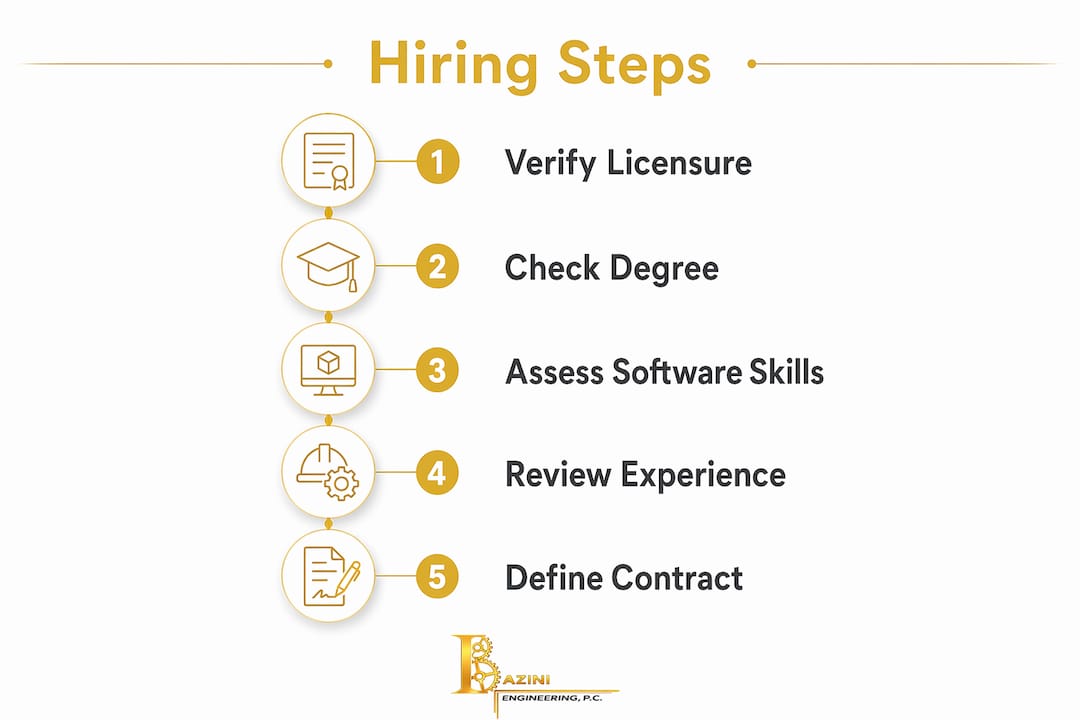
The design-build model is the most efficient for schedule but requires the most trust. The MEP engineer's primary obligation runs to the contractor, not to you. If you use this model, include owner review rights in the contract and require the MEP EOR to attend owner coordination meetings directly.
Professional liability allocation depends on contract language and state law. The MEP EOR's signing and sealing responsibility means they carry errors and omissions (E&O) exposure for the systems they design. Verify that any firm you engage carries current professional liability insurance with limits appropriate to your project's construction value.
What are the key project phases when working with an MEP engineer?
MEP involvement should begin at schematic design, not at construction documents. Early MEP involvement during schematic design reduces costly mid-construction changes by integrating systems spatially with architectural and structural elements from the start. Waiting until the architectural drawings are nearly complete before engaging your MEP engineer is one of the most common and expensive mistakes in commercial development.
Here is how MEP involvement typically maps across a commercial project:
- Schematic design. The MEP engineer establishes system types, sizes major equipment, and identifies spatial requirements for mechanical rooms, electrical rooms, and vertical shaft locations. Decisions made here affect the building's floor plate efficiency and structural coordination.
- Design development. Systems are sized in detail. Equipment is selected. Coordination with the structural engineer begins to resolve beam penetrations, slab openings, and equipment pad locations.
- Construction documents. The MEP engineer produces permit-ready drawings and specifications. This includes competitive bid support and filings with local authorities having jurisdiction (AHJs). The EOR signs and seals the full set.
- Procurement and construction administration. The MEP engineer reviews submittals, responds to requests for information (RFIs), and conducts site visits. Construction administration services are typically contracted separately from design services and are worth including in every commercial project.
- Commissioning. The MEP engineer verifies that installed systems perform as designed. Commissioning is a distinct scope that protects your investment and is required by energy codes on most commercial buildings.
Pro Tip: Require your MEP engineer to attend the first three owner-architect-contractor (OAC) meetings after construction starts. Problems caught in those early meetings cost a fraction of what they cost to fix in the field six months later.
BIM coordination is the tool that makes this sequence work. When the MEP model is federated with the architectural and structural models, clash detection catches conflicts before they become change orders. This is not optional on any commercial project above 50,000 square feet.
How does hiring an experienced MEP engineer affect cost and schedule?
The fee difference between an experienced MEP firm and a less experienced one is typically small relative to construction cost. The schedule and cost impact of their decisions is not. Off-site prefabrication reduced HVAC installation by 10 weeks on the Science Square mixed-use project, enabling on-time, on-budget completion. That result came directly from an MEP engineer who understood constructability and designed for it. Ten weeks of schedule compression on a commercial project translates to millions of dollars in carrying costs and earlier revenue.
Experienced MEP engineers also protect you from code compliance failures. MEP engineers must monitor emerging code updates and coordinate with AHJs to maintain life-safety and energy compliance. A missed energy code requirement can trigger a stop-work order or require redesign of mechanical systems after installation. An engineer who tracks ASHRAE 90.1 updates, local energy codes, and fire protection standards as part of their standard practice eliminates that risk.
The long-term building performance argument is equally compelling. Systems designed with proper load calculations, correct equipment sizing, and commissioning oversight consume less energy and require less maintenance over their service life. For a commercial asset you plan to hold or sell, that operational efficiency directly affects net operating income and cap rate valuation.
The most common cost pitfall is late coordination. When MEP drawings are not coordinated with structural and architectural drawings before construction starts, field conflicts generate change orders. A single major coordination failure, such as a duct run that conflicts with a structural beam, can cost tens of thousands of dollars to resolve in the field. Constructability strategies like off-site unitization of mechanical equipment, using 116 preassembled skids on Science Square, demonstrate what a well-prepared MEP team can accomplish when given the time and scope to plan properly.
Key takeaways
Hiring the right MEP engineer requires verifying PE licensure, defining contract structure clearly, and engaging the engineer at schematic design rather than at permit submission.
| Point | Details |
|---|---|
| PE licensure is mandatory | The MEP engineer of record must hold a state PE license to sign and seal commercial construction documents. |
| Contract structure determines liability | Direct owner contracts provide the clearest communication and liability chain for commercial developers. |
| Early engagement reduces cost | MEP involvement at schematic design prevents spatial conflicts that become expensive change orders in construction. |
| BIM coordination is non-negotiable | Revit MEP and federated BIM models catch clashes before they reach the field on any project above 50,000 sq ft. |
| Constructability expertise saves schedule | Prefabrication strategies designed by experienced MEP engineers have documented 10-week schedule reductions on commercial projects. |
What I've learned about choosing the right MEP engineer
The most underestimated factor in selecting an MEP engineer is not their portfolio. It is the clarity of the contractual relationship and how early you bring them in. I have seen developers spend months reviewing firm credentials and then hand the MEP engineer a nearly complete architectural set with six weeks to produce permit drawings. That sequence guarantees problems.
The firms that consistently deliver on commercial projects share one trait: they treat the MEP engineer as a design team member from day one, not a permit-filing service at the end. When the MEP engineer is in the room during schematic design, they catch the mechanical room that is 200 square feet too small, the electrical room with no transformer clearance, and the plumbing stack that conflicts with the structural core. Those catches cost nothing at schematic design and a great deal to fix later.
My practical advice for developers: require a PE license, verify E&O insurance, ask for references from projects of comparable size and occupancy type, and structure a direct owner contract whenever the project budget allows. Read the MEP permit set process before your first coordination meeting so you understand what you are reviewing and approving. And budget for commissioning from the start. It is not an optional add-on. It is the verification step that confirms your investment performs as designed.
The right MEP engineer is defined not only by design capability but by contractual clarity and liability. Both matter equally.
— Joseph
Work with Baziniengineering on your next commercial project

Baziniengineering provides full-service MEP engineering for commercial buildings, covering HVAC design, electrical distribution, plumbing systems, fire protection, energy code compliance, and construction administration. Founded in 2010 and licensed in New York and Florida, the firm coordinates directly with the NYC Department of Buildings, FDNY, and local AHJs to keep your project on schedule and code-compliant. Whether you are planning a new commercial development or a major tenant fit-out, Baziniengineering delivers permit-ready drawings and hands-on construction support tailored to your project's scope. If you want to understand how to budget your MEP scope before the first design meeting, that resource is a practical starting point. Contact Baziniengineering to discuss your project requirements directly.
FAQ
What does an MEP engineer of record do on a commercial project?
The MEP engineer of record signs and seals all mechanical, electrical, and plumbing construction documents, assumes professional liability for those systems, and coordinates with local authorities having jurisdiction for permit approval.
When should I hire an MEP engineer for a commercial building?
Engage your MEP engineer at schematic design, before architectural drawings are finalized. Early involvement prevents spatial conflicts between building systems and structure that are expensive to resolve during construction.
What certifications should an MEP engineer have?
A Professional Engineer (PE) license in the project state is required. Proficiency in Revit MEP, AutoCAD MEP, and BIM coordination is the current industry standard for commercial building MEP design.
How does contract structure affect my MEP project?
A direct owner contract gives you the clearest communication and liability chain. Subconsultant arrangements through an architect add a coordination layer that can slow field responses and complicate liability allocation.
What is commissioning and why does it matter?
Commissioning is the process of verifying that installed MEP systems perform as designed. It is required by most commercial energy codes and protects your building's long-term operational performance and asset value.