
TL;DR:
- Mechanical commissioning verifies that building systems meet design and regulatory standards before handover. Skipping this process increases risks of system failures, energy waste, and compliance issues that are costly to fix later. It offers measurable energy savings and long-term performance benefits, making it a cost-effective quality assurance step in construction.
Mechanical commissioning is the systematic process of verifying, testing, and documenting that mechanical building systems perform according to design intent and regulatory standards before handover. Facility managers and project stakeholders who skip this step expose their buildings to energy waste, system failures, and compliance gaps that cost far more to fix after occupancy. Studies show new construction commissioning delivers a median whole-building energy savings of 13% with a payback period of 4.2 years. That figure alone reframes commissioning from a line-item cost into a measurable financial return. Baziniengineering works with clients across New York and Florida to deliver commissioning programs that protect building performance from day one.
Why mechanical commissioning is needed: the core case
Mechanical commissioning is defined by ASHRAE as the quality-focused process for achieving, verifying, and documenting that building systems meet the owner's project requirements. The industry term is "building commissioning," and the mechanical subset covers HVAC, plumbing, and related systems specifically. Understanding why mechanical commissioning is needed starts with recognizing that design intent and installed reality rarely match without independent verification.
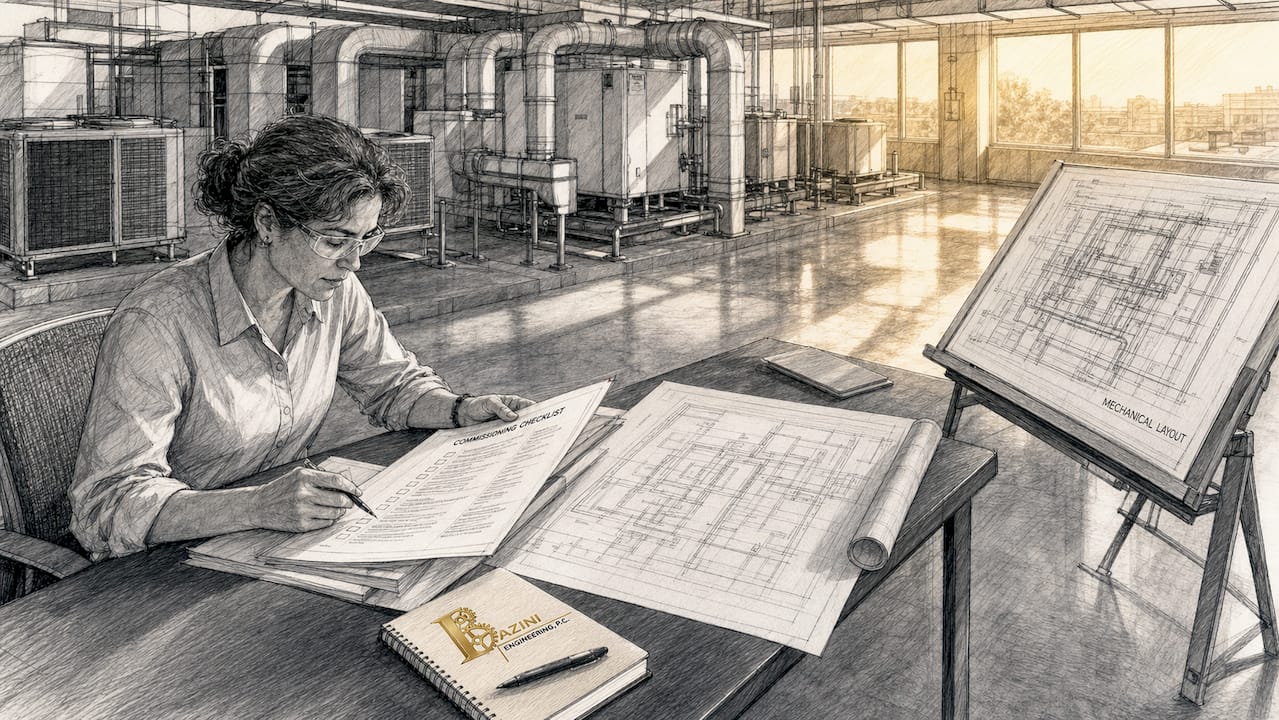
Construction projects involve dozens of contractors, subcontractors, and equipment suppliers. Each party installs their scope correctly in isolation, yet integrated systems fail when sequences, controls, and setpoints are not tested together. Commissioning closes that gap by treating the building as one operating system rather than a collection of parts.
What risks and costs arise from skipping mechanical commissioning?
The most common misconception about commissioning is that it duplicates equipment startup. Startup confirms a piece of equipment powers on. Commissioning confirms it operates correctly within the full system under real load conditions. Those are fundamentally different activities.
Skipping commissioning creates hidden costs that surface during seasonal transitions and long-term operations, not at project handover. A chiller may run fine in spring but fail to maintain setpoints during a July heat wave. A VAV box may operate correctly in isolation but hunt continuously when connected to the building automation system. These failures are harder and more expensive to diagnose after occupancy than they would have been to catch during functional performance testing.
The specific risks facility managers face without commissioning include:
- Performance failures during peak loads: Systems sized and installed correctly still fail when control sequences are not verified under full heating and cooling demand.
- Energy waste from uncorrected setpoints: Sensors out of calibration, economizer dampers stuck closed, and scheduling errors can add significant energy costs that persist for years.
- Warranty exposure: Manufacturers require documented proof of proper installation and startup. Without commissioning records, warranty claims become difficult to defend.
- Tenant complaints and lease disputes: Comfort failures drive tenant dissatisfaction. In commercial buildings, persistent HVAC complaints create legal and reputational exposure.
- Deferred maintenance costs: Problems not caught at handover compound over time. A minor control error becomes a failed actuator, which becomes a damaged coil.
Commissioning costs represent approximately 0.25% of total construction costs. That fraction is small relative to the potential rework, litigation, and energy losses it prevents.
Pro Tip: Reframe commissioning in your project budget as a cost shift, not an added expense. You are moving risk from the operational phase, where fixes are expensive, to the construction phase, where they are cheap.
How does commissioning improve energy efficiency and performance?
Commissioning delivers measurable energy savings that compound over a building's life. New construction commissioning yields a median whole-building energy savings of 13% with a median payback period of 4.2 years. Existing buildings that undergo retro-commissioning perform even better.
Retro-commissioned buildings show median energy savings of 16% with a median payback period of just 1.1 years. That payback speed reflects how much energy existing buildings waste through uncorrected control faults, sensor drift, and scheduling errors that accumulate over time.
| Building type | Median energy savings | Median payback period |
|---|---|---|
| New construction | 13% | 4.2 years |
| Existing buildings (retro-commissioning) | 16% | 1.1 years |
The savings come from specific technical corrections: verified control sequences, calibrated sensors, confirmed economizer operation, and tested building automation integration. Each correction eliminates a source of waste that would otherwise run undetected for years.
"Commissioning is a risk-reduction investment with asymmetric value. Failures make the absence of commissioning visible. Successes go uncredited because nothing went wrong."
The importance of mechanical commissioning extends beyond energy bills. Verified systems require fewer emergency maintenance calls, experience less wear from operating outside design parameters, and last longer before major component replacement. For facility managers managing operating budgets, those downstream savings matter as much as the energy line item.
What does the mechanical commissioning process involve?
The mechanical commissioning process is a structured sequence of activities that begins before design is finalized and continues through post-occupancy. This is the clearest distinction between commissioning and startup: startup is a single event, while commissioning is a phase-spanning program.
An independent Commissioning Authority leads the process to maintain objectivity and prevent conflicts of interest. The CxA reviews design documents, leads functional testing, and produces formal commissioning reports independent from the contractors who installed the systems. That independence is what gives commissioning its credibility as a verification tool.
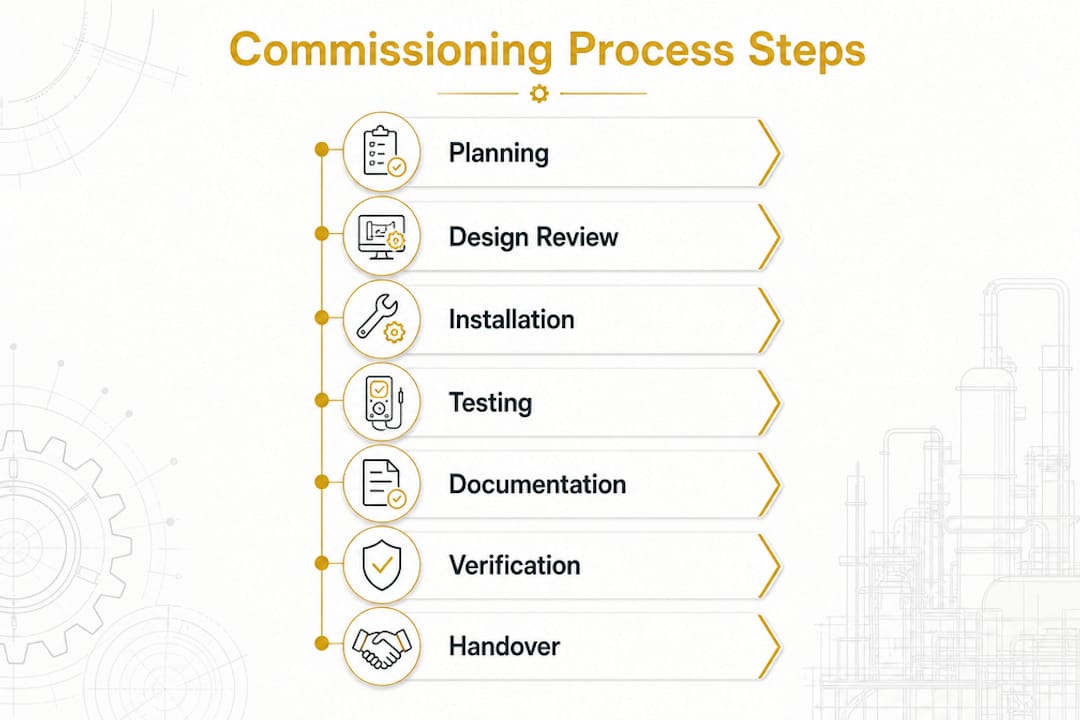
The typical mechanical commissioning process follows these steps:
- Owner's Project Requirements (OPR) development: Define performance expectations, energy targets, and operational needs before design begins.
- Basis of Design review: Confirm the engineer's design approach aligns with the OPR.
- Construction document review: Check specifications and drawings for commissionability, control sequence clarity, and testing access.
- Installation verification: Inspect equipment installation, piping, ductwork, and controls against approved submittals before systems are energized.
- Pre-functional testing: Verify individual components operate correctly before integrated testing begins.
- Functional performance testing: Test complete systems under simulated and actual load conditions, including failure scenarios and control sequence verification.
- Commissioning report and "Day 1" baseline: Document all test results, deficiencies, and corrective actions in a formal report archived in the O&M manuals.
- Post-occupancy and seasonal testing: Retest systems under opposite-season conditions to confirm performance across the full load range.
Commissioning plans act as comprehensive roadmaps with step-by-step protocols, inspection and test plans, record sheets, and formal witnessing requirements. Buildings commissioned without a formal plan tend to have incomplete testing and operational gaps that surface after handover.
Pro Tip: Engage your commissioning provider during schematic design, not at construction completion. Early involvement catches specification gaps and control sequence ambiguities before they become field problems.
How does commissioning support compliance and long-term facility management?
Commissioning documentation serves as the legal and operational record of system performance. For building code compliance, sustainability certifications like LEED, and local regulatory requirements, that documentation is not optional. It is the proof that systems perform as designed.
Commissioning creates a "Day 1" performance baseline archived in O&M manuals that supports warranty claims and contractor accountability. When a system fails two years after handover, the commissioning report tells you exactly how it performed at acceptance. That baseline makes the difference between a defensible warranty claim and a dispute with no documentation.
The table below shows how commissioning supports three distinct facility management functions:
| Function | Commissioning role | Practical benefit |
|---|---|---|
| Regulatory compliance | Documents system performance against code and certification requirements | Supports LEED, Local Law 97, and NYC DOB submissions |
| Warranty management | Provides baseline test results and deficiency records | Strengthens claims against contractors and manufacturers |
| Preventive maintenance | Archives control sequences, setpoints, and test results | Gives maintenance teams a verified reference for troubleshooting |
For facilities subject to New York City's Local Law 97 compliance requirements, commissioning documentation directly supports carbon emissions reporting and penalty avoidance. Buildings that cannot demonstrate verified system performance face both regulatory exposure and higher operating costs.
Seasonal testing during the defect liability period is a practice that most facility managers overlook. Testing systems only in the season they were commissioned misses half the performance picture. A building commissioned in spring may have undetected heating deficiencies that only appear in december. Second-season testing closes that gap and protects the owner before the warranty period expires.
Proper commercial building maintenance programs build on commissioning baselines. When maintenance teams know the verified setpoints and control sequences from day one, they can identify drift and degradation before it becomes a failure.
Key Takeaways
Mechanical commissioning is the most cost-effective quality assurance step in a building project, delivering verified performance, regulatory documentation, and long-term energy savings that startup alone cannot provide.
| Point | Details |
|---|---|
| Energy savings are measurable | New construction commissioning delivers a median 13% energy savings with a 4.2-year payback. |
| Skipping creates hidden costs | Problems from missed commissioning surface during seasonal transitions, not at handover. |
| Process spans the full project | Commissioning runs from pre-design through post-occupancy, not just at equipment startup. |
| Documentation protects owners | A "Day 1" baseline supports warranty claims, code compliance, and maintenance troubleshooting. |
| Cost fraction is small | Commissioning costs approximately 0.25% of construction costs against potentially millions in avoided rework. |
Why I think commissioning is the most undervalued step in any building project
I have seen the same pattern repeat across commercial and institutional projects: commissioning gets cut or compressed when schedules tighten and budgets come under pressure. The reasoning is always the same. The equipment is installed correctly. The contractors are experienced. What could go wrong?
What goes wrong is integration. Individual systems work. The building does not. I have walked into occupied buildings where the HVAC was fighting itself because control sequences were never verified, where tenants on the south exposure were overheating while the north side was cold, and where the building automation system was logging faults that nobody had ever reviewed. Every one of those problems would have been caught in functional performance testing.
The industry mindset still treats commissioning as a quality-of-life addition rather than a core project requirement. That framing is wrong. Commissioning is the only reliable method for verifying that a complex, integrated system performs as designed. No amount of experienced contractors or quality equipment substitutes for independent, documented functional testing.
The shift I want to see is commissioning treated the same way structural inspections are treated. Nobody questions whether a structural inspection is worth the cost. Mechanical systems are equally complex and equally consequential for building safety, comfort, and operating costs. The verification standard should match.
— Joseph
Baziniengineering's mechanical commissioning and MEP engineering services
Baziniengineering provides mechanical engineering services that cover the full commissioning lifecycle, from pre-design involvement through post-occupancy testing. The firm's MEP engineering background means commissioning is integrated with design intent from the start, not added as a separate layer at project completion.

For facility managers and project stakeholders in New York City, Long Island, and Westchester County, Baziniengineering delivers commissioning programs aligned with NYC Department of Buildings requirements, FDNY standards, and sustainability certification goals. Every engagement produces the documented performance baselines and test records that protect owners through construction, warranty, and long-term operations. Review the full range of engineering services or contact Baziniengineering directly to discuss commissioning support for your project.
FAQ
What is mechanical commissioning in a building project?
Mechanical commissioning is the systematic process of verifying, testing, and documenting that HVAC, plumbing, and related mechanical systems perform according to design intent and owner requirements. It covers everything from installation inspection through functional performance testing and post-occupancy seasonal verification.
Why is mechanical commissioning needed if equipment is installed correctly?
Correct installation does not guarantee correct integrated performance. Commissioning verifies that control sequences, building automation systems, and mechanical components work together under real load conditions, which startup alone cannot confirm.
How much energy can commissioning save?
New construction commissioning delivers a median whole-building energy savings of 13% with a 4.2-year payback period. Retro-commissioning of existing buildings achieves a median 16% savings with a payback period of just 1.1 years.
What is a Commissioning Authority?
A Commissioning Authority is an independent professional who leads the commissioning process, reviews design documents, conducts functional performance testing, and produces formal commissioning reports without a conflict of interest from the construction team.
Does commissioning help with LEED or Local Law 97 compliance?
Commissioning documentation provides the verified performance records required for LEED certification and supports Local Law 97 carbon emissions reporting in New York City. Without that documentation, compliance submissions lack the technical evidence regulators and certification bodies require.