
TL;DR:
- Local Law 97 requires NYC buildings above 25,000 square feet to report certified emissions annually and meet strict greenhouse gas limits.
- Engaging an experienced engineer during pathway selection helps ensure compliance and avoids costly penalties.
Local Law 97 (LL97) requires most New York City buildings above 25,000 gross square feet to meet annual greenhouse gas (GHG) emissions limits and file a certified report with the NYC Department of Buildings (DOB) every year. If your building's gross floor area, as recorded by the NYC Department of Finance (DOF), crosses the threshold generally triggering LL97 coverage, you are almost certainly covered. The law targets a 40% reduction in building emissions by 2030 and net-zero operational emissions by 2050. Annual reports cover the prior calendar year and are due May 1, with a grace period to June 30. After June 30, a $0.50 per square foot monthly late-filing penalty kicks in, separate from any per-ton fines for actually exceeding your emissions limit.
Key coverage triggers at a glance:
- A single building exceeding 25,000 gross square feet
- Two or more buildings on the same tax lot together exceeding 50,000 gross square feet
- Two or more condominium buildings under the same board of managers together exceeding 50,000 gross square feet
Coverage is determined by your DOF-recorded gross floor area, tied to your building's BIN (Building Identification Number) and BBL (Borough-Block-Lot). Small square-footage errors in your records can materially shift your calculated emissions limit, so verifying those figures against DOF records before you file is not optional.
Two compliance pathways exist. Article 320 is the default annual route for most private buildings. Article 321 is a one-time pathway available only to qualifying affordable housing and houses of worship. Losing Article 321 eligibility, through an ownership or use change, immediately triggers full Article 320 annual obligations.
Offsets are available but tightly capped. The maximum allowable deduction is 10% of a building's calculated emissions limit, and only contributions to the Affordable Housing Reinvestment Fund (AHRF) qualify. Renewable Energy Credits (RECs) have strict limitations, particularly for heating and hot water emissions. Electrification is the primary long-term lever; RECs alone will not get most buildings to their 2030 caps.

Every annual report must be certified by a Registered Design Professional (RDP). The RDP's role is substantive: they validate energy usage data, floor area figures, and the underlying calculations. This is technical verification, not a rubber stamp. Engaging an RDP at the assessment stage, not the filing deadline, gives you time to model retrofit options, identify high-impact measures like HVAC electrification, and avoid the per-ton penalties that apply when a building exceeds its annual limit.
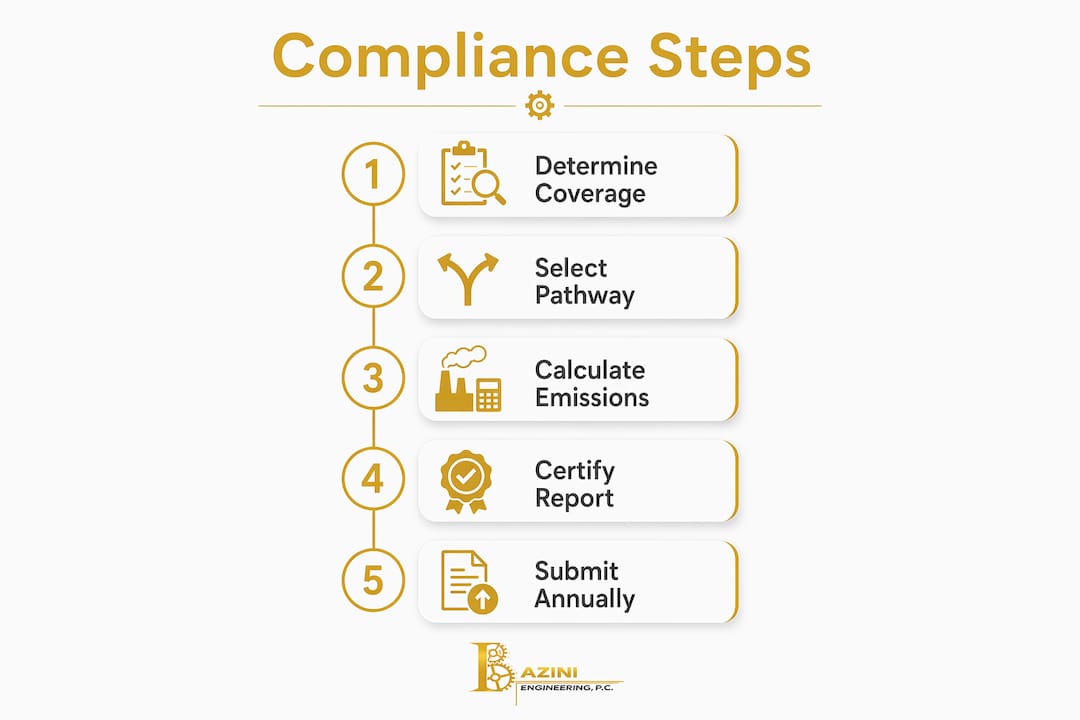
Table of Contents
Bazini Engineering, P.C. Can Get Your Building to Compliance
NYC emissions regulations move fast, and the cost of a missed filing or an exceeded limit adds up quickly. Baziniengineering provides the full engineering and RDP support that covered building owners need: floor-area verification against DOF records, energy modeling across Article 320 compliance pathways, HVAC electrification design, plumbing and hot-water system coordination, and RDP-certified calculations ready for DOB submission. The firm is licensed in New York and has direct experience coordinating with both DOB and FDNY when retrofits require permit work or fire-protection system changes.
The right time to engage is during pathway selection, before you default to a last-minute filing. Request an LL97 readiness review from Baziniengineering and get a clear picture of your building's current emissions position, your 2030 target, and the retrofit or operational changes that close the gap.
Key Takeaways
Local Law 97 requires covered NYC buildings to file annual RDP-certified emissions reports with the DOB, meet tightening GHG limits through 2030, and face per-ton penalties plus a $0.50/sf monthly late fee for noncompliance.
| Point | Details |
|---|---|
| Coverage threshold | Buildings above 25,000 GSF per DOF records are generally covered under LL97. |
| Annual deadline | Reports are due May 1; the grace period ends June 30, after which the $0.50/sf monthly penalty applies. |
| Emissions targets | LL97 requires a 40% reduction by 2030 and net-zero operational emissions by 2050. |
| Offset limits | Offsets are capped at 10% of a building's calculated emissions limit; RECs have strict limitations for heating loads. |
| Baziniengineering | Provides RDP certification, energy modeling, HVAC electrification design, and DOB/FDNY permit coordination for LL97 compliance. |