

Local Law 97 caps how much greenhouse gas most large New York City buildings can emit each year, and it fines owners who exceed that cap or who skip reporting entirely. If your building sits on a lot with more than 25,000 gross square feet of space, or shares a tax lot with other buildings that together cross 50,000 gross square feet, this law already applies to you.
The first move isn't picking a retrofit. It's confirming your building's BIN and BBL against the Department of Buildings' coverage rules and lining up a registered design professional (RDP) to verify your gross floor area before you file anything.
Here's the bottom line for your building:
- Coverage threshold: Most buildings over 25,000 gross square feet, or combined buildings on one tax lot over 50,000 gross square feet, must report annually.
- Reporting already started: 2024 emissions data was due May 1, 2025, and caps get significantly tighter in 2030.
- Money at stake: Missed filings and excess emissions both carry real penalties, and an RDP's certification is generally required before filing.
Key Takeaways
Local Law 97 requires most NYC buildings over 25,000 square feet to report annual emissions and stay under a legal cap, with penalties for missed filings and overages that scale directly with square footage and excess tonnage.
| Point | Details |
|---|---|
| Confirm coverage first | Check your BIN and BBL against the Covered Buildings List before assuming your compliance path. |
| Know your formula | Emissions limit equals gross floor area times emissions factor by property type; compare it against actual fuel-based emissions. |
| Pick the right article | Article 320 covers most buildings with annual reporting; Article 321 offers a one-time path for qualifying affordable housing and houses of worship. |
| Watch the penalty math | Missed filings cost $0.50 per square foot per month; excess emissions cost $268 per metric ton CO2e per year under Article 320. |
| Get expert help early | Bazini Engineering offers Local Law 97 compliance audits, RDP certification, and retrofit design to verify your numbers before deadlines hit. |
Official guidance and helpful resources
Owners should keep these official touchpoints bookmarked for filing season:
- DOB's Local Law 97 page for coverage rules, filing guides, and Article 320/321 references.
- ENERGY STAR Portfolio Manager for property benchmarking and utility linking.
- BEAM and DOB NOW for report submission, fee payment, and attestation.
Full filing templates, RDP certification forms, and platform walkthroughs live directly on the DOB site and within the BEAM and ESPM systems themselves.
This article is general information, not a substitute for advice from a qualified lawyer. Consult a qualified legal professional about your own circumstances before acting on anything here.
Table of Contents
- What Is Local Law 97 and Which Buildings Does It Cover?
- How Are Emissions Limits and Annual Emissions Calculated?
- Article 320 vs. Article 321: Which Compliance Path Applies?
- What Is the ESPM to BEAM Reporting Workflow?
- When Are Local Law 97 Reports and Penalties Due?
- How Much Are Local Law 97 Penalties and Can You Reduce Them?
- How Do You Confirm Your Building Is on the Covered Buildings List?
- What Should You Budget and Plan for Next?
- How Bazini Engineering Supports Local Law 97 Compliance
- Sources
What Is Local Law 97 and Which Buildings Does It Cover?
Local Law 97 sets annual limits on carbon emissions for most buildings above the 25,000 square foot threshold, with the goal of cutting citywide building emissions 40% by 2030 and reaching net zero by 2050. Buildings account for a majority of New York City's greenhouse gas output, which is why the law targets them directly rather than vehicles or industry.
Coverage isn't just about one address. A single building over 25,000 gross square feet qualifies on its own. Multiple buildings sharing a Block and Lot (BBL) that together exceed 50,000 gross square feet also qualify, even if no individual building on the lot crosses the threshold alone. Condo developments governed by one board with a combined 50,000 square feet fall under the same rule.
Three identifiers matter here, and owners often confuse them:
- BIN (Building Identification Number): Identifies the physical structure.
- BBL (Borough, Block, Lot): Identifies the tax lot, which is how combined-building coverage gets triggered.
- DOF gross area vs. GFA: The Department of Finance's gross area listing and the Local Law 97 gross floor area calculation under 1 RCNY §103-14 aren't always identical, and the DOB listing controls what you owe.
A 26,000 square foot office building is covered on its own. A lot with multiple buildings that together exceed the coverage threshold triggers coverage even if no individual building crosses that size.
How Are Emissions Limits and Annual Emissions Calculated?
Every covered building gets two numbers: a legal limit and an actual emissions total, both measured in metric tons of CO2 equivalent (tCO2e). Compliance means staying under the limit.
The limit calculation works like this, according to DOB's emissions guidance:
- Identify your building's property type in ENERGY STAR Portfolio Manager (office, multifamily, hospital, and so on).
- Multiply your gross floor area by the emissions factor assigned to that property type.
- Sum this across all property types in the building if it's mixed use.
Actual annual emissions follow a parallel formula: for each fuel source (electricity, natural gas, steam, fuel oil), multiply annual consumption by that fuel's emissions coefficient, then add the totals together.
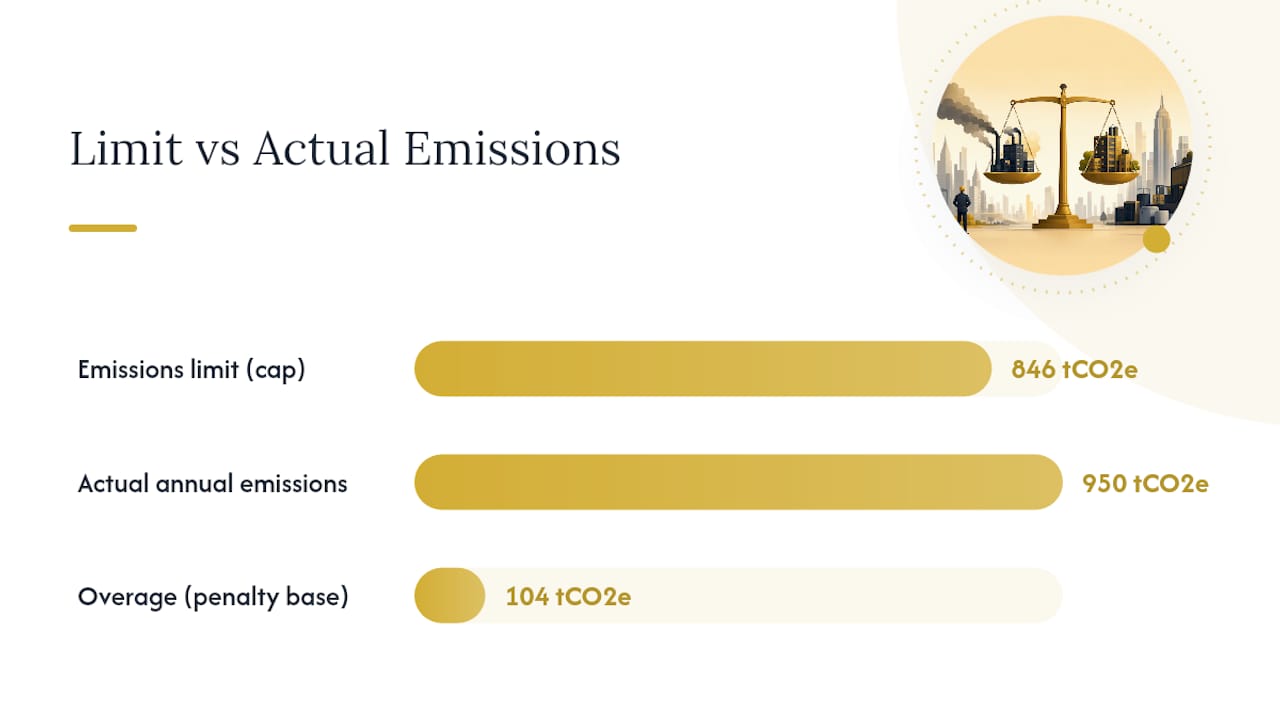
Quick example: A 100,000 square foot office building with an emissions factor of 0.00846 tCO2e per square foot has a limit of roughly 846 tCO2e per year. If its actual metered energy use converts to 950 tCO2e, it's 104 tons over the cap, and that overage is what the penalty formula multiplies against.
One detail catches owners off guard: electricity's emissions coefficient is scheduled to drop as the grid decarbonizes after 2029, which means electrification decisions made today will look better on paper in the next compliance period. Almost every Article 320 filing needs an RDP to verify these calculations before submission, since a miscounted square footage or misclassified property type changes the limit itself.
Article 320 vs. Article 321: Which Compliance Path Applies?
Most covered buildings fall under Article 320, which sets annual emissions limits and requires yearly reporting with RDP certification. A smaller group of buildings, mainly rent-regulated affordable housing and houses of worship, qualify for Article 321, a one-time, lower-cost path that requires either installing Prescribed Energy Conservation Measures (PECMs) or simply hitting the 2030 limit directly.
| Feature | Article 320 | Article 321 |
|---|---|---|
| Reporting frequency | Annual | One-time compliance demonstration |
| Who qualifies | Most covered buildings | Qualifying affordable housing, houses of worship |
| Professional certification | RDP required for most filings | Varies by PECM or limit-based path |
| Penalty structure | Per-ton overage plus missed-filing fines | Flat penalty for late or failed compliance |
The path an owner ends up on usually comes down to a few practical signals:
- A high share of rent-regulated units often points toward Article 321 eligibility.
- Market-rate multifamily, office, retail, and institutional buildings almost always land in Article 320.
- Ownership structure and unit mix should be confirmed early. Guessing wrong wastes a filing cycle.
What Is the ESPM to BEAM Reporting Workflow?
Reporting runs through three connected systems, and the order matters. Start in ENERGY STAR Portfolio Manager (ESPM), where you create or update your property profile, link your utility accounts, and confirm gross floor area and property type. From there, data flows into BEAM (Building Energy Applications and Monitoring), the official LL97 reporting portal, which pulls information from both ESPM and DOB NOW.
The full sequence looks like this:
- Set up or update your building's profile in ESPM and link the relevant utility providers.
- Verify gross floor area and property type match what DOB has on file.
- Register in BEAM, which auto-populates limit calculations from your linked ESPM data.
- Pay the required fee through DOB NOW and attach RDP certification where the pathway requires it.
- Submit and attest to the report inside BEAM.
A few things trip owners up here. Each BIN generally needs its own report, unless your buildings share the same owner, sit on the same or adjacent lots, and follow the same compliance pathway, in which case a combined report is possible. Pull your documents before you start: recent LL84 benchmarking data, twelve months of utility bills, meter maps, and any existing GFA verification. Handing an RDP a folder with these ready cuts weeks off the process.
When Are Local Law 97 Reports and Penalties Due?
Annual reports are due May 1 for the prior calendar year, so 2024 data was due May 1, 2025, and that cadence repeats every year going forward. The first compliance window, 2024 through 2029, sets the initial caps. The second window, 2030 through 2034, tightens them substantially on the road to net zero by 2050.
By the numbers: Early compliance data showed fewer than 10% of covered properties exceeded their 2024–2029 caps, but projections from NYC Accelerator suggest a far larger share could exceed the stricter 2030 limits without intervention.
Put three dates on your calendar now:
- A recurring internal deadline each spring to collect the prior year's utility data before the May 1 filing.
- An RDP engagement date at least a few months ahead of filing, not the week before.
- A 2030 readiness review this year, since equipment lead times and permitting can eat a full year before construction even starts.
How Much Are Local Law 97 Penalties and Can You Reduce Them?
Penalties come in two forms, and they're calculated differently. Missing a filing deadline costs $0.50 per square foot per month it's late, which adds up fast on a large building. Exceeding your emissions limit under Article 320 incurs a penalty calculated per metric ton of CO2e over the cap, per year. Article 321 buildings face a flat penalty for late or failed compliance instead.
Here's how that math plays out and what you can do about it:
- Take the 104 tCO2e overage example from earlier: at $268 per ton, that's roughly $27,872 in annual penalties until the building comes back under its limit.
- Compare that to a missed filing on a 100,000 square foot building: $0.50 per square foot per month adds up to $50,000 every month the report sits unsubmitted, which almost always costs more than the overage penalty itself.
- Mitigation options exist for both pathways. Owners can pursue an Article 321 mitigation filing through mediated resolution, an Eligible Energy Conservation Project (EECP), or documentation of an unforeseeable event that prevented compliance.
Pro Tip: Start your mitigation documentation the same year you learn you're over the limit, not the year the penalty notice arrives. DOB frequently asks for historical proof of diligent effort, and a thin paper trail undermines an otherwise legitimate mediated-resolution request.
How Do You Confirm Your Building Is on the Covered Buildings List?
Verifying your status takes less time than most owners assume, and it should happen before you commit to any retrofit budget.
- Check the Covered Buildings List published through DOB, and cross-reference your BIN and BBL against the DOF gross area on file.
- If your actual gross floor area differs from what DOB or DOF have listed, an RDP can submit corrected measurements to reconcile the record. This step alone has moved buildings from noncompliant to compliant on paper.
- If your buildings share heating, cooling, or electrical service across a single BBL, gather site plans and meter diagrams now. Combined reporting requires proof of shared energy service, and misdocumenting it is one of the most common technical errors owners run into.
- Pull your most recent LL84 benchmarking submission, your utility account numbers, and your tax lot records into one folder before you contact an RDP or consultant.
What Should You Budget and Plan for Next?
Once you know your number, the real work starts: figuring out what it costs to close the gap between your current emissions and your limit, especially the tighter 2030 target.
Your first hires typically fall into three roles: an RDP to verify measurements and certify filings, an energy modeling specialist to project emissions under different retrofit scenarios, and an MEP engineering firm to scope the actual mechanical and electrical work
The measures that move the needle most consistently include:
- Electrifying heating systems, since electricity's emissions factor is set to decline as the grid decarbonizes.
- Replacing aging boilers or rooftop units with high-efficiency equipment.
- Upgrading building automation and energy management systems.
- Repairing envelope weaknesses that waste conditioned air.
- Engaging tenants on plug-load reduction, especially in office and lab buildings where tenant equipment drives a large share of usage.
Expect a rough sequence of audit, design, permitting, procurement, and construction, and expect equipment lead times and DOB permit review to eat more calendar time than the construction itself. A few cost drivers worth flagging early:
- Fuel-switching complexity, particularly in buildings without existing electrical capacity for heat pumps.
- Central plant replacements, which are disruptive and expensive compared to incremental upgrades.
- Tenant disruption during construction in occupied buildings.
- Meter reconfiguration for buildings pursuing combined reporting across a shared BBL.
Buildings that clear the 2024–2029 caps comfortably aren't necessarily safe for 2030. Price your retrofit against the tighter window, not just the one you're facing this year.
A practitioner's view on what actually separates compliant buildings from the rest
The buildings that sail through Local Law 97 aren't the ones with the newest equipment. They're the ones that got an RDP involved early enough to catch a GFA discrepancy or a misclassified property type before it became a filing problem. The mistake I see most often isn't a bad retrofit decision, it's delay: owners wait to verify their numbers until the deadline is close, and by then their options for electrification or controls upgrades have shrunk to whatever can be installed fast, not whatever performs best long term. Bazini Engineering has worked through this exact sequence on projects across the city, and the pattern holds every time: early verification buys you better retrofit choices, not just fewer penalties.
How Bazini Engineering Supports Local Law 97 Compliance
Bazini Engineering gives building owners a direct path to compliance instead of a stack of reporting software to figure out alone. As a licensed MEP/FP firm, Bazini Engineering handles the full sequence: Local Law 97 compliance audits, RDP verification and certification, energy modeling, electrification and HVAC retrofit design, and coordination with DOB filing requirements.
A typical engagement starts with validating your gross floor area and property type against the DOB record, confirming your ESPM and BEAM submissions are accurate, and scoping a retrofit plan with real cost estimates rather than guesswork. If your building runs on outdated mechanical systems, Bazini's mechanical engineering team can scope the equipment upgrades that reduce your emissions exposure before the 2030 caps tighten.
Request a Local Law 97 compliance assessment through Bazini Engineering's Local Law 97 services page to get your building's numbers verified and a retrofit scope built around your actual filing deadline.