

What is latent heat in HVAC systems?
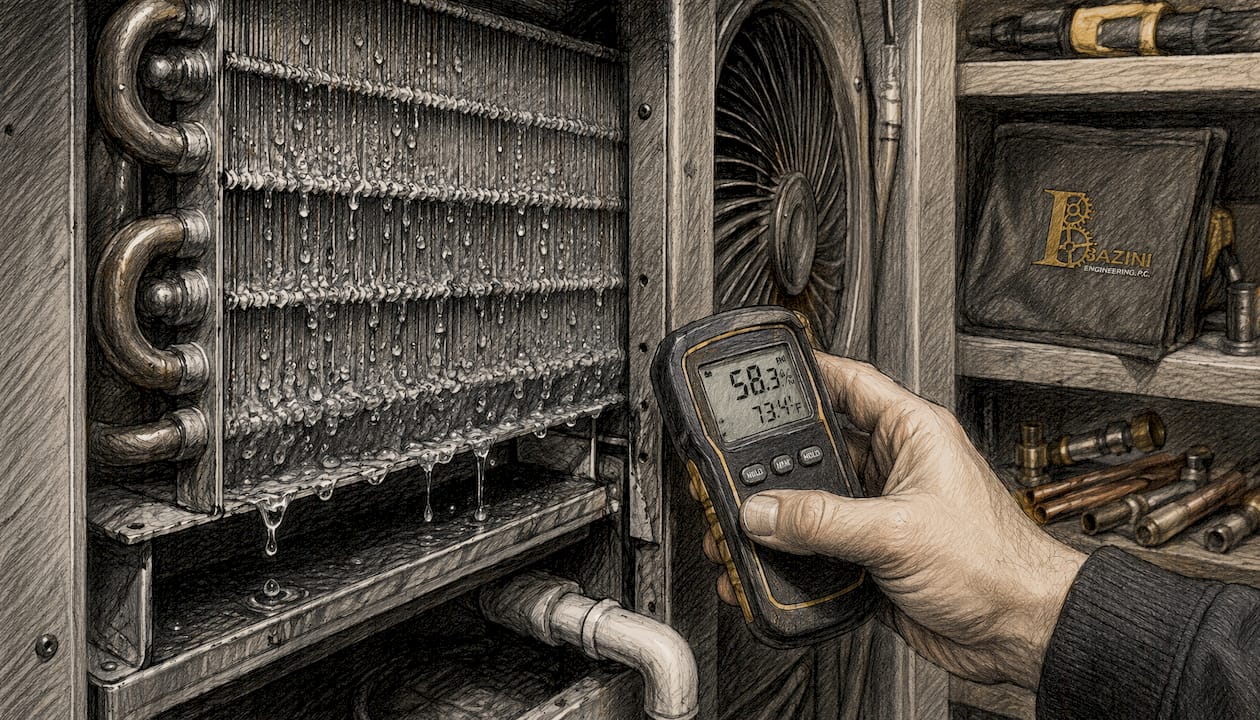
Latent heat in HVAC is the energy absorbed or released when moisture changes phase, specifically when water vapor condenses into liquid or evaporates back into vapor. Crucially, this energy transfer happens without changing air temperature. Your thermometer stays flat. Your hygrometer climbs. That gap between what the thermostat reads and how the room actually feels is latent heat at work.
ASHRAE defines latent heat as the change in enthalpy associated with a change in humidity ratio, caused by the addition or removal of moisture. In practical HVAC terms, it is measured in watts or BTU/h, the same units used for sensible cooling capacity, because energy is energy regardless of whether it moves moisture or temperature.
Key facts about latent heat in HVAC:
- It affects indoor humidity, not dry-bulb temperature
- It is invisible to a standard thermostat
- It must be removed by condensation on the evaporator coil
- High latent loads cause that sticky, clammy feeling even at comfortable temperatures
- It is measured in watts (W) or BTU/h
How does sensible heat differ from latent heat?
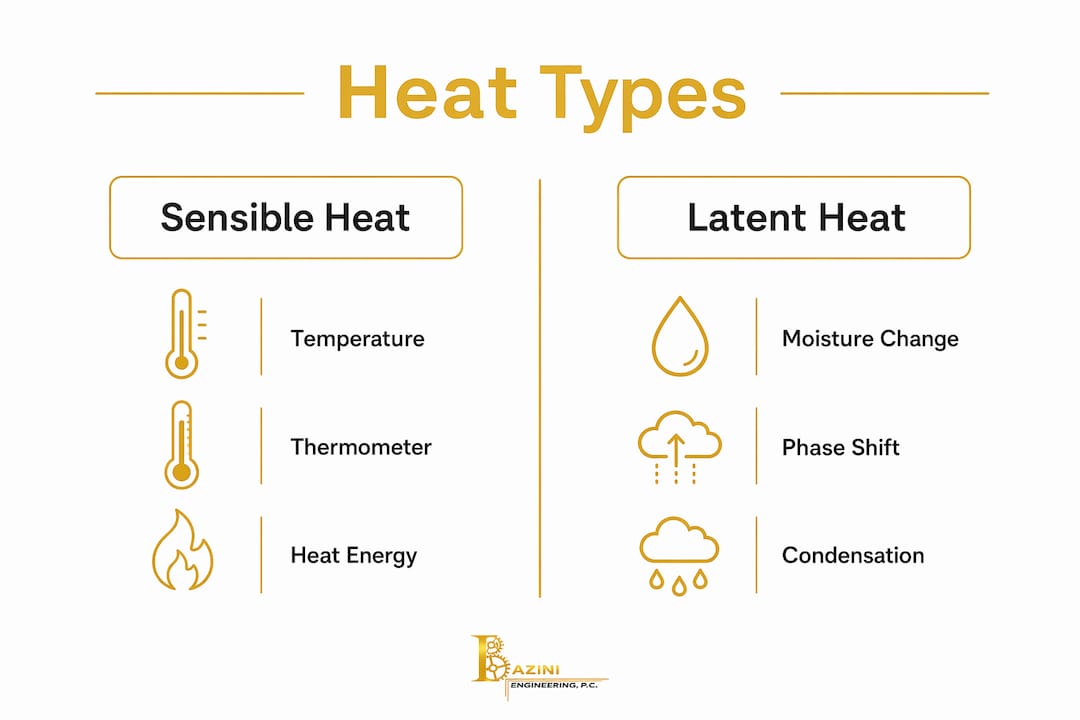
Sensible heat is the straightforward one. Add heat to a room and the thermometer rises. Remove it and the thermometer drops. Sensible heat changes dry-bulb temperature, and a standard thermometer catches every degree of it.
Latent heat does the opposite. A room full of people breathing and sweating during a meeting can feel noticeably more humid while the thermometer barely moves. That moisture load is latent. You need a hygrometer to detect it, not a thermometer.
Key contrasts between the two:
- Sensible heat: changes air temperature, detected by thermometer, caused by lighting, solar gain, and equipment
- Latent heat: changes moisture content, detected by hygrometer, caused by occupants, ventilation, and infiltration
- Both together make up the total cooling load; lighting is sensible only, while people and outdoor air contribute both
Every cooling load is a combination of the two, and the split between them is expressed as the Sensible Heat Ratio (SHR): sensible heat gain divided by total heat gain.
How latent heat removal affects comfort and HVAC performance
When an air conditioner cools air below its dew point, moisture condenses on the evaporator coil and drains away. That process is dehumidification, and it is how latent heat removal actually works. Without it, the room stays clammy regardless of what the thermostat says.
A 75°F room in a dry climate feels comfortable. A 75°F room with high humidity feels oppressive. The thermostat reads the same number in both cases because it only tracks sensible heat. The difference is entirely latent.
Effects of inadequate latent heat removal:
- Persistent clammy or sticky feeling despite correct temperature
- Mold and moisture damage risk, since the EPA links elevated indoor humidity to mold growth
- Occupant complaints that the system "isn't working" even when temperature targets are met
- Reduced perceived cooling effectiveness
Effective HVAC design manages the sensible heat ratio to match the latent and sensible loads of the specific space and climate. A system sized only for temperature control in a humid climate will consistently underperform on moisture.
Pro Tip: If occupants complain about stuffiness or clamminess at correct temperatures, check the SHR of the installed equipment against the actual latent load of the space before assuming the system is undersized.
What types of latent heat matter in HVAC?
Two main phase-change processes carry latent heat, and HVAC systems encounter both:
- Latent heat of vaporization: energy required to convert liquid water into vapor, or released when vapor condenses back to liquid. This is the dominant process in air conditioning and dehumidification.
- Latent heat of fusion: energy involved in melting or freezing, relevant mainly in ice-based thermal storage or frost formation on coils, not in standard comfort cooling.
Inside an operating air conditioner, two latent heat processes happen at once: refrigerant boils inside the evaporator coil, absorbing heat from the airstream, and water vapor from that same airstream condenses on the coil's outer surface, releasing its latent heat. Both affect system efficiency, and both must be accounted for in a proper load calculation.
Baziniengineering's engineering perspective on latent heat
At Baziniengineering, latent heat is never an afterthought. Every HVAC design the firm produces accounts for the latent load of the specific space, whether that is a high-occupancy commercial office in Manhattan or a residential project on Long Island where summer humidity routinely drives latent loads well above sensible ones.
The coil temperature must stay below the air's dew point for condensation to occur. If airflow is too high or the coil is not cold enough, moisture passes through without condensing, and the system fails its dehumidification function entirely. Baziniengineering engineers specify coil temperatures, airflow rates, and equipment SHR values together, not independently.
Pro Tip: Consumers often focus on cooling tonnage alone. Ask your engineer for the equipment's SHR and compare it to your space's calculated latent load before selecting a system.
How engineers measure latent heat in HVAC systems
Psychrometrics is the science of moist air, and it is the primary tool for quantifying latent heat in HVAC work. A psychrometric chart plots dry-bulb temperature against humidity ratio. Pure sensible heat gain moves the air condition point horizontally to the right. Pure latent heat gain moves it straight up, humidity ratio rising while temperature holds steady.
Engineers use wet-bulb temperature measurements, dew point sensors, and enthalpy calculations to separate the sensible and latent components of a total load. The formula is straightforward: total heat gain equals sensible heat gain plus latent heat gain. The SHR then tells you what fraction of that total the equipment must handle as sensible cooling versus dehumidification.
Real HVAC scenarios where latent heat shows up
Latent heat effects appear in everyday HVAC situations more often than most people realize:
- Dehumidification in humid climates: In New York summers, outdoor air entering a building carries substantial moisture. The HVAC system must condense that vapor on the evaporator coil before the space can feel comfortable.
- Crowded spaces: A conference room packed with people generates significant latent load from respiration and perspiration, often more than the lighting and equipment combined.
- Restaurant kitchens: Steam from cooking raises humidity ratios dramatically. Kitchen HVAC systems carry much lower SHR values than office systems to handle the heavy latent load.
- Indoor pools: Evaporation from pool surfaces creates a nearly continuous latent load that dominates system design.
How latent heat affects HVAC load calculations and energy use
Ignoring latent load in a load calculation produces a system that hits temperature targets but fails humidity control. That failure drives occupant discomfort, increases the risk of mold, and often leads to the system running longer cycles trying to compensate, which raises energy consumption.
Properly accounting for latent load means selecting equipment with an SHR matched to the space, sizing the coil to operate below the dew point under design conditions, and verifying that airflow rates support condensation rather than bypassing it. When Baziniengineering conducts HVAC design for a project, latent load is calculated separately from sensible load and drives coil selection, refrigerant circuit sizing, and ventilation strategy together.
Understanding HVAC maintenance contract accounting also benefits from this distinction, since systems that chronically underperform on latent removal tend to generate more service calls and higher operating costs over time.
Key Takeaways
Latent heat in HVAC is the energy tied to moisture phase changes, and managing it correctly is what separates a comfortable building from one that feels perpetually sticky regardless of the thermostat setting.
| Point | Details |
|---|---|
| Latent heat changes moisture, not temperature | It is measured in watts or BTU/h and detected by a hygrometer, not a thermometer. |
| Dehumidification is latent heat removal | Moisture condenses on the evaporator coil only when coil temperature drops below the air's dew point. |
| SHR guides equipment selection | The Sensible Heat Ratio splits total load into sensible and latent components; matching it to the space is critical. |
| Ignoring latent load raises energy costs | Systems that miss humidity targets run longer cycles, increasing energy consumption and service frequency. |
| Psychrometrics quantifies the split | Engineers use psychrometric charts and enthalpy calculations to separate sensible and latent loads precisely. |