
A pre-action sprinkler system holds water back behind a closed pre-action valve until a detection device confirms fire, then fills the piping and waits for a sprinkler head to open before any water discharges. That two-step logic makes it the standard choice for data centers, archives, and other spaces where a burst pipe or false trip could be as costly as the fire itself.
- Normal state: piping is dry, filled with supervised air or nitrogen, not water
- Trigger 1: smoke or heat detection opens the pre-action valve and floods the pipes
- Trigger 2: heat at the sprinkler head melts the glass bulb or link, releasing water only at that head
The NFPA classifies pre-action alongside wet, dry, and deluge systems, and NFPA 13 governs how these are designed and installed. Firms like Bazini Engineering specify and commission these systems daily for clients who can't afford an accidental soak.
Pro Tip: If your space houses irreplaceable records or server racks, ask your engineer whether double-interlock logic is worth the added complexity before you commit to a single-interlock design.
Key Takeaways
Pre-action sprinkler systems use a two-step detection-and-activation sequence specifically to reduce accidental water discharge in mission-critical and water-sensitive spaces.
| Point | Details |
|---|---|
| Two-trigger logic | Detection opens the valve; a sprinkler head must still activate before water discharges. |
| Interlock type matters | Double-interlock suits the highest-risk spaces; single-interlock fits reliable detection setups. |
| Standards to follow | NFPA 13 governs installation, NFPA 25 governs inspection, and NFPA 72 governs detection. |
| Weigh the trade-offs | Higher cost and fill-time delay must be justified by the value of what you're protecting. |
| Get engineering input | Bazini Engineering specifies, designs, and commissions pre-action systems for mission-critical facilities. |
Table of Contents
- How Does a Pre-Action System Work, Step by Step?
- Single-Interlock, Double-Interlock, and Non-Interlock: What's the Difference?
- What Components Make Up a Pre-Action System?
- What Are the Benefits of a Pre-Action Sprinkler System?
- Where Are Pre-Action Systems Typically Installed?
- Pre-Action vs. Dry Pipe vs. Deluge: What Sets Each Apart?
- How Often Should Pre-Action Systems Be Inspected and Tested?
- What Are the Downsides of a Pre-Action Sprinkler System?
- What Should You Consider When Specifying a Pre-Action System?
- Sources
How Does a Pre-Action System Work, Step by Step?
The sequence starts long before any alarm sounds. Piping sits pressurized with supervised air or nitrogen, and the pre-action valve stays shut, keeping water in the supply line rather than the overhead network. Nothing moves until something tells it to.
- Detection event. A smoke detector, heat detector, or connected fire alarm signal reports a condition to the panel.
- Valve opens. The pre-action valve releases, and water begins filling the previously dry pipe network.
- Fill stage. Water travels through the system; fill time depends on pipe length, diameter, and valve type, and it directly affects how fast suppression can actually happen once a head opens.
- Sprinkler activation. Heat at an individual head melts its thermal link or bulb, and only that head discharges water onto the fire.
- Supervision throughout. Air pressure switches and valve supervisory contacts continuously report status to the fire alarm control panel, flagging leaks or tampering before they become failures.
That fill delay is the trade-off every specifier weighs: faster detection response versus a built-in buffer against accidental discharge. Fire Systems, Inc. documents this dual-trigger mechanism as the defining feature separating pre-action from ordinary wet-pipe protection.
Pro Tip: Document your maximum allowable fill time in the design phase. It's the number contractors and inspectors will ask for during commissioning, and guessing at it later causes real delays.
Single-Interlock, Double-Interlock, and Non-Interlock: What's the Difference?
Not all pre-action systems use the same trigger logic, and the choice changes both risk and cost.
- Single-interlock: detection alone opens the valve and fills the pipes; sprinkler heads still control final discharge.
- Double-interlock: both detection and a drop in air pressure (from an opened sprinkler head) must occur before water enters the pipes.
- Non-interlock: either detection or air pressure loss alone triggers water fill, which offers less protection against false trips and sees limited use today.
| System type | Trigger requirement | Typical use case |
|---|---|---|
| Single-interlock | Detection only | Facilities with reliable, well-maintained detection |
| Double-interlock | Detection AND pressure loss | Data centers, archives, highest-value assets |
| Non-interlock | Detection OR pressure loss | Rarely specified in new designs |
The Reliable Sprinkler design guide treats these as distinct configurations, not interchangeable options, and that distinction should show up explicitly in your specification documents to avoid bidding confusion.
What Components Make Up a Pre-Action System?
Every pre-action installation shares a core set of hardware, each piece watching for a different failure condition.
- Pre-action valve (electric or pneumatic release): the gatekeeper between water supply and dry piping.
- Detection devices: smoke or heat detectors wired to the fire alarm panel.
- Air or nitrogen supply: compressor or nitrogen generator maintaining supervised pressure in the piping.
- Supervisory switches: monitor valve position and air pressure, reporting faults immediately.
- Alarm check valve: confirms water flow and triggers notification once discharge begins.
Air compressors and valve seals are the usual maintenance headaches. Wiring faults on detectors are the next most common issue, and both deserve attention during routine inspection rather than waiting for a trip test to expose them.
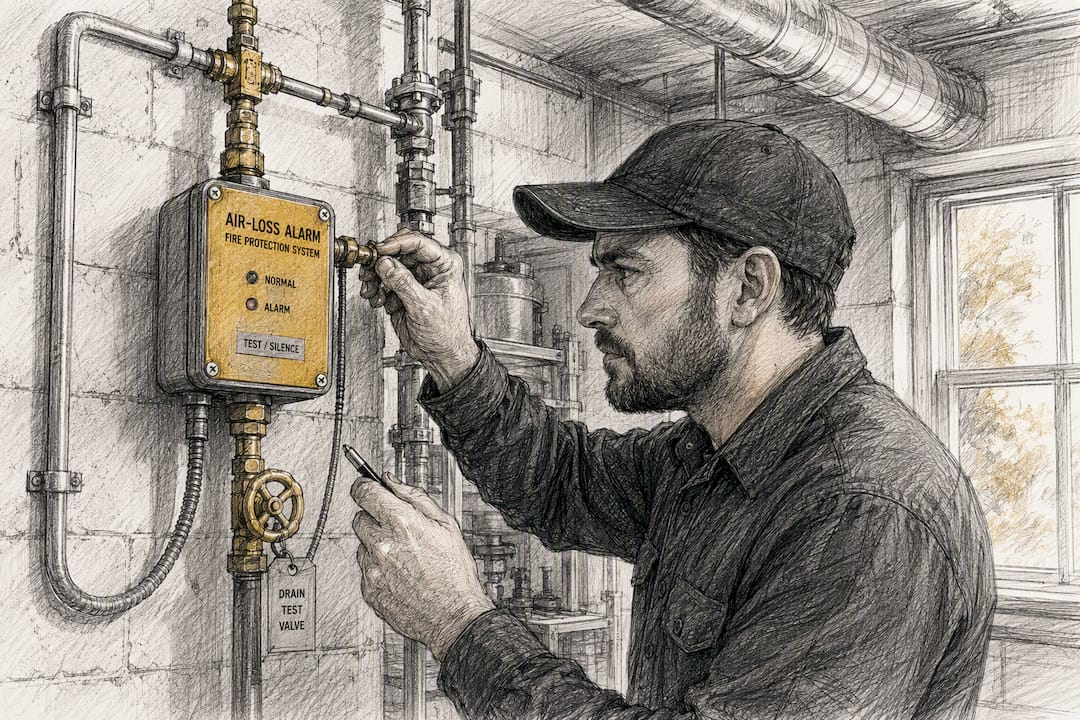
Pro Tip: A supervisory air-loss alarm that keeps tripping isn't a nuisance to silence. It's usually a slow leak at a fitting, and ignoring it invites a real failure later.
What Are the Benefits of a Pre-Action Sprinkler System?
The core advantage is straightforward: water doesn't sit in the pipes above your servers, artifacts, or vault contents until an actual fire is detected. That single fact drives most of the specification decisions around these systems.
- Substantially lower risk of accidental discharge from a punctured pipe or mechanical damage, since the line stays dry under normal conditions
- Detection integration filters out false alarms before they can cause flooding
- Air or nitrogen-filled piping tolerates freeze-prone spaces better than a fully charged wet system
- Frequently paired with clean-agent suppression for layered protection in the same room
A pre-action system is most defensible where the cost of accidental water, whether that's ruined servers, damaged archives, or downtime, outweighs the added cost and complexity of the system itself.
That's the calculation facility managers make every time they compare pre-action against a simpler wet-pipe layout, according to Fire Systems, Inc.
Where Are Pre-Action Systems Typically Installed?
You'll find pre-action protection concentrated wherever the contents matter more than the building shell.
- Data centers and server rooms: electronics and accidental water don't mix
- Archives and museums: irreplaceable, often one-of-a-kind materials
- Records storage facilities: paper and microfilm degrade fast when wet
- Electrical and control rooms: live equipment raises the stakes of any discharge
- Vaults and surgical suites: downtime cost and asset sensitivity both run high
Trade guidance from Davis-Ulmer notes these spaces often pair pre-action piping with clean-agent systems or sectional isolation valves for an added layer of protection where a single system isn't enough.
Pre-Action vs. Dry Pipe vs. Deluge: What Sets Each Apart?
Dry-pipe systems also hold air-pressurized piping, but they release water the moment a single sprinkler head opens; there's no detection step in between. Deluge systems go the other direction entirely: every head is open, and the moment the valve actuates, water floods the whole area at once, which suits high-hazard zones like aircraft hangars or chemical storage.
- Dry-pipe: one trigger (sprinkler head opens), simpler, but no protection against accidental pipe damage triggering discharge
- Deluge: open heads, instant full coverage, used where fire spreads too fast for selective activation
- Pre-action: two triggers required, the only one of the three built specifically to reduce accidental water release
| Choose this system | When you need |
|---|---|
| Dry-pipe | Simple freeze protection, lower cost, standard risk tolerance |
| Deluge | Rapid, total coverage for high-hazard, fast-spreading fires |
| Pre-action | Maximum protection against accidental discharge in sensitive spaces |
How Often Should Pre-Action Systems Be Inspected and Tested?
Code compliance isn't optional here, and the standards are specific about what to check and how often.
- NFPA 13 governs the original design and installation requirements for the pre-action valve and piping arrangement.
- NFPA 25 sets inspection, testing, and maintenance schedules for water-based systems, including trip tests, main drain tests, and valve supervisory checks.
- NFPA 72 covers the detection and signaling hardware that actually triggers the pre-action valve, including detector calibration and alarm verification.
Owners and facility managers will cite NFPA 25 and NFPA 13 during any acceptance test or annual inspection, so tying your commissioning checklist directly to those sections up front avoids delays during code review. A solid commissioning plan includes a functional trip test of the pre-action valve, a simulated air-loss event, detector calibration, and full alarm verification back to the control panel.
What Are the Downsides of a Pre-Action Sprinkler System?
Pre-action protection isn't free, and it isn't simpler than a wet-pipe alternative.
- Higher upfront cost for the valve, air supply equipment, and detection wiring
- Pipe-fill time introduces a real, if usually brief, delay between detection and discharge compared with wet-pipe systems where water is already in the line
- More components means more potential failure points: valve electronics, air compressors, detector wiring
- Ongoing costs include supervised-air equipment upkeep and more involved periodic testing than a standard wet system requires
Pro Tip: Budget for the air compressor's maintenance cycle separately from the sprinkler system itself. It's the component most often overlooked until it fails during an inspection.
What Should You Consider When Specifying a Pre-Action System?
A workable specification answers several questions before drawings ever reach a contractor.
- Interlock type: single or double, based on how much false-trip tolerance the space can accept
- Air supply: supervised compressor or nitrogen generator, sized for the piping volume
- Maximum fill time: documented explicitly, not left to assumption
- Valve type: electric release, pneumatic, wet-pilot, or dry-pilot, each with different response characteristics
- Alarm integration: wiring coordination with the fire alarm control panel and building management system
Multi-hazard spaces, unusual hydraulic demands, or anything requiring interpretation of local amendments to NFPA 13 is where bringing in a licensed fire-protection engineer pays for itself, especially when permit coordination with the local building department is on the line.
Pro Tip: Pressure-balance the air supply before final acceptance testing. A poorly balanced system nuisance-fills every time ambient temperature swings, and that's a callback nobody wants.
When Does a Pre-Action System Actually Make Sense?
If losing the contents of a room, whether that's a server farm or a rare-book archive, costs more than the extra design and maintenance a pre-action system demands, the choice is clear. Borderline cases deserve a technical review rather than a guess.
Get a Fire Protection Design Review From Bazini Engineering
If you're weighing a pre-action system against a wet-pipe or dry-pipe alternative, the fastest way to get a straight answer is a design review from an engineer who specifies these systems for a living, not a sales rep. Bazini Engineering handles fire suppression specification, permit expediting, and commissioning oversight for facility owners across mission-critical and water-sensitive spaces.

That means you get a licensed engineering team that can tell you whether double-interlock is worth the cost for your server room, draft the NFPA-compliant specification, and shepherd the permit through your local building department, all under one contract instead of coordinating separate vendors. Our fire suppression engineering team can also loop in mechanical coordination when freeze protection or room pressurization factors into the design. Reach out through our services page to request a code review or design proposal for your next project.