

A mechanical system is defined as an interconnected assembly of components designed to transmit and control force, motion, or energy to perform a specific function. The term covers everything from a simple lever prying open a crate to a multi-story HVAC system conditioning air across a commercial building. Understanding what is a mechanical system means grasping three core stages: input, process, and output. Every mechanical system takes in energy or force, transforms it through physical mechanisms, and delivers a controlled result. This framework applies equally to students studying physics, engineers designing infrastructure, and building owners evaluating their facilities.
What is a mechanical system and how is it classified?
A mechanical system, in standard engineering vocabulary, refers to any arrangement of physical parts that work together to convert or transmit force and motion. The mechanical system definition includes both the components themselves and the physical principles governing their interaction, such as leverage, torque, and gear ratios.
The most fundamental classification splits mechanical systems into two categories: static and dynamic. Static vs dynamic systems serve entirely different purposes and require different engineering approaches. Static systems support structural loads without movement. Beams, trusses, and load-bearing columns are static mechanical systems. They do not move, but they perform critical work by resisting forces and maintaining structural integrity.
Dynamic systems involve moving parts and active energy transfer. Engines, motors, actuators, and conveyor assemblies all qualify. Within dynamic systems, engineers further distinguish between translational systems, which move in a straight line, and rotational systems, which spin around an axis. Both types are modeled using three physical elements: mass (inertia), spring (elasticity), and damper (friction). These three elements define how a dynamic system responds to force over time.
What are the main types of mechanical motion?
Mechanical systems operate through four standard types of motion: linear, rotary, reciprocating, and oscillating. Each type describes how components move and how that movement transfers energy through the system.
| Motion Type | Description | Common Example |
|---|---|---|
| Linear | Straight-line movement in one direction | Hydraulic cylinder, ball screw |
| Rotary | Circular movement around a fixed axis | Electric motor shaft, gear wheel |
| Reciprocating | Back-and-forth straight-line movement | Piston in an engine, pump plunger |
| Oscillating | Swinging movement around a pivot point | Pendulum clock, windshield wiper |
Most real-world mechanical systems combine more than one motion type. A car engine converts reciprocating piston motion into rotary crankshaft motion. A Geneva mechanism converts continuous rotary input into intermittent rotary output. A slider-crank converts rotary motion into linear motion. Understanding which motion type dominates a system tells you which components will wear fastest and which failure modes to anticipate.
Key motion conversion mechanisms include:
- Gears: Transfer rotary motion between shafts while changing speed and torque
- Pulleys and belts: Transmit rotary motion across distances with flexible connectors
- Cams: Convert rotary motion into precise reciprocating or oscillating output
- Levers: Amplify force by exploiting mechanical advantage around a fulcrum
- Linkages: Connect multiple moving parts to guide complex motion paths
How does a mechanical system work?
Components of mechanical systems fall into three functional categories: input, process, and output. This classification explains how energy and motion flow through the system from start to finish.
Input components introduce energy into the system. Motors, engines, hand cranks, and hydraulic pumps all serve as input devices. They convert electrical, chemical, or human energy into mechanical force or motion.
Process components transform that input. Gears reduce speed and increase torque. Belts and chains transmit motion across distances. Cams and linkages redirect or reshape motion paths. This middle stage is where the real mechanical engineering happens. A system's efficiency, precision, and reliability are largely determined by how well its process components are designed.
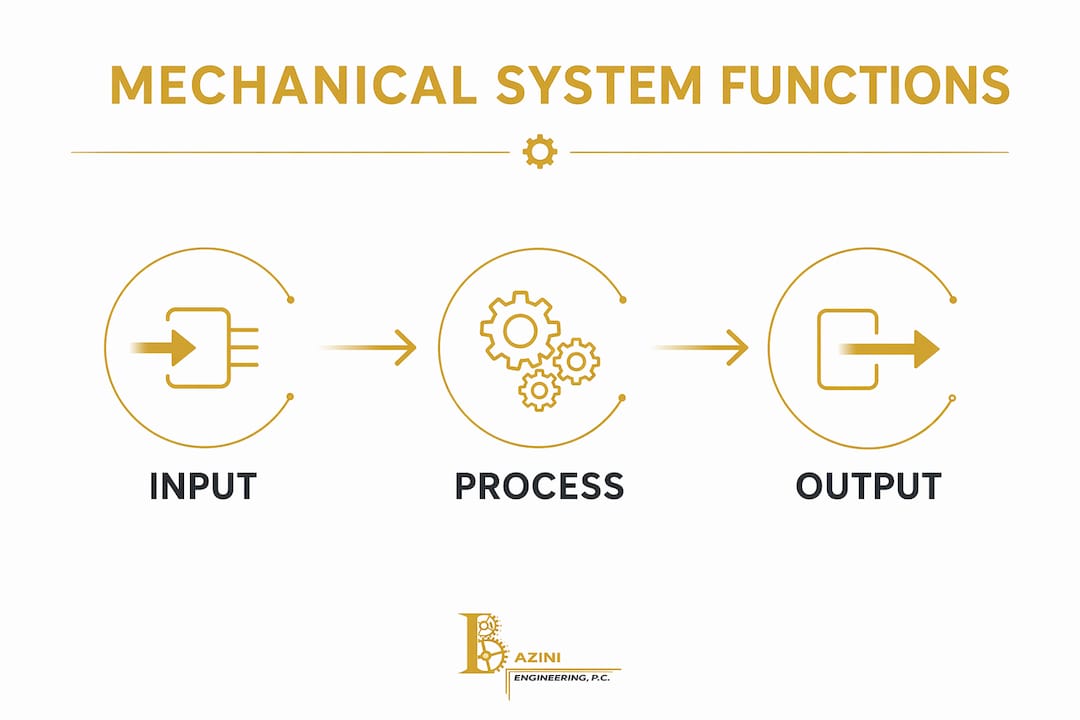
Output components deliver the result. Wheels move a vehicle. Actuators position a robotic arm. Blades cut material. The output stage defines what the system actually accomplishes.
Effective mechanical system design prioritizes energy conversion mechanisms and repeatability over raw power input. A system that converts 60% of its input energy into useful output through well-chosen mechanisms outperforms a more powerful system with poor mechanism selection. Friction, backlash, and misalignment all bleed energy from the process stage before it reaches the output.
Pro Tip: When evaluating any mechanical system, trace the energy path from input to output and identify where losses occur. Fixing a single high-loss conversion point often delivers more performance gain than upgrading the power source.
Human-machine interface components, including levers, handwheels, and control switches, are critical for safe operation and are frequently underweighted in early design phases. A system that performs well but cannot be safely operated or adjusted by a technician creates real-world risk.
Mechanical system examples in buildings and industry
Mechanical systems in buildings include HVAC assemblies, plumbing networks, elevators, escalators, and fire suppression systems. Each one converts input energy into a controlled environmental or operational output.
HVAC systems are among the most complex building mechanical systems. A commercial HVAC assembly combines fans (rotary motion), compressors (reciprocating motion), dampers (linear motion), and heat exchangers (static thermal transfer) into a single coordinated system. The mechanical design determines airflow rates, pressure differentials, and energy consumption across the entire building.
Elevators are another clear example. A traction elevator uses a motor driving a sheave (rotary), connected by steel cables (linear force transfer) to a counterweighted cab. The mechanical system must deliver precise, repeatable vertical positioning while managing the inertia of a loaded cab.
Beyond buildings, mechanical systems appear across:
- Transportation: Automotive drivetrains, aircraft landing gear, ship propulsion systems
- Manufacturing: CNC machine tool assemblies, conveyor systems, robotic welding arms
- Infrastructure: Bridge expansion joints, dam gate mechanisms, water treatment pump stations
- Daily life: Bicycle gear systems, washing machine drum assemblies, door hinge and latch mechanisms
Static mechanical systems, though passive, are fundamental for building safety and foundational stability. A steel truss supporting a roof does no visible work, but its mechanical design determines whether the building stands under load. Passive systems are not simpler than dynamic ones. They are just differently critical.
Modern buildings increasingly use mechatronic systems, which blend mechanical components with sensors, actuators, and control software. A building automation system controlling HVAC dampers based on occupancy sensor data is a mechatronic assembly. The mechanical components still do the physical work, but electronic controls determine when and how they operate.
Maintenance and design considerations for mechanical systems
Maintenance strategy for mechanical systems depends directly on whether the system is static or dynamic. Applying the wrong maintenance approach to either type causes premature failure and unnecessary cost.
Static systems need condition-based monitoring. Engineers inspect for corrosion, fatigue cracking, settlement, and load path changes. These systems do not wear in the traditional sense, but they degrade under sustained or cyclic loading. Periodic structural assessments and non-destructive testing are the standard tools.
Dynamic systems require usage-based or time-based maintenance schedules. Bearings accumulate fatigue cycles. Seals degrade under pressure and temperature cycling. Lubricants break down. Gears develop surface wear. Each failure mode has a predictable lifecycle, and maintenance intervals should be set accordingly. Facilities teams using building maintenance software can track usage hours, schedule preventive tasks, and log condition data to extend system life.
One of the most common design failures in dynamic mechanical systems is ignoring damping. Ignoring damping elements in mechanical system modeling leads to inaccurate predictions and mechanical failure due to vibration. A system that looks correct on paper but lacks adequate damping will resonate under operating loads, accelerating fatigue and causing unexpected failures. Damping is not optional. It is a core design requirement for any dynamic system.
Pro Tip: Always model damping explicitly in dynamic system design, even for low-speed applications. Resonance can occur at surprisingly low frequencies in large structures and long shaft assemblies.
How are mechanical systems evolving in modern engineering?
Modern mechanical systems form part of wider mechatronic frameworks that blend mechanical components with sensors, actuators, and control software for precision and efficiency. This integration is the defining trend in mechanical engineering today.
The shift matters for several reasons:
- Sensors give mechanical systems real-time feedback on position, force, temperature, and vibration
- Actuators replace manual adjustments with programmable, repeatable motion control
- Control software coordinates multiple subsystems simultaneously, something no purely mechanical design can achieve
- Digital twins allow engineers to model and test mechanical system behavior before physical prototypes exist
The result is that mechanical engineering now requires fluency in controls, electronics, and software alongside traditional mechanics. A mechanical engineer designing a modern elevator, robotic assembly cell, or variable air volume HVAC system must understand how the mechanical components interact with their control architecture. The boundaries between mechanical, electrical, and software engineering are narrowing on every major project.
Key takeaways
Mechanical systems are the physical foundation of every building, machine, and infrastructure asset, and understanding their classification, components, and maintenance requirements determines how well they perform over time.
| Point | Details |
|---|---|
| Core definition | A mechanical system transmits force, motion, or energy through input, process, and output stages. |
| Static vs dynamic | Static systems resist loads without moving; dynamic systems require active maintenance and usage-based schedules. |
| Four motion types | Linear, rotary, reciprocating, and oscillating motions define how components interact and wear. |
| Damping is non-negotiable | Ignoring damping in dynamic system design leads to vibration failures and inaccurate performance predictions. |
| Mechatronics integration | Modern mechanical systems combine physical components with sensors, actuators, and control software for precision. |
Why mechanism design matters more than most engineers admit
Most conversations about mechanical systems gravitate toward power: horsepower ratings, torque figures, load capacities. In my experience, that focus misses the more consequential question, which is how well the system converts and controls that power through its mechanisms.
I have reviewed building mechanical designs where the HVAC equipment was correctly sized but the ductwork geometry created pressure losses that cut airflow by 30% at the terminals. The mechanical system had plenty of power. The mechanism design was the problem. The same pattern shows up in elevator systems with undersized sheaves, in pump stations with mismatched impeller curves, and in manufacturing lines where conveyor geometry creates jams at predictable points.
The other thing I consistently see underestimated is the value of static mechanical systems. Engineers and building owners focus on the equipment that moves, because that is what fails visibly. But a poorly designed beam connection or an undersized truss chord can compromise a building's structural integrity silently over years. Static systems deserve the same analytical rigor as dynamic ones.
For students entering mechanical engineering, my advice is to spend more time on mechanism kinematics and less time on raw power calculations. Understanding how a Geneva mechanism, a four-bar linkage, or a ball screw converts motion will serve you across every application you encounter. Power is easy to add. Good mechanism design is hard to retrofit.
— Joseph
Work with Baziniengineering on your next mechanical system project
Baziniengineering brings over a decade of MEP engineering expertise to mechanical system design, from HVAC and plumbing to fire protection and building automation integration. Whether you are designing a new commercial facility, upgrading aging building systems, or navigating NYC Department of Buildings permit requirements, the team at Baziniengineering delivers code-compliant, field-ready mechanical designs tailored to your project's specific operational demands.

Baziniengineering serves clients across New York City, Long Island, Westchester County, and Florida, coordinating directly with local agencies to keep projects on schedule. If your project involves complex mechanical system design or integration with electrical and plumbing systems, contact Baziniengineering to discuss your engineering needs.
FAQ
What is the simplest mechanical system definition?
A mechanical system is an interconnected assembly of components that transmits and controls force, motion, or energy to perform a specific function, operating through input, process, and output stages.
What are the four types of mechanical motion?
The four standard types are linear, rotary, reciprocating, and oscillating. Most real-world mechanical systems combine more than one motion type within a single assembly.
How does a mechanical system differ from an electrical system?
A mechanical system transmits force and motion through physical components like gears, levers, and linkages. An electrical system transmits energy through conductors and circuits. Modern mechatronic systems integrate both.
Why is damping important in mechanical system design?
Damping controls vibration in dynamic systems. Ignoring damping in design leads to resonance, accelerated fatigue, and mechanical failure, even in systems that appear correctly sized on paper.
What mechanical systems are found in commercial buildings?
Commercial buildings contain HVAC assemblies, plumbing networks, elevators, escalators, and fire suppression systems. Each converts input energy into a controlled environmental or operational output across the building.