
TL;DR:
- A four-pipe HVAC system uses separate hot and chilled water circuits to provide simultaneous heating and cooling in different zones. It is ideal for buildings with diverse thermal demands, such as hospitals and large offices, where occupant comfort depends on zone-level independence. Proper commissioning and regular maintenance are essential to prevent system issues like zone fighting and energy waste.
A four-pipe HVAC system is defined as a hydronic climate control configuration that uses two independent water circuits, one for hot water and one for chilled water, to deliver simultaneous heating and cooling across different building zones. Unlike conventional two-pipe systems that require a full seasonal changeover, a four-pipe system keeps both circuits active at all times. Four-pipe fan coil units hold approximately 61.9% of the North American market share, a figure that reflects how widely the industry has adopted this approach for flexible, zone-level climate control. For facility managers overseeing multi-zone commercial buildings, understanding this system is the foundation for every comfort, energy, and maintenance decision you make.
What is a four-pipe HVAC system and how does it work?
A four-pipe HVAC system runs two separate hydronic circuits through the building: a hot water supply and return pair fed by a central boiler, and a chilled water supply and return pair fed by a central chiller. That gives you four pipes total running to each terminal unit, which is where the name comes from. Each circuit operates independently, so the boiler and chiller can run at the same time without interfering with each other.
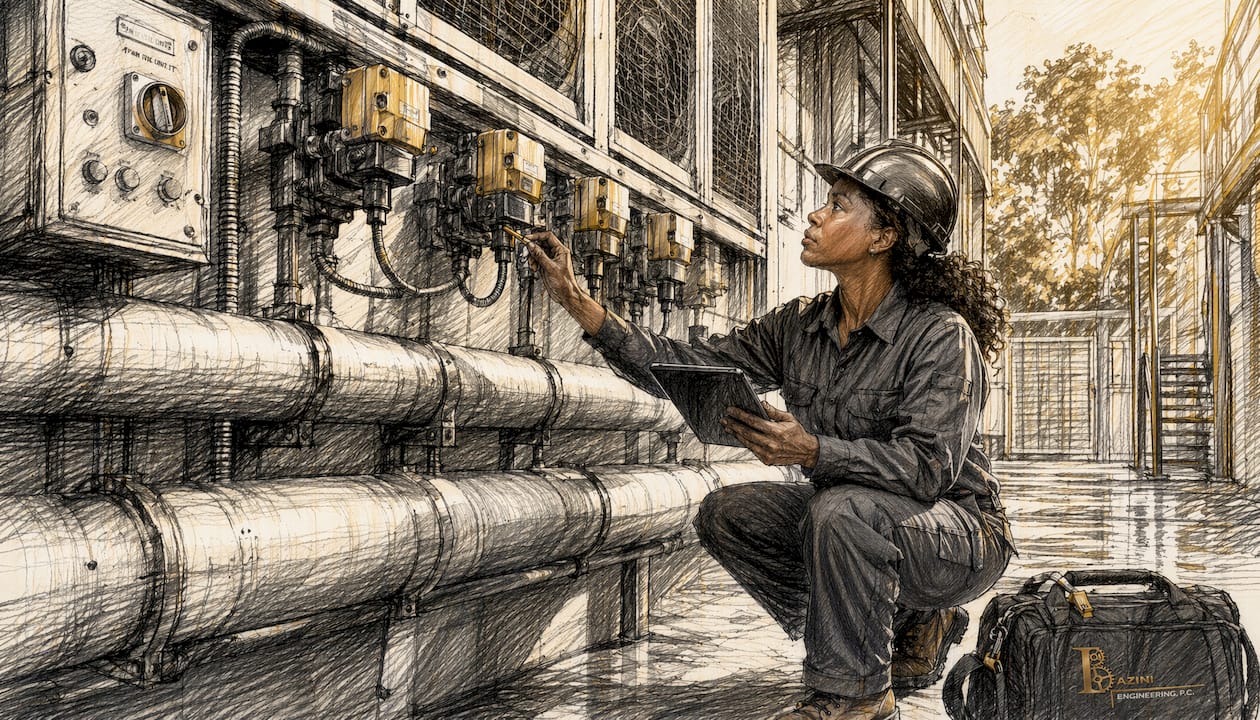
The terminal units in a four-pipe system are typically fan coil units (FCUs). Each FCU contains two separate coils: one connected to the hot water circuit and one connected to the chilled water circuit. A room thermostat signals the appropriate control valve to open, directing either hot or chilled water through the relevant coil. The fan then pushes conditioned air into the space.
Three key heat exchangers per refrigerant circuit enable simultaneous heating, cooling, and energy recovery within multifunctional units. Those exchangers handle the cold side (chilled water), the hot side (hot water), and the source side (ambient or water loop). This architecture is what separates a four-pipe system from simpler configurations.
| Component | Function |
|---|---|
| Central boiler | Heats water and circulates it through the hot water supply and return pipes |
| Central chiller | Cools water and circulates it through the chilled water supply and return pipes |
| Fan coil unit (FCU) | Terminal unit with dual coils that conditions air at the zone level |
| Control valves | Open or close to direct hot or chilled water to the appropriate coil |
| Zone thermostat | Signals control valves based on the space's heating or cooling demand |
Pro Tip: Commission each zone's thermostat and control valve together during installation. A valve that opens correctly but receives the wrong signal from a misconfigured thermostat will waste energy from day one.
What are the advantages of four-pipe systems compared to two-pipe HVAC systems?
The defining advantage of a four-pipe system over a two-pipe system is simultaneous, zone-level climate control. A two-pipe system uses a single supply and return pipe, switching the entire building between heating mode and cooling mode seasonally. Two-pipe systems struggle with occupant comfort when outdoor temperatures fluctuate between 45°F and 55°F because the whole building must commit to one mode. A four-pipe system eliminates that problem entirely.
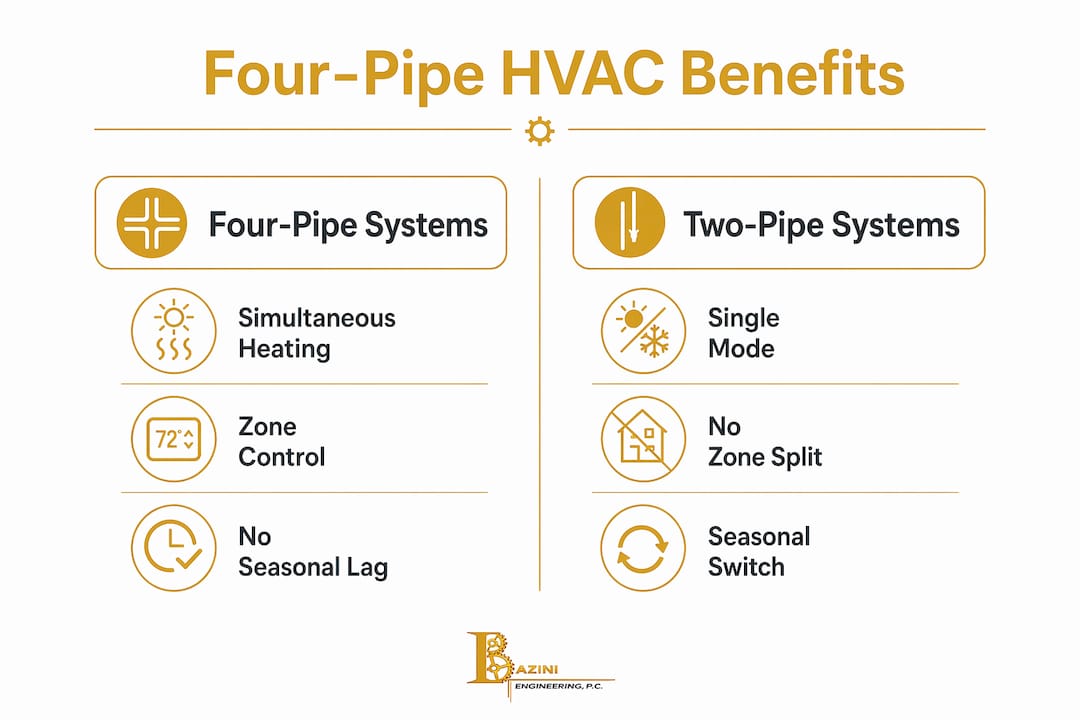
Consider a large office building on a mild spring day. The south-facing perimeter offices are overheating from solar gain, while the interior conference rooms need heating after a cold night. A two-pipe system forces a choice. A four-pipe system handles both demands at the same time, in the same building, without any manual intervention.
Four-pipe systems maintain an always-ready state for heating or cooling without seasonal lag time. That readiness is why they are standard in high-end residential and commercial facilities where occupant expectations are high and complaints are costly.
Modern four-pipe systems also offer energy recovery potential. Heat extracted from cooling zones can be repurposed to satisfy heating zones, reducing central boiler reliance during shoulder seasons. This recovery only works when simultaneous loads are present, but in the right building, it delivers measurable savings.
Key differences between two-pipe and four-pipe systems:
- Seasonal changeover: Two-pipe systems require a manual or automated switchover between heating and cooling seasons. Four-pipe systems require none.
- Zone independence: Two-pipe systems condition all zones in the same mode. Four-pipe systems allow each zone to heat or cool independently.
- Shoulder season performance: Two-pipe systems create comfort complaints during transitional weather. Four-pipe systems perform consistently year-round.
- Energy recovery: Two-pipe systems have no mechanism for heat transfer between zones. Four-pipe systems can recover heat from cooling zones to offset heating loads.
- Installation cost: Two-pipe systems cost less to install due to fewer pipes and simpler terminal units. Four-pipe systems carry a higher upfront investment.
| Feature | Two-pipe system | Four-pipe system |
|---|---|---|
| Simultaneous heating and cooling | No | Yes |
| Seasonal changeover required | Yes | No |
| Zone-level independence | Limited | Full |
| Energy recovery capability | None | Available |
| Terminal unit complexity | Single coil FCU | Dual coil FCU |
| Typical application | Smaller buildings, single-use | Hotels, hospitals, large offices |
What are the practical considerations and challenges of implementing four-pipe HVAC systems?
Four-pipe systems cost more to install than two-pipe systems. The additional piping, dual-coil fan coil units, and two sets of control valves per terminal unit all add to the capital budget. Facility managers should treat this as a long-term investment rather than a line-item comparison against simpler alternatives.
System complexity is the most common source of operational problems. Failures in valve actuators and misconfigured thermostats are the leading maintenance challenges in four-pipe installations. When a control valve sticks open or a thermostat sends conflicting signals, the system can simultaneously heat and cool the same zone, a condition known as "fighting." Fighting wastes energy and accelerates equipment wear without improving comfort.
Retrofitting an existing building is another significant challenge. Retrofitting a two-pipe system into a four-pipe configuration is rarely economically viable because it requires replacing every fan coil unit with a dual-coil version and routing two entirely new piping circuits through occupied spaces. In most established buildings, the structural and spatial constraints make this impractical.
Common implementation challenges to plan for:
- Higher upfront costs for piping, dual-coil FCUs, and additional control valves
- Increased maintenance burden on actuators and thermostat logic
- Risk of zone "fighting" if controls are not correctly configured
- Space requirements for four-pipe runs in ceiling plenums and mechanical rooms
- Need for experienced commissioning engineers to set up control sequences correctly
Pro Tip: Budget for a full controls commissioning phase before occupancy. Catching a misconfigured valve sequence during commissioning costs a fraction of what it costs to diagnose and fix after the building is occupied.
In which building types do four-pipe HVAC systems offer the greatest benefits?
Four-pipe HVAC systems are best suited for buildings with mixed thermal demands, specifically those where different zones require heating and cooling at the same time. Hotels, hospitals, large office buildings, and mixed-use developments are the clearest examples. These buildings share a common trait: diverse occupancy patterns that create unpredictable and simultaneous thermal loads.
A hospital is a strong case study. Patient rooms may need heating while server rooms and operating theaters require continuous cooling. A hotel faces the same dynamic: guest rooms on the north side of the building need heat on a cold morning while the kitchen and fitness center generate excess heat that needs to be removed. A four-pipe system handles all of this without any manual mode switching.
Buildings with significant solar exposure variation also benefit. A tower with east and west facades experiences peak solar gain at different times of day, creating simultaneous heating and cooling demands across the floor plate. A four-pipe system responds to each zone's real-time need rather than averaging across the building.
Facility types where four-pipe systems deliver the most value:
- Hotels and resorts with 24-hour occupancy and varied room loads
- Hospitals and healthcare facilities with continuous mixed thermal demands
- Large office buildings with perimeter and interior zone conflicts
- Mixed-use developments combining residential, retail, and commercial spaces
- University buildings with lecture halls, labs, and administrative offices under one roof
Simpler systems may outperform four-pipe configurations in buildings with uniform occupancy and predictable, single-mode thermal loads. A warehouse, a single-tenant retail space, or a small office with consistent use patterns rarely justifies the added cost and complexity.
How to optimize operation and maintenance for four-pipe HVAC systems
Correct control valve calibration is the single most important operational task in a four-pipe system. Dual valve control in each terminal unit needs careful configuration to prevent simultaneous heating and cooling in the same zone. The control sequence must include a dead band, a temperature range where neither valve opens, to prevent the system from fighting itself.
Regular actuator inspection prevents the most common failure mode. Actuators cycle thousands of times per year in active buildings. A sticky or failed actuator holds a valve open when it should be closed, causing energy waste that shows up on utility bills before it shows up on a work order. Quarterly actuator checks are a low-cost way to catch this early.
Energy recovery in four-pipe systems is effective only when simultaneous heating and cooling loads allow heat transfer between circuits. Without balanced loads, the system may carry higher pumping energy penalties without the offsetting savings. Monitoring zone loads in real time lets you identify when recovery is active and when it is not, which informs decisions about scheduling and setpoint management.
Operational best practices for facility managers:
- Set a thermostat dead band of at least 2°F–4°F between heating and cooling setpoints in each zone
- Schedule quarterly actuator inspections and annual valve stroke tests
- Use a building automation system (BAS) to monitor zone-level valve positions and flag simultaneous open conditions
- Review energy recovery performance monthly during shoulder seasons to confirm heat transfer is occurring
- Train maintenance staff on the specific control logic of your system, not just general HVAC principles
Pro Tip: If your BAS can log valve position data, set an alert for any zone where both the hot and chilled water valves show open simultaneously. That alert pays for itself the first time it catches a fighting condition before it runs for a week undetected.
For facility managers looking at net-zero building targets, understanding how four-pipe systems interact with your overall energy strategy is critical. A guide for facility managers on net-zero buildings covers how simultaneous heating and cooling systems fit within broader decarbonization frameworks.
Key Takeaways
A four-pipe HVAC system delivers simultaneous zone-level heating and cooling that two-pipe systems cannot match, but only when correctly specified, commissioned, and maintained.
| Point | Details |
|---|---|
| Core definition | Two independent water circuits, hot and chilled, allow heating and cooling at the same time in different zones. |
| Best applications | Hotels, hospitals, large offices, and mixed-use buildings with simultaneous and varied thermal loads benefit most. |
| Main challenge | Valve actuator failures and misconfigured thermostat logic cause zone "fighting" and energy waste. |
| Retrofit reality | Converting a two-pipe building to four-pipe is rarely practical due to piping and equipment replacement costs. |
| Energy recovery | Heat transfer between circuits only saves energy when simultaneous loads are present and the system is properly designed. |
What I've learned specifying four-pipe systems for complex buildings
The most common mistake I see facility operators make with four-pipe systems is treating them as a premium upgrade rather than a specific solution to a specific problem. The system earns its cost in buildings where simultaneous thermal demands are real and recurring. It does not earn its cost in a building where the heating and cooling loads are predictable and sequential.
The second mistake is underinvesting in commissioning. A four-pipe system with a poorly configured control sequence is worse than a well-commissioned two-pipe system. The complexity that gives you flexibility also gives you more ways to waste energy if the controls are not set up correctly. I have seen buildings where the four-pipe system was fighting in half the zones because nobody set a proper dead band during commissioning. The utility bills looked like a two-pipe system in the wrong season, every month of the year.
Industry experts recommend thorough feasibility studies before specifying four-pipe systems, and I agree completely. The feasibility study is not just about budget. It is about understanding your building's actual load profile across seasons and zones. If that profile shows consistent simultaneous demands, a four-pipe system is the right answer. If it does not, you are paying for capability you will never use.
The facility managers who get the most out of four-pipe systems are the ones who monitor them actively. They watch valve positions, track energy recovery performance, and catch actuator issues before they become comfort complaints. The system rewards attention. It punishes neglect more visibly than simpler alternatives.
— Joseph
Baziniengineering's mechanical engineering services for HVAC system design
Specifying a four-pipe HVAC system correctly requires more than selecting equipment. It requires a full mechanical engineering analysis of your building's load profile, zone configuration, control logic, and code compliance requirements.

Baziniengineering provides mechanical engineering services covering HVAC system design, specification, and optimization for commercial, institutional, and mixed-use buildings across New York City, Long Island, and Westchester County. The firm's engineers work through the full design process, from feasibility and load analysis through permit-ready construction documents and coordination with the NYC Department of Buildings. If your building has complex heating and cooling demands, Baziniengineering's MEP engineering services give you the technical foundation to specify the right system and commission it correctly.
FAQ
What is a four-pipe HVAC system in simple terms?
A four-pipe HVAC system uses two separate water circuits, one for hot water and one for chilled water, to heat and cool different building zones at the same time. Each zone has its own fan coil unit with independent valves for each circuit.
How does a four-pipe system differ from a two-pipe system?
A two-pipe system uses a single supply and return pipe that switches between heating and cooling seasonally, while a four-pipe system keeps both hot and chilled water circuits active at all times. This allows a four-pipe system to heat one zone and cool another simultaneously.
What buildings benefit most from a four-pipe HVAC system?
Hotels, hospitals, large office buildings, and mixed-use developments benefit most because they have simultaneous and varied thermal loads across different zones throughout the day.
What are the main maintenance challenges for four-pipe systems?
Valve actuator failures and misconfigured thermostat logic are the leading maintenance issues. When both the hot and chilled water valves open in the same zone at the same time, the system wastes energy heating and cooling simultaneously, a condition called "fighting."
Is it practical to retrofit a building from a two-pipe to a four-pipe system?
Retrofitting is rarely practical. It requires replacing every fan coil unit with a dual-coil version and routing two entirely new piping circuits through the building, which is cost-prohibitive and structurally difficult in most existing buildings.