
For multi-zone commercial buildings with variable occupancy, VAV is usually the better choice; for single-zone spaces or steady process airflow needs, CAV is often simpler and more reliable. The catch: VAV only delivers on its energy promise when outdoor-air and minimum-flow controls are designed and commissioned correctly. Get that wrong, and you trade energy savings for indoor air quality problems.
TL;DR:
- VAV systems can achieve 10 to 21% energy savings over CAV systems in offices, primarily depending on climate and outdoor air control strategies.
- Proper outdoor-air control methods like demand-controlled ventilation or decoupling outdoor air from supply flow are essential to prevent under-ventilation at part load.
- CAV systems cost less initially and are simpler to commission, but VAV systems often lead to lower lifetime energy costs if controls are properly tuned.
- Failing to correctly set minimum flow, outdoor-air delivery, or reheat reset parameters can cause indoor air quality issues and system inefficiency.
- A hybrid approach combining CAV for steady zones and VAV for variable zones can suit buildings with diverse needs, requiring careful load analysis and commissioning.
Table of Contents
- VAV vs CAV: How Each System Actually Controls Air
- VAV vs CAV Benefits and Drawbacks: What You're Actually Trading
- VAV vs CAV Energy Efficiency and the IAQ Trade-Off Nobody Skips Past
- Design and Commissioning Checklist That Prevents the Usual Failures
- How Bazini Engineering Applies These Trade-Offs on Real Projects
- When a Hybrid CAV and VAV Design Actually Makes Sense
- Get System Selection and Commissioning Support From Bazini Engineering
- Sources
- FAQ
VAV vs CAV: How Each System Actually Controls Air
The fundamental difference comes down to what stays fixed and what moves. A constant air volume (CAV) system holds airflow steady and adjusts supply-air temperature at the air handling unit to meet the load. A variable air volume (VAV) system does the opposite: it keeps supply-air temperature relatively constant and instead modulates the volume of air delivered to each zone through VAV boxes and dampers, as EPA's ventilation systems research lays out.
A distinction that trips up a lot of people: VAV is not the same thing as a VFD. VAV describes the distribution strategy; a variable frequency drive is the motor controller that lets the supply fan actually ramp down when zones call for less air. You can have a VAV system without VFDs (though you probably shouldn't), and you can put a VFD on a CAV fan for other reasons entirely, according to EPA's HVAC and IAQ text modules.
Terminal units matter here too. VAV systems typically use one of a few box types:
- Cooling-only boxes for simple zones with light heating needs
- Series fan-powered boxes that run continuously, blending primary and plenum air
- Parallel fan-powered boxes that cycle on only during heating calls, saving fan energy
Lab and fume-hood applications deserve a separate mention. VAV can cut exhaust energy in a lab, but face velocity, room pressurization, and minimum safe airflow all have to hold regardless of load, which makes lab VAV design a different animal from office VAV.
VAV vs CAV Benefits and Drawbacks: What You're Actually Trading
The comparison rarely comes down to one system being universally better. It comes down to what the building needs.
- VAV benefits. Zonal control lets each space respond to its own load, and part-load energy performance is typically strong because fans and coils don't run at full output when demand drops.
- VAV drawbacks. More components mean more commissioning work, more failure points, and a real risk of under-ventilating core zones if outdoor-air controls aren't reset properly.
- CAV benefits. Fewer moving parts translate into predictable outdoor-air delivery and lower technical risk, which is exactly why single-zone retail spaces, process areas, and constant-exhaust applications still lean CAV.
- CAV drawbacks. The fan runs at full volume regardless of load, so fan energy stays high even when the space needs almost nothing.
First cost versus lifecycle cost is where these trade-offs get real for owners. CAV systems cost less upfront and commission faster. VAV systems cost more to install and commission but usually pay that back through lower fan and reheat energy over the building's life, assuming the controls are tuned correctly.
Pro Tip: Don't evaluate VAV vs CAV on first cost alone. Ask for a 10 year operating cost comparison alongside the install quote; the fan energy difference alone often justifies VAV's higher commissioning cost in buildings with real load diversity.
VAV vs CAV Energy Efficiency and the IAQ Trade-Off Nobody Skips Past
VAV systems typically deliver 10 to 21% energy savings over comparable constant-volume systems in modeled office scenarios, according to EPA's project comparing CV and VAV performance. That range depends almost entirely on climate and, more importantly, on how outdoor air is controlled at part load.
The trade-off in one line: VAV saves fan energy by reducing total airflow, but if outdoor-air fraction isn't managed as that airflow drops, ventilation to occupied zones drops right along with it.
Three outdoor-air strategies matter here:
- Fixed outdoor-air fraction (FOAF) keeps outdoor air as a set percentage of supply air, meaning OA delivery falls as total volume falls.
- Constant outdoor air (COA) decouples the outdoor-air damper from the supply-air modulation, holding OA delivery steady even as total flow drops.
- Demand-controlled ventilation (DCV), often CO2-based, resets outdoor air to actual occupancy rather than a fixed schedule.
EPA's modeling work flags exactly this risk: improperly configured VAV can under-deliver outdoor air to core zones at part load, and recommends VAV(COA) strategies, economizer coordination, or separate core/perimeter systems as mitigation. Minimum VAV box settings, paired with CO2 reset logic, are what keep ventilation intact once the box throttles down. Skip that step, and you've built an energy-efficient system that quietly under-ventilates the people inside it.
Design and Commissioning Checklist That Prevents the Usual Failures
Most VAV problems trace back to a handful of design and commissioning gaps, not equipment failure. ASHRAE's guidance on fan selection and terminal units points to specific fixes:
- Fan selection: size the fan to run efficiently across the full expected operating range, generally targeting a 70 to 80% operating point rather than peak efficiency at design load, which avoids stall and low-frequency noise at part load per ASHRAE's noise and vibration guidance.
- Static pressure control: reset duct static pressure based on the most-open damper rather than a fixed setpoint, so VFDs aren't fighting an artificially high target.
- Terminal selection: parallel fan-powered boxes cycle on only during heating, which tends to save energy over series boxes that run continuously, though series units offer steadier acoustics.
- Bypass control: on constant-volume fans without VFDs, bypass dampers relieve excess air but waste the fan energy VAV is supposed to save, so they're a poor substitute for real speed control.
Commissioning has to verify all of this in the field, not just on paper.
Pro Tip: Trend the reheat valve positions for two weeks after occupancy. If several zones are reheating constantly at minimum flow, your minimum-flow setpoints are too high, your supply-air temperature reset isn't working, or both.
Verify minimum-flow settings at each box, confirm outdoor-air delivery at part load with actual measurements, and check that supply-air temperature reset sequences respond the way the design intended.
How Bazini Engineering Applies These Trade-Offs on Real Projects
Choosing between VAV and CAV isn't a formula. It's a project-specific read on zone count, load diversity, and ventilation obligations, and getting it wrong shows up in occupant complaints or utility bills years after the design is signed off.
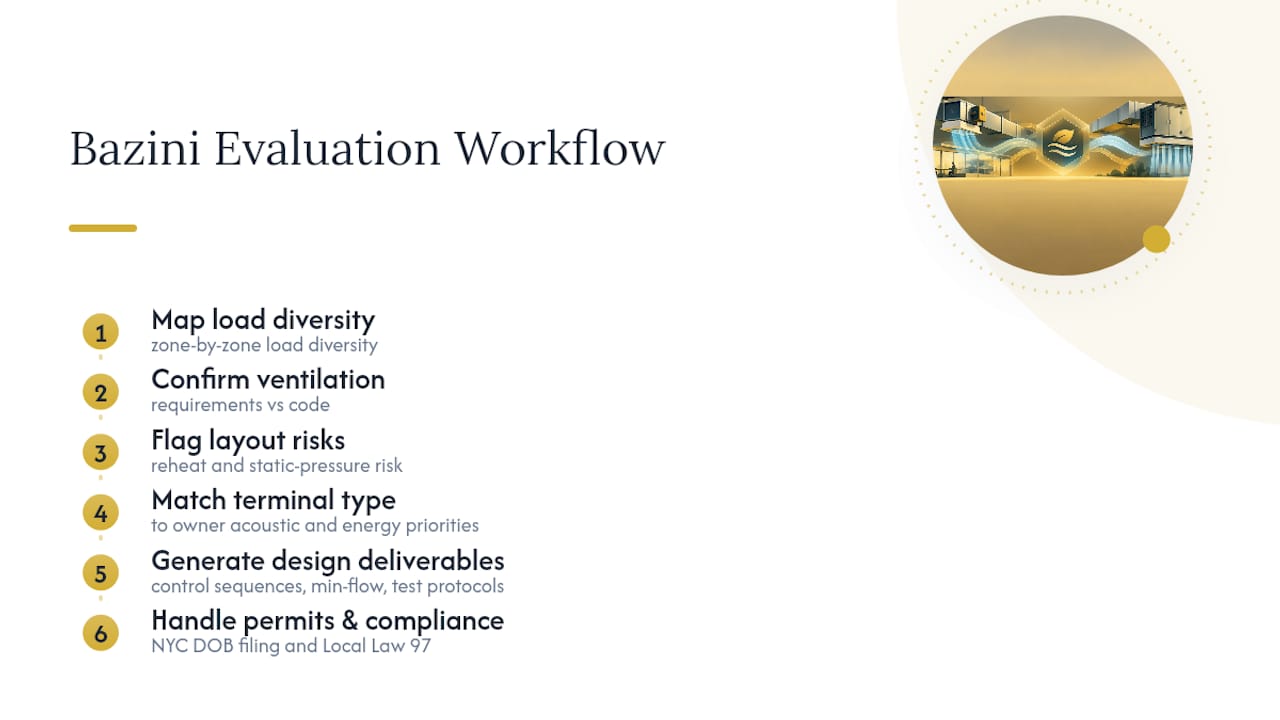
Bazini Engineering works through a short evaluation on every HVAC project: map zone-by-zone load diversity, confirm ventilation requirements against code, flag reheat and static-pressure risk in the proposed layout, and match terminal-unit type to the acoustic and energy priorities the owner actually cares about. That evaluation feeds directly into mechanical engineering design deliverables, which typically include control sequences, minimum-flow schedules, and test protocols the commissioning team can execute against.
Licensed in New York and Florida, the firm also handles NYC Department of Buildings permit filing and Local Law 97 compliance work, which matters when a VAV retrofit changes a building's energy profile enough to affect its compliance path.
When a Hybrid CAV and VAV Design Actually Makes Sense
Plenty of buildings don't fit neatly into either category. A common pattern: CAV for core or process zones with steady, predictable loads, and VAV for perimeter zones where solar gain and occupancy swing throughout the day. Lab floors, server rooms, and spaces with strict pressurization or exhaust requirements often push toward this hybrid.
Before committing, owners should weigh energy priorities against ventilation risk tolerance, phasing constraints if the retrofit happens in stages, and how much capital cost the project can absorb upfront versus over time.
— Joseph
Get System Selection and Commissioning Support From Bazini Engineering
You can work with a mechanical engineering team that maps your actual zone loads, ventilation obligations, and reheat risk before specifying anything, providing an alternative to relying on rule-of-thumb sizing.

The firm's services cover HVAC system design, controls sequencing, and commissioning test protocols, along with plumbing, fire suppression, and Local Law 97 compliance work when a project touches those systems too. If you're evaluating a retrofit or a new build and want a design that holds up through commissioning rather than falling apart at part-load conditions, request a project scoping conversation through the services page and get a proposal scoped to your building's actual load profile.
Sources
- Ventilation systems and controls study (EPA IAQ)
- EPA project report comparing CV and VAV systems (model results)
- ASHRAE technical materials on VAV terminal units
- Pump and fan technology report (DOE/BTO)
FAQ
What Are the Key Differences Between VAV and CAV Fume Hoods?
A CAV fume hood exhausts a constant volume regardless of sash position, which wastes conditioning energy but keeps controls simple. A VAV fume hood modulates exhaust based on sash height while holding face velocity steady, which saves energy but demands tighter commissioning to protect lab safety.
What Is the Difference Between VAV and a VFD?
VAV is a distribution strategy that varies the amount of air delivered to a zone; a VFD is a motor controller that varies fan speed. Most efficient VAV systems pair the two, using a VFD to ramp fan speed down as VAV boxes throttle back, since fan power drops roughly with the cube of speed.
What Is the Biggest Disadvantage of a VAV System?
The biggest disadvantage is ventilation risk at part load: if outdoor-air controls aren't reset as total airflow drops, core zones can receive less fresh air than they need. Reheat energy at minimum flow and the added commissioning complexity are the other common pain points.
What Is the Difference Between VAV and VRF?
VAV is a central, ducted air distribution strategy that varies airflow volume from one air handler to multiple zones. VRF (variable refrigerant flow) is a decentralized system that circulates refrigerant directly to zone-level units, letting each zone heat or cool independently without shared ductwork. The two solve similar zoning problems through entirely different equipment.
How Do I Know Whether My Building Needs VAV or CAV?
Buildings with multiple zones, varying occupancy, or significant solar exposure differences generally benefit more from VAV's part-load savings. Single-zone spaces, process areas, or buildings with constant exhaust requirements often do better with CAV's simplicity, and a firm like Bazini Engineering can run the zone-by-zone load analysis needed to confirm which fits your specific layout.