

A licensed professional engineer (PE) is the only individual legally authorized to sign, seal, and submit engineering documents required for construction permit approval in every U.S. jurisdiction. For construction project managers and property developers, understanding the role of PE engineer on permits is not a procedural detail. It is the difference between a project that moves forward on schedule and one that stalls in a rejection loop for months.
All 51 U.S. jurisdictions mandate PE seals on critical engineering documents, making licensure the non-negotiable threshold for any engineering work tied to public safety. That legal requirement shapes every phase of the permit process, from pre-application due diligence through final agency approval.
What responsibilities does a PE engineer have in the permitting process?
The PE's role in permits is both technical and legal. A licensed engineer prepares, signs, and seals engineering plans, calculations, and specifications that accompany permit applications. That seal is not a formality. It is a legally verifiable professional guarantee that the submitted design complies with applicable codes and protects public safety.
The specific tasks a PE performs during permitting include:
- Plan preparation and sealing. The PE drafts or reviews all engineering drawings, structural calculations, mechanical layouts, and fire protection designs before submission. Every document that requires an engineering stamp must bear the PE's seal and signature.
- Pre-application due diligence. PEs conduct pre-application reviews identifying zoning constraints, environmental restrictions, and utility conflicts before a single drawing goes to the agency. This step prevents fatal surprises during formal review.
- Code and regulatory analysis. The PE confirms that the design satisfies local building codes, energy codes, and fire protection standards. For MEP projects in New York City, this includes compliance with NYC Department of Buildings requirements and FDNY regulations.
- Technical response management. When a municipality issues review comments, the PE prepares written technical responses, revised drawings, and supplemental engineering controls. Rejection loops often stem from missing documentation rather than actual design flaws, and an experienced PE anticipates those gaps before submission.
- Legal accountability. A PE license requires passing the Fundamentals of Engineering and Principles and Practice of Engineering exams, plus supervised field experience. That credential carries ethical obligations. The PE is personally liable for the accuracy and safety of sealed documents.
Pro Tip: Ask your PE to provide a pre-submission checklist specific to your jurisdiction. Agencies like the NYC Department of Buildings publish plan examination requirements, and a PE who reviews those requirements before submission cuts review cycles significantly.
How does PE involvement affect permit approval timelines?

Complex municipal permits can take over 6 months to approve, and that timeline extends further when submissions arrive incomplete or non-compliant. PE involvement compresses that window by producing packages that reviewers can verify efficiently.
PE-certified engineering submissions experience significantly fewer rejections and avoid costly redesign delays. That outcome is not accidental. Experienced PE firms include detailed engineering controls and supplemental studies in initial permit packages specifically to bypass common municipal review hold-ups. A reviewer who receives a complete, well-organized, PE-stamped package can confirm code compliance without issuing a correction notice.
The financial stakes are real. Pre-design deposits between $2,000 and $5,000 often initiate engineering reviews at the municipal level, and those deposits are non-refundable regardless of whether the project advances. Developers who engage a PE before that deposit stage arrive at the review table with a submission that justifies the investment.
| Scenario | Typical Outcome |
|---|---|
| PE-stamped submission, complete documentation | Fewer review cycles, faster approval |
| Incomplete submission without PE seal | Correction notices, resubmission delays |
| PE engaged after initial rejection | Redesign costs, extended timeline |
| PE engaged at pre-application stage | Jurisdictional issues resolved before submission |
The table above reflects a consistent pattern across commercial and residential permit processes. Early PE engagement is the single most reliable way to protect your project schedule.
What jurisdictional and code complexities shape the PE's role?
Local regulations vary more than most developers expect. Different jurisdictions interpret building codes inconsistently, and even small projects may legally require PE involvement depending on local rules. A project that proceeds without a PE stamp in one county may face permit rejection for the identical scope in an adjacent municipality.
Code triggers that require PE involvement include:
- Parcel maps and subdivision improvements. Most jurisdictions require PE-stamped civil drawings for any subdivision or parcel map filing.
- Grading permits. Significant earthwork, particularly on sloped sites, triggers PE requirements for grading plans and drainage calculations.
- Infrastructure modifications. Any work touching public utilities, roads, or stormwater systems typically requires a PE seal regardless of project size.
- Environmental compliance plans. Projects disturbing over one acre must have stormwater pollution prevention plans prepared by licensed PEs or qualified specialists to comply with environmental regulations. California's Porter-Cologne Act is one prominent example of this requirement.
The most dangerous assumption a developer can make is that project size determines PE requirements. Experts caution against assumptions on PE requirements based on project size alone. Written confirmation from the local authority having jurisdiction is the only reliable standard.
Pro Tip: During your intake meeting with a PE, request that they pull written documentation of permit requirements directly from the relevant municipal agency. Verbal guidance from a permit counter is not binding. Written requirements protect you if the agency's interpretation changes mid-review.
Overlapping permits add another layer of complexity. A commercial renovation in New York City may require separate permits from the Department of Buildings, FDNY, and the Department of Environmental Protection, each with distinct engineering documentation standards. A PE who works regularly in that jurisdiction knows which documents each agency expects and sequences submissions accordingly.
PE engineers vs. unlicensed professionals in permitting
The distinction between a licensed PE and an unlicensed engineer or draftsman is not a matter of experience. It is a matter of legal authority. Only a PE can sign and seal engineering documents for permit submission. An engineer-in-training (EIT), a draftsman, or an unlicensed designer cannot legally certify that a design meets code, regardless of their technical skill.
The PE seal implies a legally verifiable professional guarantee of compliance and safety, backed by the engineer's personal license. That guarantee matters to municipal reviewers, who prioritize PE-stamped submissions because the seal transfers professional accountability to the engineer of record. If a design fails, the PE bears legal and ethical responsibility.
For developers, this distinction has direct insurance and liability implications. A project built on unlicensed engineering documents may face coverage disputes if a structural or systems failure occurs. Lenders and insurers increasingly require PE-stamped documentation as a condition of financing and coverage.
The scope difference is equally significant. A PE can certify structural calculations, MEP system designs, fire protection layouts, and energy code compliance analyses. An EIT working under a PE's supervision can perform technical work, but every document that leaves the office for a permit agency must carry the supervising PE's seal.
How to optimize PE engagement for faster permit approvals
Construction managers and developers who treat PE engagement as a late-stage task consistently face the delays they were trying to avoid. The highest-value PE work occurs early, identifying jurisdictional quirks before expensive redesign cycles become necessary after submission.
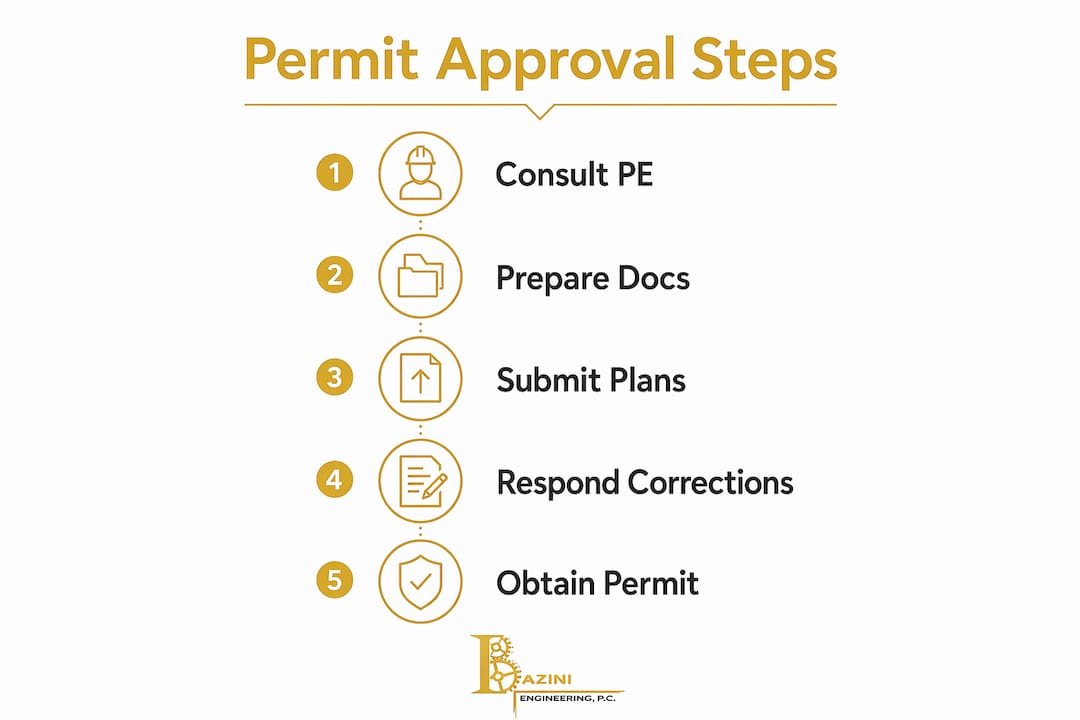
Follow this sequence to get the most from your PE relationship:
- Engage the PE at project inception. Bring your PE into the project before schematic design is complete. Early consultation identifies code triggers, required permits, and jurisdictional constraints while design changes are still inexpensive.
- Document jurisdictional requirements in writing. Direct your PE to obtain written permit requirements from every relevant agency. File those documents with your project records.
- Integrate PE review before final plan submission. Schedule a formal PE review of all drawings and calculations before the submission package is assembled. This review catches coordination conflicts between structural, MEP, and architectural elements that generate correction notices.
- Maintain direct communication between the PE, contractor, and developer. Permit review comments often require rapid responses. A communication structure that routes agency questions directly to the PE of record eliminates delays caused by intermediaries.
- Leverage PE expertise in complex regulatory environments. PE involvement is recommended even when not legally required because engineering oversight prevents structural, drainage, and utility conflicts that cause costly remediation. Treat the PE as a risk management resource, not just a stamp provider.
Pro Tip: Build a permit response timeline into your project schedule. When a municipality issues a correction notice, most agencies require a response within 30 to 90 days. A PE who is already familiar with your project can turn around a compliant response far faster than one brought in after the fact.
Key takeaways
The role of a PE engineer on permits is legally defined, technically demanding, and directly tied to project schedule and budget outcomes. Developers who engage licensed engineers early and treat permitting as a risk management function consistently outperform those who treat it as a compliance checkbox.
| Point | Details |
|---|---|
| PE seal is legally required | All 51 U.S. jurisdictions mandate PE seals on engineering documents tied to public safety. |
| Early engagement reduces cost | PE involvement at pre-application stage prevents redesign cycles and submission rejections. |
| Jurisdictional rules vary widely | Written confirmation from local agencies is the only reliable standard for PE requirements. |
| Unlicensed professionals cannot substitute | Only a licensed PE can legally certify and seal engineering documents for permit submission. |
| Communication structure matters | Direct PE access during review cycles cuts response time and protects project schedules. |
What I've learned from watching permits go sideways
After years of working on MEP permit packages across New York City, Long Island, and surrounding jurisdictions, the pattern I see most often is not technical failure. It is timing failure. Developers bring a PE in after the design is locked, after the contractor has priced the job, and sometimes after the first rejection notice has already arrived. At that point, the PE is not a permit engineer. The PE is a remediation specialist, and remediation is always more expensive than prevention.
The conventional wisdom in development circles is that you hire the PE when the permit requires one. That framing misses the point entirely. Permitting is the project's risk management backbone, and the PE is the professional who makes that function work. A PE who reviews a project at the schematic stage can identify a zoning conflict, a fire protection trigger, or an energy code gap that would have generated a correction notice six months later. That early identification is worth far more than the fee.
I also think developers underestimate how much a PE's relationship with local agencies matters. Reviewers at the NYC Department of Buildings and FDNY see thousands of submissions. A package from a PE they recognize, organized the way they expect, with the supplemental documentation they typically request, moves faster. That is not a formal advantage. It is a practical one, and it is built over years of consistent, accurate work.
The developers I have seen succeed in complex permitting environments share one habit. They treat the PE as a project partner from day one, not a vendor called in to stamp drawings at the end.
— Joseph
Work with Bazini Engineering on your next permit package

Bazini Engineering brings licensed PE expertise to MEP permit packages across New York City, Long Island, Westchester County, and surrounding regions. From pre-application due diligence through agency coordination with the NYC Department of Buildings and FDNY, the firm's engineers manage every phase of the permitting process with the precision that complex projects require. Whether you are managing a commercial renovation, a new residential development, or an industrial facility upgrade, Bazini Engineering delivers code-compliant designs and permit-ready documentation that hold up under municipal review. Connect with the team at Bazini Engineering to discuss your project's permitting requirements and get a licensed PE working on your side from the start.
FAQ
What does a PE engineer do on a permit application?
A PE prepares, signs, and seals all engineering documents required for permit submission, certifying that the design complies with applicable codes and safety standards. The PE also manages technical responses to agency review comments and coordinates resubmissions when required.
Is a PE stamp legally required for construction permits?
All 51 U.S. jurisdictions require a licensed PE seal on engineering documents that affect public safety, making PE involvement a legal requirement for most commercial and infrastructure permit applications.
How does a PE reduce permit rejection rates?
PE-stamped submissions give municipal reviewers a complete, code-verified package that reduces the likelihood of correction notices. Experienced PEs anticipate common documentation gaps and include supplemental engineering controls in the initial submission to prevent rejection loops.
Can an engineer-in-training submit permit documents?
An EIT can perform technical work under a licensed PE's supervision, but only the supervising PE can legally sign and seal documents for permit submission. Submissions without a PE seal are rejected by agencies in every U.S. jurisdiction.
When should a developer engage a PE for permitting?
PE engagement at the pre-application stage produces the best outcomes. Early involvement allows the PE to identify jurisdictional requirements, code triggers, and design conflicts before submission, preventing costly redesign cycles and schedule delays.