

A special inspector in MEP projects is a qualified, independent professional retained by the owner to verify that mechanical, electrical, and plumbing installations comply with approved construction documents and applicable building codes. This role is formally defined under IBC Chapter 17, which establishes the framework for the Statement of Special Inspections (SSI), the Special Inspection Agency (SIA), and the reporting requirements that govern the entire process. The NYC Department of Buildings and similar Authorities Having Jurisdiction (AHJs) across the country require this independent oversight as a condition of occupancy approval. Understanding the role of special inspector in MEP work is not optional knowledge for construction professionals or property owners. It is the difference between a smooth project closeout and costly delays.
What does a special inspector do in MEP projects?

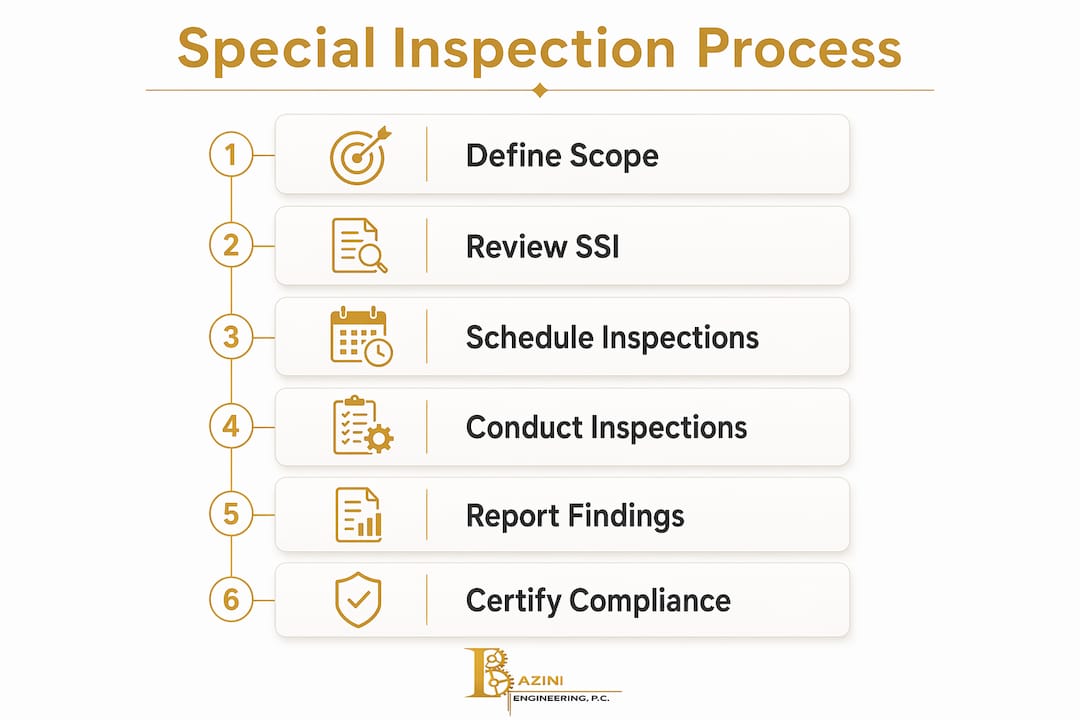
The role of special inspector in MEP is defined by the approved SSI, which itemizes every construction activity requiring observation and specifies whether that observation must be continuous or periodic. Special inspections provide independent verification by qualified inspectors who are separate from the contractors performing the work. That independence is the foundation of the entire system.
Here is what the special inspector's scope of work covers in practice:
- Review approved construction documents. Before setting foot on site, the SI studies the SSI, approved plans, and specifications to understand exactly what must be observed and when.
- Perform field observations at defined intervals. The SSI specifies continuous or periodic intervals, so the inspector arrives at precisely the right phase, not randomly.
- Verify installation against approved plans. For MEP work, this means confirming that duct routing, electrical conduit sizing, plumbing rough-in, and fire protection components match the engineer of record's approved drawings.
- Witness testing and commissioning activities. Pressure tests, fire alarm functional tests, and HVAC balancing verifications often fall within the SI's observation scope.
- Document findings in formal inspection reports. Special inspection reports include project identification, inspection dates, results, corrective actions, and inspector credentials. These form the official compliance record.
- Issue nonconformance reports (NCRs). When work does not match approved plans or code requirements, the SI documents the deficiency and tracks corrective action to resolution.
- Submit the final report to the AHJ. The final special inspection report is mandatory for the AHJ to issue a certificate of occupancy.
Pro Tip: Request a copy of the SSI before the project begins. Reviewing it early lets you identify which MEP phases require inspector presence and build those windows into your construction schedule from day one.
How do special inspections differ from other construction inspections?
This is where most project teams get confused, and that confusion costs time and money. There are four distinct inspection roles on a typical MEP project, and none of them are interchangeable.
- Special Inspector (SI). Retained by the owner, operates independently, and verifies compliance with approved plans and codes for specific high-consequence elements defined in the SSI. The SI's independence from contractors is required by NYC and most other jurisdictions to prevent conflicts of interest.
- Municipal Building Inspector. Employed by the jurisdiction to enforce code compliance on behalf of the public. This inspector does not perform special inspections and does not substitute for the SI. Confusing the SI with the municipal inspector is a common mistake that leads to incomplete inspections and occupancy delays.
- Contractor Quality Control. Internal to the contractor's organization. It is not independent, and it does not satisfy the SSI's requirements. Contractor QC is a good practice, but it carries no regulatory weight as a substitute for special inspection.
- Engineer of Record (EOR). The licensed professional who designed the MEP systems and sealed the drawings. The EOR reviews submittals and responds to RFIs, but does not perform special inspections. Structural observation by the EOR is a separate, distinct service.
The practical implication is clear. Each role has a defined lane. When a general contractor assumes that the municipal inspector's visit covers the SSI requirements, the project ends up with gaps in the compliance record. Those gaps surface at certificate of occupancy time, when fixing them is most expensive.
How does special inspection integrate with MEP project scheduling?
Scheduling is where the theory of special inspections meets the reality of construction. The biggest failure mode for MEP special inspections is scheduling the inspector's presence too late, after work is concealed or completed. Once MEP systems are enclosed behind drywall or above a finished ceiling, the inspection window is gone.
Effective integration requires coordination among four parties: the owner, the general contractor, the MEP subcontractors, and the Special Inspection Agency. The table below shows the key coordination touchpoints and their timing.
| Phase | Coordination Action | Responsible Party |
|---|---|---|
| Pre-construction | Finalize and submit SSI to AHJ for approval | Owner / EOR |
| Pre-construction | Engage Special Inspection Agency | Owner |
| Rough-in | Schedule SI presence before concealment | GC / MEP Sub |
| Testing | Notify SI of pressure and functional tests | MEP Sub |
| Closeout | Compile and submit final inspection report | SIA |
Special inspection effectiveness depends heavily on timing to witness installations before they are concealed. This is not a suggestion. It is a structural constraint of the process.
Digital inspection platforms have changed how SIAs manage documentation. Tools that allow field inspectors to log observations, attach photos, and generate NCRs in real time reduce the lag between field findings and formal reporting. That speed matters because unresolved NCRs at project closeout are a direct path to occupancy delays.
Pro Tip: Build inspector notification windows into your MEP subcontract language. Require subs to give the SIA at least 48 hours' notice before any inspection-required installation phase. That single clause prevents most scheduling failures.
What qualifications does a special inspector need for MEP work?
Qualified special inspectors must hold certifications appropriate to their inspection category. General construction experience does not qualify someone to perform MEP special inspections. The AHJ approves the SIA and its inspectors, and that approval is category-specific.
Here are the primary credentials relevant to MEP special inspection work:
- ICC Special Inspector Certifications. The International Code Council offers certifications covering mechanical, electrical, and plumbing systems. These are widely recognized by AHJs across the country.
- Professional Engineer (PE) License. Some jurisdictions require a PE for specific inspection categories, particularly where engineering judgment is involved in evaluating compliance.
- Fire Protection Certifications. Inspectors working on sprinkler systems and fire alarm installations often need NICET (National Institute for Certification in Engineering Technologies) credentials at the appropriate level.
- AHJ-Specific Approvals. The NYC Department of Buildings maintains its own approval process for special inspectors. An inspector approved in one jurisdiction is not automatically approved in another.
- Continuing Education. Most certification bodies require ongoing education to maintain approval status. Category-specific competence must be demonstrated and maintained, not just earned once.
The practical takeaway for owners and GCs is straightforward. Verify the SIA's credentials before the project begins, not after an AHJ rejects an inspection report because the inspector lacked the right certification for that specific MEP category.
Key takeaways
Special inspections in MEP projects succeed when the SSI drives scheduling, the inspector operates independently, and documentation is treated as a live compliance record rather than end-of-project paperwork.
| Point | Details |
|---|---|
| SSI defines the scope | Every MEP activity requiring inspection is itemized in the SSI, making the SI's role task-specific and scheduled. |
| Independence is non-negotiable | The SI must be independent from contractors to provide objective verification and satisfy AHJ requirements. |
| Schedule before concealment | Inspector presence must be confirmed before MEP systems are enclosed to avoid missed verifications and rework. |
| Credentials are category-specific | ICC, NICET, and PE credentials must match the specific MEP inspection category approved by the AHJ. |
| Reports drive occupancy approval | Final special inspection reports are mandatory for the AHJ to issue a certificate of occupancy. |
What i've learned about special inspections after years in MEP engineering
The most consistent problem I see on MEP projects is not a lack of qualified inspectors. It is a lack of respect for the process at the planning stage. Owners and GCs treat the special inspection requirement as an administrative checkbox rather than a quality system. That mindset creates the exact conditions for failure.
I have watched projects stall at the finish line because an SI showed up after mechanical rough-in was already enclosed. The contractor had to open ceilings, the SIA had to reinspect, and the certificate of occupancy was pushed back by weeks. Every one of those costs was avoidable. The SSI told everyone exactly when the inspector needed to be there. Nobody read it carefully enough.
The smarter approach is to treat SI reports as ongoing quality records, not end-of-project paperwork. When the SIA's field observations are integrated into the project's quality management system from day one, NCRs get resolved in real time instead of piling up at closeout. That shift in mindset alone reduces rework costs significantly.
Special inspectors also add value that goes beyond code compliance. An experienced SI who knows MEP systems will catch installation errors that a municipal inspector, working quickly through dozens of sites, will miss. That is not a criticism of municipal inspectors. It is a recognition that the SI's focused, task-specific role is designed for depth, not breadth. Owners who understand this use their SIA as a risk management tool, not just a regulatory requirement.
— Joseph
How Baziniengineering supports MEP special inspection compliance

Baziniengineering designs MEP systems that are built to be inspected. Every set of construction documents the firm produces is coordinated with the SSI requirements, so the special inspection process has a clear, accurate foundation to work from. When the approved drawings match the installed systems, the SI's job is straightforward and the AHJ's review moves faster.
Baziniengineering works directly with owners and general contractors throughout New York City, Long Island, and Westchester County to coordinate with the NYC Department of Buildings, FDNY, and other AHJs. That coordination includes permit expediting support and compliance documentation that aligns with MEP engineering in NYC requirements. If your project needs MEP engineering services that reduce inspection risk and support a clean occupancy approval, Baziniengineering is the right call.
FAQ
What is the role of a special inspector in MEP projects?
A special inspector in MEP projects is an independent, owner-retained professional who verifies that mechanical, electrical, and plumbing installations comply with approved plans and building codes, as defined by the Statement of Special Inspections under IBC Chapter 17.
Who hires the special inspector on a construction project?
The owner retains the special inspector or Special Inspection Agency. This ensures the SI operates independently from the contractor, which is a requirement in NYC and most other jurisdictions.
What happens if special inspections are missed during MEP installation?
Missed inspections create gaps in the compliance record that the AHJ will flag during certificate of occupancy review. Resolving those gaps often requires opening concealed work for reinspection, which causes schedule delays and added cost.
What certifications does a special inspector need for MEP work?
Special inspectors for MEP work typically hold ICC Special Inspector certifications, NICET credentials for fire protection systems, or a Professional Engineer license, depending on the inspection category and the AHJ's specific approval requirements.
How does the statement of special inspections affect MEP scheduling?
The SSI defines exactly which MEP activities require continuous or periodic inspection and when. GCs and MEP subcontractors must schedule inspector presence before critical phases, particularly before any work is concealed, to satisfy the SSI's requirements and avoid noncompliance findings.