

TL;DR:
- A commissioning agent in HVAC is an independent professional who verifies that systems meet project requirements and perform efficiently. Engaging an independent CxA early in the process ensures better performance, compliance, and cost savings throughout the building's lifecycle.
A commissioning agent in HVAC is the independent professional responsible for verifying that mechanical systems meet the Owner's Project Requirements (OPR) and perform efficiently under real operating conditions. Known formally as a Commissioning Authority (CxA), this role sits outside the design and construction team, giving building owners an objective set of eyes on every phase of a project. The role of commissioning agent in HVAC directly affects energy costs, system reliability, and long-term compliance with standards like ASHRAE 90.1-2022. For property owners and building managers, understanding what a CxA does and when to engage one is one of the most financially sound decisions you can make.
What are the main duties of an HVAC commissioning agent?
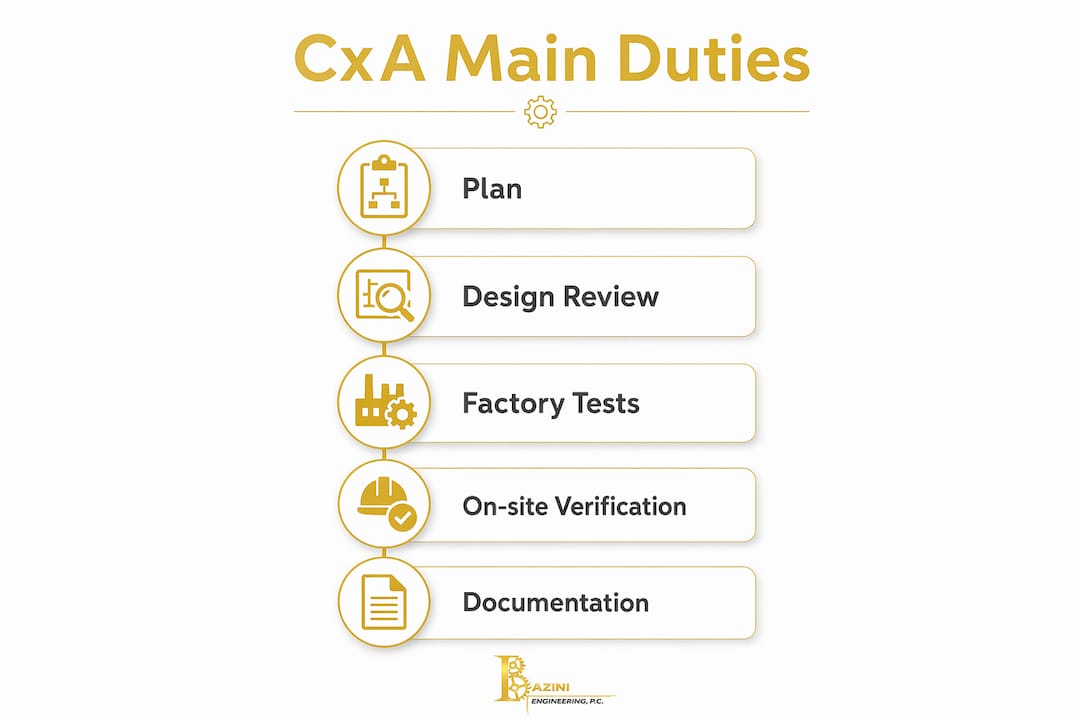
The commissioning agent's responsibilities span the entire project lifecycle, from the earliest planning conversations through post-occupancy reviews. That scope is what separates the CxA from every other party on the project.
The HVAC commissioning process follows five defined phases: Pre-Design, Design, Construction, Acceptance, and Post-Occupancy. Each phase carries specific deliverables the CxA owns.
-
Pre-Design. The CxA works with the owner to document the OPR, which defines what the HVAC system must accomplish in terms of comfort, energy use, and code compliance. Getting this document right before design begins prevents expensive misalignments later.
-
Design review. The CxA reviews drawings and specifications for commissionability, checking that controls sequences are documented, that equipment is accessible for testing, and that design intent aligns with the OPR. Errors caught on paper cost a fraction of what they cost in the field.
-
Construction observation. The CxA visits the site to verify that installation matches the approved design. This includes checking duct connections, equipment mounting, sensor placement, and control wiring before walls close.
-
Functional performance testing. The CxA develops and executes test scripts that simulate real operating conditions. This is where controls sequences, safeties, and alarm responses get verified against the OPR.
-
Deficiency tracking and post-occupancy review. The CxA documents every deficiency and tracks corrective actions to closure. Commissioning follows a 10-month warranty review after occupancy, catching issues that only appear under seasonal load changes.
Pro Tip: Engage the CxA before the design team starts drawing. Early involvement costs less and catches coordination errors while they are still just marks on paper.
Why does the commissioning agent need to be independent?

Independence is not a preference. For projects over 50,000 sq. ft., ASHRAE 90.1-2022 Section 8.4 mandates that the commissioning agent be independent of both the mechanical contractor and the designer of record. That legal requirement exists for a practical reason: a contractor cannot objectively verify their own work.
The CxA's independence protects the owner's interests in three specific ways:
- Conflict-free evaluation. The CxA does not design or install systems, so they have no financial stake in hiding deficiencies. Their only obligation is to the owner's documented requirements.
- Credible documentation. When a dispute arises between the owner and a contractor, commissioning records signed by an independent professional carry legal weight that contractor self-certification does not.
- Objective performance baseline. An independent CxA sets a performance baseline the facility team can use for years. That baseline becomes the reference point for diagnosing future system drift.
The distinction between a CxA, a mechanical contractor, and a designer is worth stating clearly. The mechanical contractor installs the system. The designer specifies it. The CxA verifies that what was installed matches what was specified and that the whole integrated system performs as the owner intended.
How does commissioning improve energy efficiency and reduce costs?
The financial case for commissioning is direct and well-documented. Properly commissioned buildings operate 8–20% below the operating costs of non-commissioned buildings. That range reflects differences in building type and complexity, but the direction is consistent: commissioning saves money.
Energy savings follow the same pattern. Commissioned buildings show a median energy saving of 13% in new construction and 16% in existing buildings. The payback period for commissioning investment averages 1.7 years. For a building with a 20-year service life, that math is straightforward.
Skipping commissioning does not eliminate the cost. It defers it. Unverified controls sequences, miscalibrated sensors, and improperly balanced systems generate service calls, tenant complaints, and energy waste for years. Commissioning shifts that cost upfront, replacing reactive repairs with defensible records the owner controls.
The risk of skipping commissioning compounds over time. Managing building systems post-handover without commissioning can increase energy consumption by 50–90% as systems drift from their design setpoints. Commissioning sets the baseline that prevents that drift from going undetected.
For building managers specifically, commissioning documentation gives your facilities team a reference they can use every time a system behaves unexpectedly. Without it, diagnosing a controls problem means guessing at what the system was supposed to do in the first place.
How does commissioning differ from TAB and equipment startup?
Property owners frequently conflate commissioning with two related but narrower processes: Testing, Adjusting, and Balancing (TAB) and equipment startup. The differences matter because each process answers a different question.
TAB measures and adjusts airflow and water flow values to match design specifications. A TAB technician confirms that a supply air terminal delivers 400 CFM as designed. TAB adjusts flows to design values; commissioning verifies system behavior under dynamic conditions. TAB does not test whether the building automation system responds correctly when a zone calls for cooling at 2:00 AM.
Equipment startup confirms that a piece of equipment runs. A startup technician verifies that a chiller powers on, reaches setpoint, and does not fault. Contractor startup confirms equipment runs; commissioning confirms the entire integrated system operates according to the OPR with comprehensive functional testing.
Commissioning covers what TAB and startup leave out: controls integration, sequences of operation, interlock verification, alarm responses, and occupied versus unoccupied mode transitions. A building can pass TAB and startup and still fail to meet the owner's energy and comfort requirements.
Pro Tip: Request the TAB report and the commissioning report as separate deliverables. If a contractor offers both as a single document, that is a signal the commissioning scope has been compressed.
What should you look for when selecting a commissioning agent?
Selecting the right CxA requires evaluating credentials, experience, and timing of engagement. The HVAC industry recognizes two primary professional certifications for commissioning agents:
- CCP (Certified Commissioning Professional) issued by the Building Commissioning Association (BCxA)
- BEAP (Building Energy Assessment Professional) issued by ASHRAE
Commissioning professionals must hold certifications like CCP or BEAP and demonstrate documented commissioning experience on comparable project types. Ask candidates for a sample commissioning plan and a list of completed projects with references.
Beyond credentials, evaluate these factors before signing an agreement:
- Independence verification. Confirm the CxA has no financial relationship with the mechanical contractor or designer on your project.
- Early engagement. Engaging the commissioning agent early in pre-design maximizes value by catching design coordination errors before construction begins. A CxA brought in at substantial completion can only test what was built, not influence what was designed.
- OPR development support. A qualified CxA helps you write the OPR, not just verify against it. If a candidate skips this step, their scope is too narrow.
- Documentation deliverables. Confirm the contract requires a final commissioning report, a systems manual, and a training record for your facilities team.
Facilities teams benefit from commissioning documentation to verify performance over time and diagnose issues when system drift occurs. That documentation is only as useful as the CxA who produced it, so credentials and experience matter as much as price.
Key Takeaways
A commissioned HVAC system costs less to operate, performs more reliably, and gives building managers the documentation they need to maintain performance for the life of the building.
| Point | Details |
|---|---|
| Independence is mandatory | ASHRAE 90.1-2022 requires CxA independence for projects over 50,000 sq. ft. |
| Engage early for maximum value | A CxA involved in pre-design catches errors before construction, reducing costly changes. |
| Commissioning pays for itself | Buildings with commissioning operate 8–20% below the costs of non-commissioned buildings, with a 1.7-year payback. |
| TAB and startup are not commissioning | TAB adjusts flows; startup confirms equipment runs; commissioning verifies integrated system performance against the OPR. |
| Documentation protects your investment | Commissioning reports give facilities teams a performance baseline and legal protection in contractor disputes. |
What I've learned from watching buildings skip commissioning
Most building owners treat commissioning as optional until they are paying for a controls contractor to diagnose a problem that commissioning would have caught on day one. I have seen this pattern repeat across commercial and institutional projects: a building opens, the HVAC system appears to work, and then six months later the energy bills are 30% higher than projected and nobody can explain why.
The uncomfortable truth is that commissioning creates value that is invisible when it works. A building that performs exactly as designed rarely prompts anyone to say, "Thank the commissioning agent." But when systems drift, when tenants complain, when energy costs spike, the absence of commissioning documentation makes every diagnosis harder and every repair more expensive.
My recommendation to property owners is direct: treat the CxA fee as part of the mechanical system budget, not as an optional consulting line item. The 1.7-year average payback is not a marketing claim. It reflects what happens when you verify a system before problems compound. Insist on it from the start, and insist on a CxA who was in the room when the OPR was written.
— Joseph
How Baziniengineering supports your HVAC commissioning needs
Baziniengineering brings independent commissioning authority expertise to commercial, residential, and institutional projects across New York City, Long Island, and Westchester County. The firm's mechanical engineering team reviews design documents for commissionability, oversees functional performance testing, and delivers the documentation your facilities staff needs to maintain system performance long after occupancy.

Property owners and building managers working on projects subject to ASHRAE 90.1-2022 requirements can rely on Baziniengineering's experience with NYC Department of Buildings coordination and energy code compliance. Explore the full range of engineering services Baziniengineering offers, including specialized mechanical engineering support for HVAC systems from pre-design through post-occupancy review.
FAQ
What is the role of a commissioning agent in HVAC?
A commissioning agent, formally called a Commissioning Authority (CxA), is the independent professional who verifies that HVAC systems meet the Owner's Project Requirements and perform correctly under real operating conditions. The CxA reviews design documents, oversees installation, and conducts functional performance testing across all project phases.
When is an independent commissioning agent legally required?
ASHRAE 90.1-2022 Section 8.4 requires an independent commissioning agent for projects over 50,000 sq. ft. The CxA must be independent of both the mechanical contractor and the designer of record.
How much money does HVAC commissioning save?
Commissioned buildings operate 8–20% below the operating costs of non-commissioned buildings, with median energy savings of 13% in new construction and 16% in existing buildings. The average payback period is 1.7 years.
What certifications should a commissioning agent hold?
Qualified commissioning agents hold the Certified Commissioning Professional (CCP) credential from the Building Commissioning Association or the Building Energy Assessment Professional (BEAP) credential from ASHRAE, along with documented project experience.
Is commissioning the same as Testing, Adjusting, and Balancing?
No. TAB adjusts airflow and water flow values to match design specifications. Commissioning verifies that the entire integrated system, including controls sequences and alarm responses, operates according to the Owner's Project Requirements under dynamic conditions.