
Plumbing code compliance means following the adopted model codes and local amendments that set minimum standards for how plumbing systems are designed, installed, and inspected in the United States. Get it wrong, and you face failed inspections, stop-work orders, and denied occupancy certificates. Get it right, and you have a system that protects drinking water quality, handles waste safely, and passes every review without drama. The core framework rests on a handful of key entities every builder and engineer needs to know:
- International Plumbing Code (IPC): Published by the International Code Council (ICC), dominant in eastern and central states
- Uniform Plumbing Code (UPC): Published by the International Association of Plumbing and Mechanical Officials (IAPMO), prevalent in western states
- Authority Having Jurisdiction (AHJ): The local or state body that enforces adopted codes through permits and inspections
- NSF/ANSI/CAN 61: The referenced standard for drinking water system components, required under both major codes
- Licensed professionals: Required for most permitted work, with narrow owner-performed exceptions defined by each AHJ
What are the two primary plumbing codes used in the U.S.?
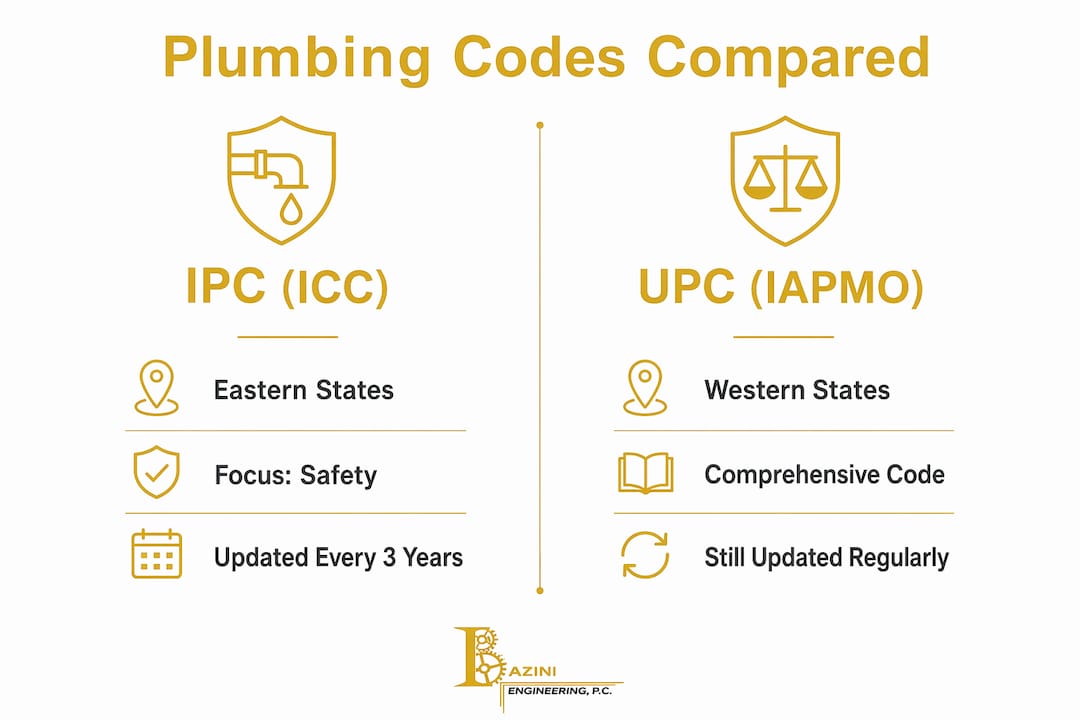
The U.S. plumbing industry runs on two model codes: the IPC and the UPC. Both update every three years and prioritize health and safety, but they differ in structure, governance, and geographic reach.
The IPC, crafted by the ICC, is more prevalent in the eastern and central regions of the country and is known for its flexibility and adaptability to local needs. It references companion codes like the International Residential Code (IRC) and the International Fuel Gas Code (IFGC) for provisions outside its core scope. That cross-referencing can complicate interpretation on complex projects, since contractors must reconcile multiple documents simultaneously.
The UPC, developed by IAPMO since 1926, takes a different approach. It functions as a standalone comprehensive code, placing as much installation guidance as possible in one document. Western states favor it, though there are exceptions: Arizona, for instance, follows the IPC despite being surrounded by UPC states.
| Feature | IPC (ICC) | UPC (IAPMO) |
|---|---|---|
| Publisher | International Code Council | International Association of Plumbing and Mechanical Officials |
| Update cycle | Every 3 years | Every 3 years |
| Primary region | Eastern and central U.S. | Western U.S. |
| Code structure | References companion I-Codes | Standalone, single-volume |
| Voting process | Simple majority, code officials only | Two-thirds supermajority, diverse stakeholders |
| ANSI designation | No | Yes |
How is plumbing code compliance enforced, and what do AHJs do?
The Authority Having Jurisdiction is the engine of enforcement. Whether that is a city building department, a county inspector's office, or a state agency, the AHJ reviews plans, issues permits, and conducts inspections at defined project milestones. Non-compliance can lead to failed inspections, stop-work orders, and denial of occupancy certificates, which means real financial consequences on any project timeline.
The enforcement sequence follows a predictable path:
- Permit application: Submit plumbing plans, fixture unit calculations, and material specifications before any work begins
- Plan review: The AHJ's plan reviewer checks design documents against the adopted code and flags deficiencies
- Permit issuance: Work may begin only after the permit is issued and posted on site
- Rough-in inspection: Inspector verifies pipe installation, slope, and connections before walls are closed
- Pressure and leak testing: Required tests confirm system integrity at this stage
- Final inspection: Conducted after fixture installation to verify function, code compliance, and proper connections
- Certificate of occupancy: Issued only after all inspections pass
Pro Tip: Contact your AHJ's plan review office before submitting documents. A five-minute conversation about local amendments and submittal requirements can save weeks of back-and-forth on corrections.
Which product standards and certifications does plumbing code compliance require?
Codes do not just regulate installation methods. They also specify which products are permitted, and those products must meet referenced technical standards. NSF/ANSI/CAN 61 covers drinking water system components and is referenced directly in the UPC's Section 604.1. NSF/ANSI 14 covers plastic piping systems. ASTM standards govern specific materials throughout both codes.
What trips up many contractors is the certification mark question. AHJs verify compliance by checking that a product is listed by an accredited organization they recognize, not by requiring a specific logo or shield. The UPC, for example, does not mandate IAPMO certification or the UPC Shield. Any accredited listing agency accepted by the AHJ satisfies the requirement.
Key certification and standards organizations relevant to plumbing products:
- NSF International: Certifies to NSF/ANSI/CAN 61, NSF/ANSI 14, and other referenced standards
- IAPMO: Operates a product listing program widely accepted by AHJs in UPC jurisdictions
- ASSE International: Publishes performance standards for backflow preventers and specialty devices
- CSA Group: Certifies products to Canadian and U.S. standards, accepted across North American jurisdictions
- ICC Evaluation Service: Issues evaluation reports for products and methods not explicitly addressed in the IPC
To verify a product before installation, check the certification body's published listing database rather than relying solely on packaging marks.
What are the most common misconceptions about plumbing code compliance?
Several persistent misunderstandings create real project problems. Knowing them ahead of time is cheaper than learning them during an inspection.
- Passing final inspection guarantees system longevity. It does not. Final inspection verifies minimum life-safety and sanitation standards. Complex commercial systems often require engineered designs that exceed code minimums to perform reliably over their service life.
- IPC and UPC are interchangeable. They are not. The UPC's standalone structure versus the IPC's multi-code referencing creates real differences in how contractors apply requirements, especially on multi-system commercial projects.
- Only products bearing the UPC Shield comply with the UPC. False. The UPC requires listing by an AHJ-accepted accredited agency, not a specific mark. Unnecessary product re-selection based on this misconception causes avoidable delays.
- The base model code is what your jurisdiction enforces. Local amendments frequently modify model code provisions. The adopted version in your jurisdiction may differ from the published model code in ways that matter for your specific project.
- Skipping permits saves time. Skipping the permit-to-inspection sequence is the most common source of costly stop-work orders and project delays. Unpermitted work also creates liability during property transactions.
- Any licensed plumber can pull any permit. Licensed contractors are typically required for permitted work, but the specific license type and scope vary by jurisdiction. Some AHJs allow owner-performed work under strict self-permitting provisions; most do not.
What does a step-by-step plumbing compliance checklist look like?
A clear sequence prevents the gaps that cause inspection failures. Permit applications must include fixture unit load calculations and detailed material specifications before construction begins, and reviewers verify these during plan review.
- Confirm jurisdiction and adopted code. Identify which version of the IPC or UPC your AHJ has adopted, including any local amendments, before designing anything.
- Engage a licensed professional. For commercial, institutional, or complex residential projects, a licensed plumbing engineer prepares code-compliant drawings and specifications.
- Prepare and submit permit documents. Include fixture unit calculations, pipe sizing, material schedules, and any required energy or water conservation compliance documentation.
- Obtain permit approval before starting work. No exceptions. Work begun before permit issuance risks legally binding stop-work orders.
- Schedule rough-in inspection. Before closing walls or ceilings, the inspector verifies pipe slope, connections, and installation against code requirements.
- Conduct pressure and leak testing. Both the IPC and UPC require testing of water supply and drainage systems at specified pressures and durations.
- Install backflow prevention devices. Codes require backflow prevention aligned with the federal Safe Drinking Water Act, with device type determined by hazard classification.
- Complete fixture installation. Install all fixtures per manufacturer instructions and code specifications after rough-in approval.
- Schedule and pass final inspection. The inspector checks fixture function, connections, and overall system compliance. Address any deficiencies before requesting re-inspection.
- Retain all documentation. Keep permits, inspection records, and product certifications on file. These matter during future renovations, sales, and insurance claims.
For residential projects, reviewing common plumbing violations before submitting plans helps catch issues before the inspector does.
How do local amendments change what you actually need to comply with?
Model codes are starting points, not final answers. Local jurisdictions adopt amended versions of model codes, and those amendments create a patchwork of requirements that can differ significantly from one municipality to the next. A contractor working across county lines may face two different pipe material requirements, two different venting rules, or two different fixture count thresholds for the same building type.
The practical solution is direct communication with local code officials before and during design. Most AHJs publish their adopted amendments online, but published documents do not always capture informal interpretations that inspectors apply in the field. Calling the plan review office, attending pre-application meetings, and asking specific questions about local deviations from the model code is time well spent.
Staying current also requires ongoing effort. Both the IPC and UPC publish new editions every three years, and jurisdictions adopt new editions on their own schedules, sometimes years after publication. A state may be enforcing the 2021 edition of the IPC while the 2024 edition is already available. Knowing which edition governs your project is a basic due-diligence step that professionals cannot skip.
Pro Tip: When conflicting requirements arise between the model code and a local amendment, the local amendment governs. Document the conflict, get the AHJ's written interpretation, and design to the stricter requirement if written guidance is not available.
Key Takeaways
Plumbing code compliance in the U.S. requires adherence to adopted model codes, AHJ-enforced permits and inspections, and product certification to referenced standards, with local amendments shaping the specific requirements on every project.
| Point | Details |
|---|---|
| Two dominant model codes | IPC (ICC) covers eastern and central states; UPC (IAPMO) covers western states, both update on a regular cycle. |
| AHJs enforce compliance | Permits, plan review, rough-in inspections, and final inspections are all mandatory steps before occupancy. |
| Product certification matters | Products must be listed by an AHJ-accepted accredited agency; no single mark or shield is universally required. |
| Local amendments govern | Jurisdictions modify model codes; always confirm the adopted version and local amendments before designing. |
| Final inspection is not a guarantee | Passing inspection confirms minimum life-safety standards, not long-term system performance or reliability. |
Why plumbing code compliance deserves more respect than it gets
Most people treat plumbing codes as bureaucratic friction. That framing is understandable and almost entirely wrong.
Codes represent decades of accumulated failure analysis. The backflow prevention requirements, the venting rules, the fixture unit calculations — every one of them exists because something went wrong somewhere, often badly. Viewing compliance as a checklist to clear misses the point. The checklist is a distillation of what actually keeps water systems from making people sick or buildings from flooding.
The local amendment problem is where even experienced professionals get caught. Engineers who work across multiple jurisdictions sometimes assume that what passed in one city will pass in the next. It usually does not. The patchwork of adopted editions and local modifications means that genuine expertise requires knowing not just the model code but the specific adopted version in every jurisdiction where you work. That is not a minor administrative detail. It is the difference between a project that moves and one that stalls at plan review.
The product certification misconception is worth calling out separately because it costs real money. Contractors who reject compliant products because they lack a specific shield or mark, then source alternatives that carry the mark but are otherwise identical, are adding cost and delay for no compliance benefit. The AHJ cares about accredited listing, not branding.
Baziniengineering's plumbing engineering services are built around exactly this kind of jurisdictional fluency. Code-compliant design is not a feature of good engineering. It is the baseline.
Working on a project in New York City, Long Island, or Westchester County and need plumbing designs that clear plan review the first time? Baziniengineering's full engineering services cover plumbing, mechanical, fire protection, and permit coordination from design through final inspection.