

The NYC Building Code is defined as the locality-specific, integrated regulatory framework governing all construction, renovation, and alteration work within New York City's five boroughs, codified under Title 28 of the New York City Administrative Code. Understanding what is NYC building code means recognizing it as far more than a single document. It encompasses the Building, Plumbing, Mechanical, and Fuel Gas Codes, each enforced by the NYC Department of Buildings (DOB), and it operates alongside the NYC Zoning Resolution and a growing body of local laws. For property developers, contractors, and real estate professionals, this framework is the foundation of every project decision from design through certificate of occupancy.
What is NYC building code and how is it structured?
The NYC code framework includes multiple layers: the Building, Plumbing, Mechanical, and Fuel Gas Codes under Title 28, plus the Zoning Resolution and local laws, each enforced separately. That layered structure is the single most important fact to internalize before any NYC project begins. Missing even one layer creates exposure to violations, delays, and cost overruns.
The four primary sub-codes each govern a distinct technical domain. The Building Code covers structural systems, fire resistance, egress, and occupancy classifications. The Plumbing Code regulates water supply, drainage, and sanitary systems. The Mechanical Code addresses HVAC and ventilation systems. The Fuel Gas Code governs natural gas and propane installations. All four fall under Title 28 and are administered by the DOB.

Supporting these is the NYC Energy Conservation Code, which sets minimum performance standards for building envelopes, mechanical systems, and lighting. Compliance with the Energy Conservation Code is a prerequisite for permit sign-off on most new construction and major renovation projects. Baziniengineering routinely coordinates energy code submissions alongside MEP filings to prevent last-minute conflicts at plan review.
The NYC Zoning Resolution is legally separate from the Building Code but must be satisfied simultaneously. Clearing the Building Code alone is not sufficient. The Zoning Resolution governs land use, setbacks, floor area ratios, and density, and it is administered by the NYC Department of City Planning rather than the DOB. A project can be structurally sound and code-compliant yet still be denied a permit for a zoning violation.
Pro Tip: Map out which sub-codes apply to your specific project type before design begins. A commercial tenant fit-out triggers different code layers than a new residential building, and knowing this early prevents redesign costs.
| Code / Regulation | Scope | Enforcing Agency |
|---|---|---|
| NYC Building Code | Structure, fire resistance, egress, occupancy | NYC Department of Buildings |
| NYC Plumbing Code | Water supply, drainage, sanitary systems | NYC Department of Buildings |
| NYC Mechanical Code | HVAC, ventilation systems | NYC Department of Buildings |
| NYC Fuel Gas Code | Gas piping and appliances | NYC Department of Buildings |
| NYC Energy Conservation Code | Envelope, mechanical, and lighting performance | NYC Department of Buildings |
| NYC Zoning Resolution | Land use, setbacks, density, FAR | NYC Department of City Planning |
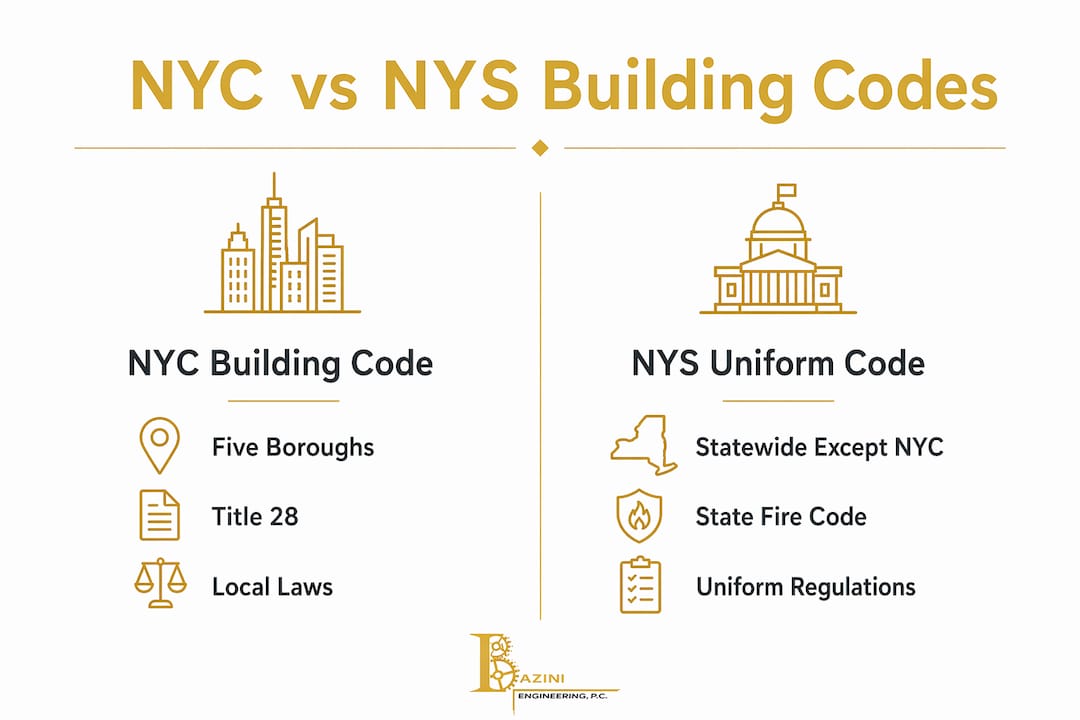
How does NYC building code differ from the NYS Uniform Code?
NYC Building Code is distinct and operates entirely outside New York State's Uniform Fire Prevention and Building Code, reflecting the city's unique density and building stock. This distinction trips up professionals who work across both NYC and upstate or Long Island projects. The two systems share some International Building Code roots, but their governance, amendments, and enforcement structures diverge significantly.
The NYS Uniform Code applies to every municipality in New York State except New York City. Local building departments in those municipalities enforce it, with the State Fire Prevention and Building Code Council overseeing updates. In contrast, NYC develops and amends its own Construction Codes through the City Council, with the DOB serving as the primary enforcement authority. NYC's localized approach balances international standards with urban-specific needs, including high-rise construction, dense mixed-use buildings, and aging infrastructure.
NYC also layers in local laws that have no equivalent in the NYS Uniform Code. Local Law 97, for example, imposes carbon emissions caps on large buildings. Local Law 11 mandates periodic facade inspections. These laws are enacted by the City Council and enforced by the DOB, adding compliance obligations that apply only within the five boroughs.
Pro Tip: Confirm the applicable jurisdiction at the very start of project planning. A project in Yonkers follows the NYS Uniform Code enforced by the Yonkers Building Department. A project in the Bronx follows NYC Construction Codes enforced by the DOB. Assuming one applies when the other does is a costly mistake.
| Factor | NYC Building Code | NYS Uniform Code |
|---|---|---|
| Geographic scope | Five boroughs of New York City | All NYS municipalities except NYC |
| Governing authority | NYC City Council and DOB | NYS Fire Prevention and Building Code Council |
| Enforcement agency | NYC Department of Buildings | Local municipal building departments |
| Local law integration | Yes (Local Laws 97, 11, and others) | No equivalent local law layer |
| Code update cycle | Independent NYC cycle | Tied to NYS legislative updates |
What are the permit requirements under NYC building code?
In 2024, NYC processed over 285,000 permit applications, a figure that reflects both the city's construction volume and the DOB's administrative scale. Every project that involves construction, alteration, or demolition requires a permit, and the type of permit determines the review timeline and professional requirements.
The most common permit categories are:
- Alt-1 (Alteration Type 1): Required for changes to a building's use, occupancy, or egress. This is the most complex alteration permit and triggers full plan review.
- Alt-2 (Alteration Type 2): Covers multiple work types that do not change use or occupancy, such as mechanical upgrades or partition changes.
- PL (Plumbing Permit): Required for any plumbing work, including new fixtures, pipe replacements, and drainage modifications.
- EL (Electrical Permit): Covers electrical installations and upgrades, filed separately through the DOB's electrical unit.
Minor permits typically take 1–4 weeks to process, while major new building filings require 4–12 weeks due to complex review. That timeline gap matters enormously for project scheduling. Contractors who submit incomplete filings or use the wrong permit type restart the clock entirely.
Performing construction without proper permits in NYC triggers violations costing between $2,500 and $25,000, plus Stop Work Orders that can halt projects indefinitely. A Stop Work Order does not just pause construction. It freezes financing draws, delays tenant occupancy, and can trigger lease penalties. The financial exposure from unpermitted work far exceeds the cost of proper filing.
NYC also introduced its first-ever Existing Building Code as of December 2025, tailored to streamline renovation and alteration work compliance. This is a significant development for developers working on existing building stock, as it provides a dedicated compliance pathway separate from the new construction code.
Pro Tip: Engage a Registered Architect or Professional Engineer for all DOB filings. Self-certification is available for some project types, but PE and RA sign-off reduces plan review rejections and provides professional liability coverage that protects the project owner.
What are the practical implications for NYC project planning?
The complex layered nature of NYC's regulatory system means ignoring even a single code layer risks project shutdown or significant penalties. For developers and contractors, this translates into a specific set of planning disciplines that must be built into every project from day one.
Choosing the correct filing class is a liability driver. Registered Architects handle layout and space planning filings, while Professional Engineers provide structural calculations and carry stricter DOB review requirements. Misassigning the filing class delays approval and can result in rejected applications that require complete resubmission.
Chapter 33 governs construction safety in NYC and is cited in many Stop Work Orders, covering everything from minor alterations to major projects. Its provisions include public protection measures, crane operations, demolition procedures, and mandatory professional certifications for site supervisors. Chapter 33's provisions cover public protection, crane operations, demolition, and mandatory professional certifications that directly influence on-site construction management. A contractor who overlooks Chapter 33 requirements on a gut renovation faces the same enforcement exposure as one working on a high-rise.
The NYC Zoning Resolution adds another layer of complexity. The Zoning Resolution must be satisfied simultaneously for construction to proceed, affecting design and permits. Zoning conflicts discovered late in design force costly redesigns. Checking zoning compliance before schematic design is complete is not optional. It is the baseline due diligence for any NYC project.
Best practices for developers and contractors navigating NYC construction regulations include:
- Conduct a zoning analysis and code review before finalizing the project program.
- Identify all applicable sub-codes and local laws at project inception, including energy code and any Local Law obligations.
- Assign the correct filing professional (RA or PE) based on the scope of work.
- Build DOB review timelines into the project schedule, not as a contingency but as a fixed phase.
- Coordinate with the DOB early on complex projects through pre-application meetings.
- Track all open violations on the property before filing, as unresolved violations can block new permit issuance.
Pro Tip: Early coordination with the DOB through a pre-application meeting is available for complex projects and costs nothing. It surfaces potential objections before you invest in full construction documents, saving weeks of revision time.
Key Takeaways
NYC building code compliance requires simultaneous adherence to multiple sub-codes, the Zoning Resolution, and local laws, all enforced by the DOB with significant financial penalties for violations.
| Point | Details |
|---|---|
| Multi-layer framework | NYC Building Code includes Building, Plumbing, Mechanical, and Fuel Gas Codes plus zoning and local laws. |
| NYC vs. NYS distinction | NYC operates its own independent code system, separate from the NYS Uniform Code, with unique local law obligations. |
| Permit timelines matter | Minor permits take 1–4 weeks; major filings take 4–12 weeks. Build these into your project schedule. |
| Non-compliance is costly | Unpermitted work triggers fines of $2,500–$25,000 and Stop Work Orders that freeze projects indefinitely. |
| Filing class selection | Assigning the wrong professional type to a filing delays approval and creates liability exposure for the project owner. |
Why NYC building code complexity demands a different mindset
I have worked on projects across New York City long enough to know that the professionals who struggle most with the NYC code system are not the ones who lack technical knowledge. They are the ones who treat the Building Code as a checklist rather than a system. The code is not a single document you satisfy and move on from. It is a set of interlocking obligations that run in parallel throughout the entire project lifecycle.
The introduction of the Existing Building Code in December 2025 is a good example of why continuous education matters. Developers who were still filing renovation projects under the old framework missed a compliance pathway that could have simplified their approvals. Staying current with code cycles is not a passive activity. It requires deliberate tracking of DOB bulletins, City Council legislation, and local law enactments.
The other lesson I keep returning to is the value of multidisciplinary coordination early in a project. Zoning, building code, energy code, and fire protection requirements do not exist in separate silos on a real project. They interact constantly. A mechanical system that satisfies the Energy Conservation Code may require shaft penetrations that affect fire resistance ratings under the Building Code. Catching that conflict in schematic design costs a few hours of coordination. Catching it during plan review costs weeks and real money.
Developers and contractors who build compliance into their project culture, rather than treating it as a final hurdle, consistently deliver projects faster and with fewer surprises. That is not a theory. It is the pattern I see on every well-run NYC project.
— Joseph
How Baziniengineering supports your NYC code compliance
Navigating the NYC Building Code is significantly more manageable with the right engineering partner from the start.
Baziniengineering provides MEP and fire protection engineering services specifically designed for the NYC regulatory environment, including DOB filing coordination, energy code compliance, and Local Law 97 compliance support. The firm's engineers work across commercial, residential, and institutional projects throughout New York City, Long Island, and Westchester County, delivering code-compliant designs that move through plan review efficiently. Whether your project requires plumbing engineering, mechanical systems design, or fire suppression coordination, Baziniengineering brings the technical depth and DOB familiarity to keep your project on schedule and within compliance.
FAQ
What is the NYC Building Code?
The NYC Building Code is the locality-specific regulatory framework under Title 28 of the NYC Administrative Code that governs all construction, alteration, and demolition within New York City's five boroughs. It includes the Building, Plumbing, Mechanical, and Fuel Gas Codes, enforced by the NYC Department of Buildings.
How does the NYC Building Code differ from the NYS Uniform Code?
NYC operates its own independent Construction Codes developed by the City Council and enforced by the DOB, while the NYS Uniform Code applies to all other New York State municipalities and is enforced by local building departments. NYC also layers in local laws with no equivalent in the state system.
What permits are required for construction in NYC?
Common permits include Alt-1 for changes to use or occupancy, Alt-2 for multi-trade alterations, PL for plumbing work, and EL for electrical work. In 2024, the DOB processed over 285,000 permit applications, reflecting the volume and variety of work requiring formal approval.
What are the penalties for building without a permit in NYC?
Unpermitted construction in NYC triggers violations ranging from $2,500 to $25,000 and Stop Work Orders that can halt a project indefinitely, freezing financing and delaying occupancy.
What is the NYC Existing Building Code?
The NYC Existing Building Code, introduced in December 2025, is a dedicated compliance framework for renovation and alteration work on existing buildings, providing a streamlined pathway separate from the new construction code requirements.