
On a $10 million project, that means budgeting roughly $200,000 to $800,000 for mechanical, electrical, and plumbing design alone. Before you accept any proposal, ask the engineer for both a percent-of-construction figure and a staff-hour breakdown, so you can check the math from two directions instead of one.
TL;DR:
- MEP engineering fees for commercial projects in 2026 typically range from 2% to 8% of total construction costs, with higher percentages for more complex facilities like data centers.
- System complexity, redundancy requirements, higher BIM levels, and project schedule compression significantly increase engineering hours and fees.
- Regional labor rates can add 10% to 35% to costs, but owners may reduce expenses by negotiating complexity premiums separately from regional labor rate premiums.
- Fee structures vary from percentage of total or MEP-specific costs to hourly billing and lump-sum agreements, with hybrid models gaining popularity for risk management.
- A detailed RFP that specifies phase deliverables, CA hours, staff composition, and assumptions ensures comparable proposals and prevents costly change orders during construction.
Table of Contents
- MEP Engineering Fees Explained: Benchmark Ranges By Building Type
- What Drives MEP Engineering Fees Up Or Down
- Percentage, Hourly, Lump-Sum: How MEP Fees Actually Get Billed
- Getting Comparable Proposals: An RFP Checklist That Works
- How Delivery Method Changes What You Pay For MEP Design
- How Bazini Engineering Approaches Fees On U.S. Projects
- Get A Transparent MEP Fee Estimate For Your Project
- Sources
MEP Engineering Fees Explained: Benchmark Ranges By Building Type
The percent range you should expect depends heavily on what you're building, not just how big it is. Commercial MEP engineering fees in 2026 run from 2% to 8% of total construction cost, but that top-level number hides a lot of variation once you break it down by facility type.
A tilt-up warehouse with basic rooftop units and minimal plumbing runs 1.5% to 3%, because the systems are simple and repeat design patterns are common. Data centers often exceed that, landing at 7% to 10%, because uptime requirements demand N+1 or 2N electrical and cooling redundancy that multiplies engineering hours.
Here's how that translates into dollars on a few common project sizes:
- A 10,000-square-foot retail buildout at $2 million in construction cost, at 3%, means roughly $60,000 in MEP design fees.
- A 50,000-square-foot office renovation at $12 million in construction cost, at 4%, lands near $480,000.
- A 100,000-square-foot hospital wing at $40 million in construction cost, at 7%, puts MEP fees around $2.8 million.
Statistic to watch: MEP systems themselves commonly account for 25% to 55% of total construction cost depending on building type, which is why the design fee (a professional-services line, separate from equipment and installation) scales so directly with facility complexity rather than square footage alone.
What Drives MEP Engineering Fees Up Or Down
Two buildings with identical square footage can carry wildly different MEP fees, and the gap almost never comes down to size. It comes down to what the systems have to do and how many people have to agree on how they do it.
System complexity is the biggest lever. A lab classification, a medical gas system, or specialized refrigeration for a cold-storage facility adds engineering hours that a standard office build never touches. Coordination depth matters just as much: projects requiring higher BIM levels of development (LOD 300 versus LOD 400, for instance) and multiple coordination cycles with structural and architectural teams push fees upward because clash detection and resolution eat design time.
Schedule compression is an underappreciated cost driver. A compressed construction timeline forces overlapping design and construction administration phases, which means more site visits, faster RFI turnaround, and often overtime billing.
- Redundancy requirements (N+1, 2N systems) add design and QA hours
- Higher LOD/BIM coordination cycles increase modeling and clash-resolution time
- Compressed schedules raise construction administration intensity
- Regional labor markets shift the baseline rate before complexity is even factored in
Regional cost multipliers matter too. Northeast and West Coast metros commonly run 10% to 35% above the national average, while Texas, the Southeast, and much of the Midwest sit at or below it.
Pro Tip: Ask your engineer to itemize which fee premium comes from complexity versus which comes from regional labor rates. Complexity premiums are usually non-negotiable; regional rate premiums sometimes have room to move if you're flexible on which office staffs the project.
Percentage, Hourly, Lump-Sum: How MEP Fees Actually Get Billed
MEP consultants typically quote fees one of four ways, and each fits a different risk profile.
- Percentage of total construction cost. This is the most common structure for full-service projects where scope is well-defined early. It scales naturally with project size but can overpay on simple, high-cost-per-square-foot builds.
- Percentage of MEP construction cost. Instead of the whole building budget, this ties the fee to the MEP trade budget specifically, often expressed as 3% to 8% of MEP construction value. It's a better fit when the building shell cost is unusually high or low relative to typical ratios.
- Staff/hourly billing. Rates commonly run $90 to $150 per hour for a senior engineer, $80 to $130 for a BIM manager, and $60 to $100 for a design engineer. This model suits projects with evolving scope, renovations with unknowns, or small engagements where a percentage fee doesn't make sense.
- Lump-sum. Predictable for the owner, but only fair when the scope, phase deliverables, and coordination cycles are locked down in writing before signing. Vague lump-sum contracts are where change orders quietly erode the value of that predictability.
Hybrid models, a lump-sum base fee with hourly rates for CA overages or added scope, are increasingly common and give both sides a way to manage risk without renegotiating the whole contract.
Getting Comparable Proposals: An RFP Checklist That Works
Most fee disputes trace back to a request for proposal that never defined what "included" meant in the first place. A tight RFP fixes that before the contract is signed.
Ask every firm to break out fees by phase: schematic design, design development, construction documents, and construction administration. That phase split matters because CA alone often consumes 25% to 30% of total fee hours, and firms that lowball CA hours tend to come back asking for change orders once the project breaks ground.
A solid RFP should require:
- A clear list of deliverables per phase, not just a fee total
- Stated CA hours or site-visit counts, not "as needed"
- Explicit commissioning scope, since this is the item most often quietly excluded
- BIM/LOD expectations spelled out, including who owns model updates
- Travel and site-visit assumptions, especially for out-of-metro projects
Request both a percent-of-construction number and a staff-hour breakdown from every bidder. If the percentages land close together but the staffing assumptions look thin (say, one design engineer where a comparable proposal shows a senior engineer plus two design engineers), that's a red flag worth a direct conversation before you sign anything.
A simple three-column comparison – phase deliverables, CA hours, and staff mix – side by side across proposals, exposes discrepancies more effectively than comparing total fee amounts alone.
How Delivery Method Changes What You Pay For MEP Design
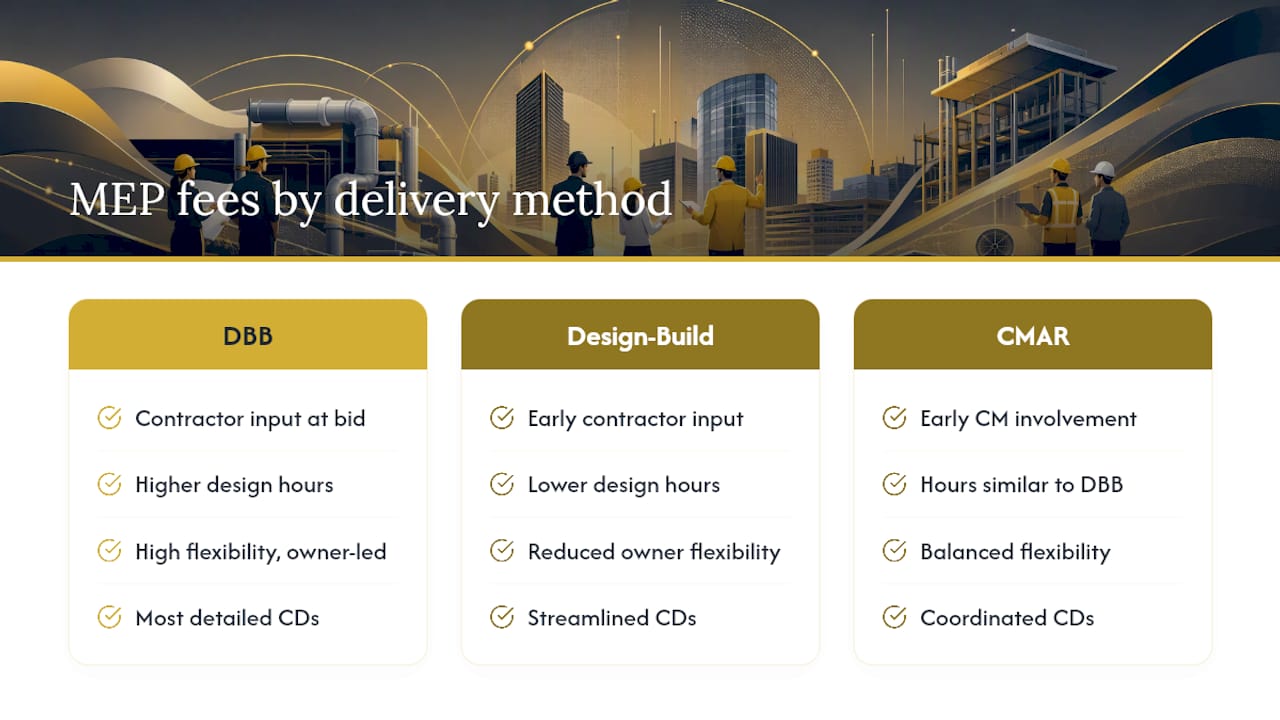
The way you structure the project delivery method shifts MEP fees almost as much as building type does. Design-Bid-Build, the traditional model, tends to produce the most detailed, fully coordinated construction documents because the engineer has no contractor input until bidding closes. That thoroughness usually costs more in design-phase hours, but it also produces the cleanest bid comparisons and the fewest RFIs during construction.
Design-Build shifts the dynamic. The MEP engineer often works for the design-builder rather than the owner directly, and fees can compress because construction documents get streamlined around a contractor's preferred systems and vendors. That can lower design fees by ten to twenty percent on paper, but owners sometimes trade away some design flexibility and independent oversight to get there.
Construction Manager at Risk (CMAR) sits in between. Early CM involvement lets the MEP engineer coordinate constructability decisions during design instead of after, which can reduce costly redesign cycles later. Fees under CMAR often land close to Design-Bid-Build levels, but the hours shift earlier in the schedule, more coordination during design development, less firefighting during construction administration.
Whichever method you choose, get the MEP engineer's fee proposal written against that specific delivery structure. A fee quoted for Design-Bid-Build assumptions rarely transfers cleanly to a Design-Build contract without renegotiation.
How Bazini Engineering Approaches Fees On U.S. Projects
Bazini Engineering, P.C. structures MEP/FP engagements around transparent, project-based fees rather than opaque hourly billing that leaves owners guessing until the invoice arrives. Every proposal lays out the phase breakdown, so clients see exactly what schematic design, design development, construction documents, and construction administration cost before committing.
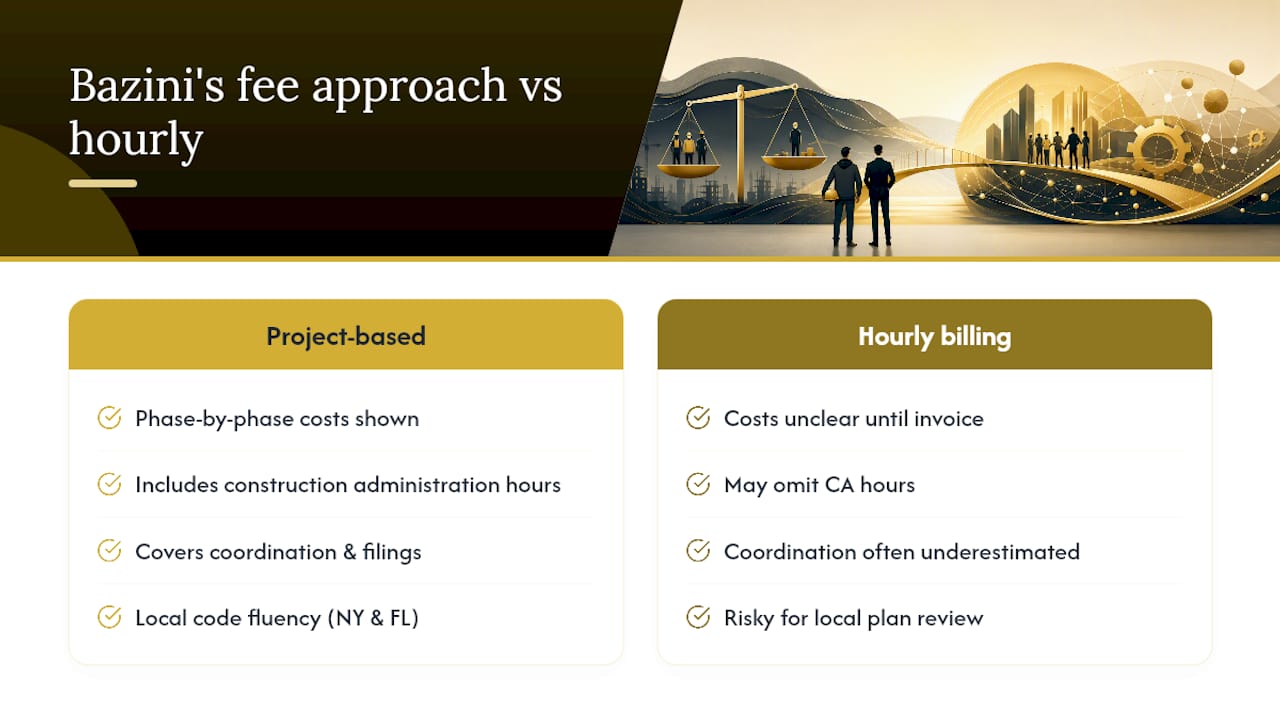
Licensed in both New York and Florida, the firm handles the coordination work that often gets underestimated in a fee proposal, filings with the NYC Department of Buildings, FDNY coordination, and Local Law 97 compliance audits for owners facing energy-retrofit deadlines. That regional depth matters because a fee proposal written without local code fluency tends to run into costly surprises during plan review.
The firm's view: a fee that looks low on paper but excludes CA hours or code research isn't actually a lower fee, it's a deferred cost.
— Joseph
Get A Transparent MEP Fee Estimate For Your Project
Bazini Engineering prices MEP/FP design work project by project, with phase-by-phase fee breakdowns instead of a single bundled number you have to take on faith. For developers comparing proposals across firms, that transparency is the difference between a number you can defend to a lender and a number you have to hope holds up.

The firm's services cover HVAC and mechanical design, plumbing layouts, fire suppression and sprinkler systems, and Local Law 97 compliance support for owners across New York City, Long Island, and Westchester County. If you're budgeting a project right now and want a fee structure you can actually compare against other bids, reach out to Bazini Engineering for a project-specific estimate before you finalize your RFP.