
Local Law 97's two highest immediate financial risks are the $268-per-ton exceedance penalty and the $0.50-per-square-foot failure-to-file penalty. File your building emissions report on time, even if your building exceeds its cap, and engage a registered design professional now to document your mitigation plan before the penalty math turns against you.
TL;DR:
- Buildings exceeding their emissions cap face a penalty of $268 per metric ton for each ton over the limit, assessed annually per building.
- Failure-to-file penalties are $0.50 per square foot of gross floor area, regardless of emission performance, and can surpass exceedance costs for large buildings.
- Owners should submit their BEEC report before May 1, use a registered design professional if required, and keep detailed utility documentation to avoid errors and delays.
- Mitigation options include formal resolutions like mediated plans, energy projects tied to incentives, or documented unforeseen events, each with specific costs and paperwork.
- Engaging specialized engineering firms can help accurately model emissions, prepare compliant retrofit plans, and avoid costly penalties from technical errors or incomplete filings.
Table of Contents
- How Local Law 97 Penalties Actually Work
- Filing Deadlines, Portals, and Common Mistakes
- Article 321: Your Penalty Mitigation Options
- Your Compliance Checklist and Timeline
- Why Engineering Expertise Changes the Penalty Math
- Get a Local Law 97 Compliance Audit Before Your Deadline Hits
- Sources
- FAQ
How Local Law 97 Penalties Actually Work
The NYC Department of Buildings enforces two distinct penalty categories, and confusing them is the most expensive mistake an owner can make. One punishes buildings for emitting too much carbon. The other punishes buildings for not telling the city anything at all, and it's often worse.
The exceedance penalty applies when a building's actual emissions exceed its assigned annual limit. The formula is simple: (actual emissions minus the emissions limit) multiplied by $268 per metric ton of carbon dioxide equivalent, assessed annually on a per Building Identification Number (BIN) basis, according to the DOB's violations guidance. A building that emits 500 metric tons against a 300 ton cap owes 200 tons times $268, or $53,600, for that year alone.
The failure-to-file penalty is flat and unforgiving: $0.50 per square foot of gross floor area, applied independent of whether the building would have passed or failed its emissions cap. A 100,000 square foot building that simply misses its filing deadline faces $50,000 in penalties, a cost that compounds the longer the report stays unfiled.
Penalty Snapshot: A large office tower exceeding its cap by a significant amount faces exceedance penalties in the tens of thousands of dollars. If that same building fails to file its report, it faces failure-to-file penalties that can be several times higher than the exceedance penalties.
Beyond these two, the DOB can also pursue false statement penalties when a submitted report contains materially inaccurate data, whether from bad utility records or a rushed calculation. Owners who file quickly but carelessly sometimes create more legal exposure than owners who file late but accurately.
- Exceedance penalty: (actual tCO2e − limit) × $268, billed annually per BIN
- Failure-to-file: $0.50 per gross square foot, assessed regardless of actual emissions performance
- False statement penalties: triggered by materially inaccurate BEEC data
- All penalties assessed per building, not per owner or portfolio
Filing Deadlines, Portals, and Common Mistakes
Every building over roughly 25,000 gross square feet falls under Local Law 97, and most owners will file a Building Emissions Energy and Water Compliance report, commonly called a BEEC, through the DOB's filing systems, as outlined by NYC Accelerator. The report converts your utility consumption, electricity, natural gas, steam, and fuel oil, into metric tons of carbon dioxide equivalent using standardized grid and fuel conversion factors, then compares that total against your building's calculated cap.
The annual deadline is May 1. A 60-day grace period pushes the practical drop-dead date to June 30, and owners can request further extensions through a formal DOB process under specific conditions.
- Pull your Local Law 84 benchmarking data first. Reconciling LL84 totals against your BEEC numbers before submission catches most discrepancies early.
- Confirm your occupancy classification matches DOB records. A mismatch here is one of the most common reasons a filing gets kicked back automatically.
- Confirm whether your building requires a Registered Design Professional stamp. Missing an RDP sign-off where one is required functions as an automatic failure to file, even if you submitted something.
- Submit through the correct portal well before June 30, not on the deadline itself, in case the system flags an error you need time to fix.
Pro Tip: Keep a dated PDF of every utility bill you use in your BEEC calculation. If the DOB questions your numbers later, having the source documents ready is the difference between a quick clarification and a drawn-out dispute.
Article 321: Your Penalty Mitigation Options
Owners who miss a cap or a deadline are not out of options. Article 321 of the New York City Construction Codes lays out three formal mitigation pathways, and the DOB's Penalty Mitigation Guide spells out exactly what each one requires.
Mediated Resolution fits buildings that can show good-faith progress toward compliance. It requires a documented work plan, typically certified by a registered design professional, laying out the retrofit or operational changes that will bring emissions down over time. This path carries the steepest filing fee of the three.
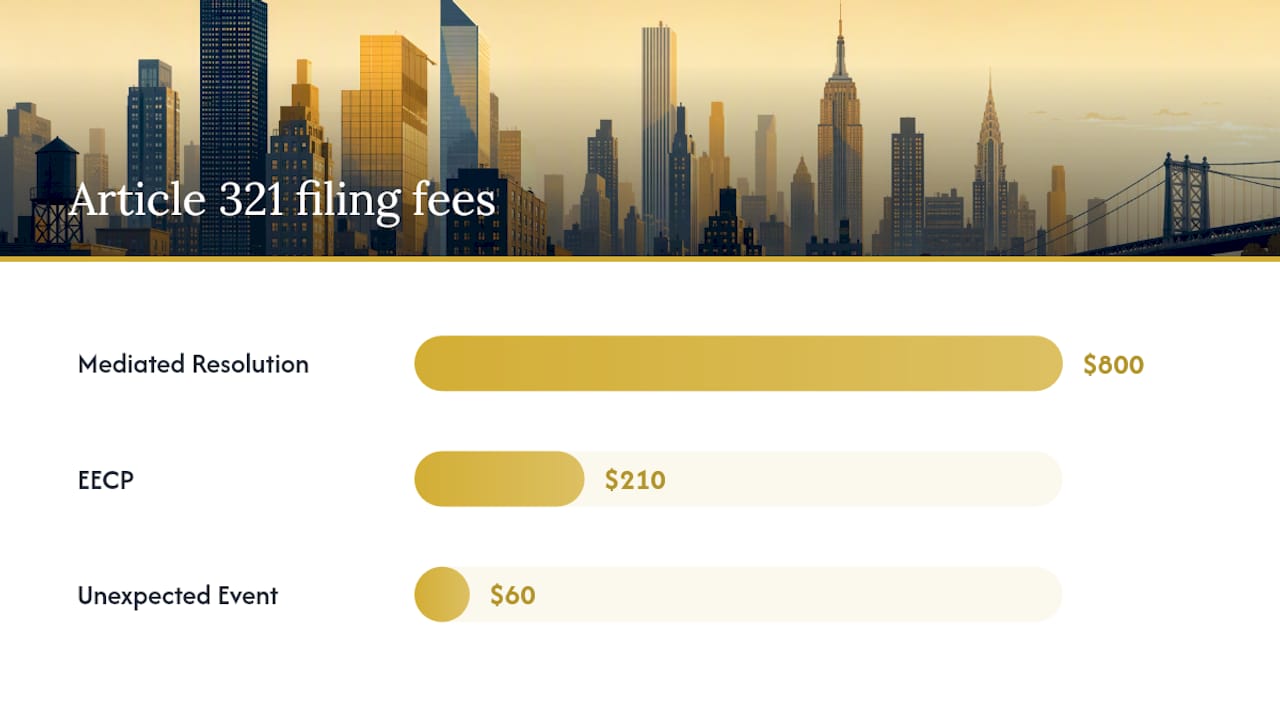
The Energy Efficiency and Clean Energy Program (EECP) applies when a building has committed to a funded energy project, often tied to an agency program or a capital improvement already underway. It requires narrative documentation explaining the scope, timeline, and expected emissions impact of that project.
Unexpected or Unforeseeable Event covers rare circumstances, think fire damage, equipment failure beyond normal wear, or another documented disruption that made compliance impossible. This route demands hard evidence: photographs, damage reports, contractor assessments, and a timeline connecting the event to the emissions shortfall.
Filing fees under Article 321 are fixed by mitigation type: Mediated Resolution runs $800, EECP costs $210, and Unexpected or Unforeseeable Event applications cost $60, according to the DOB's mitigation guide.
- Mediated Resolution: highest fee, requires an RDP-certified work plan
- EECP: mid-range fee, tied to a funded or committed energy project
- Unexpected Event: lowest fee, narrowest use case, requires physical evidence
- All three are filed as tickets through the DOB's online filing system, with the building's BIN prepopulated
Preparing a credible, well-documented application matters more than picking the "right" category on paper. A thin work plan gets rejected regardless of which box you check.
Your Compliance Checklist and Timeline
Penalty exposure shrinks fastest when owners treat Local Law 97 compliance as an ongoing budget line, not a once-a-year scramble. Here's how to sequence the work.
Immediate, 0 to 30 days: Reconcile your LL84 benchmarking data against actual utility bills. Collect twelve months of electricity, gas, steam, and fuel oil records. Submit your BEEC report even if you expect to exceed your cap, since filing preserves every mitigation option described above. Retain a registered design professional if your building type requires one.
Short term, one to six months: Implement low-cost energy conservation measures, better boiler controls, LED retrofits, adjusted setpoints, that produce measurable emissions reductions without major capital outlay. Enroll in relevant NYSERDA or Con Edison incentive programs, which can offset a meaningful share of retrofit costs. Get vendor bids moving now rather than waiting for a Period 2 deadline that will flood contractors with demand.
- Reconcile benchmarking and utility data (weeks 1 to 2)
- File BEEC and retain your RDP (by May 1, or June 30 with the grace period)
- Launch low-capex energy measures and incentive applications (months 1 to 6)
- Scope mid-term retrofits: HVAC replacement, envelope upgrades, electrification, solar or combined heat and power where the building supports it (months 6 to 36)
- Model your Period 2 exposure now, since caps tighten again around 2030 and long-lead capital projects need years of runway, not months
Pro Tip: Keep every contract, RDP report, and DOB correspondence in one file, organized by BIN. When you apply for mitigation later, that paper trail is what turns a rejected application into an approved one.
Documentation isn't paperwork for its own sake. It's the evidence base that supports every mitigation filing you'll ever submit.
Why Engineering Expertise Changes the Penalty Math
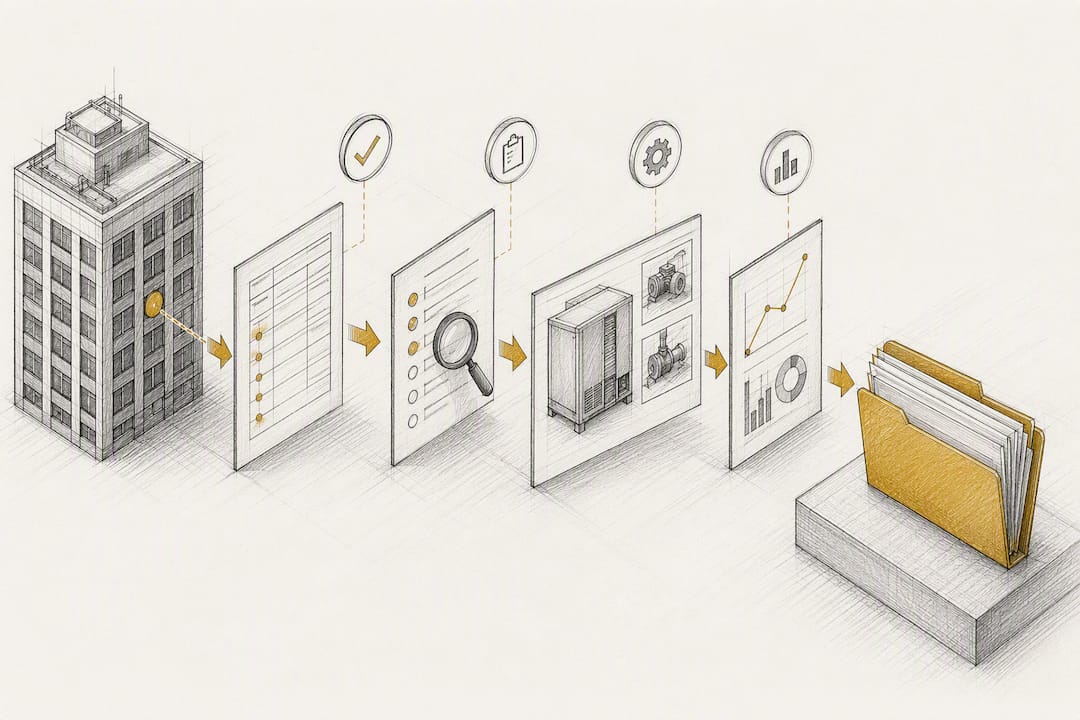
Most owners don't get hit with Local Law 97 fines because they ignored the law. They get hit because nobody on staff had the technical background to model emissions accurately or catch a filing error before the DOB did. Specialized engineering firms run Local Law 97 compliance audits, provide the registered design professional sign-off many filings require, and design HVAC retrofits that actually bring a building under its cap.
If your building has multiple fuel sources, a mixed-use occupancy classification, or a cap you're already flirting with, in-house staff usually can't carry that analysis alone. That's the point where bringing in a licensed MEP engineer stops being optional.
— Joseph
Get a Local Law 97 Compliance Audit Before Your Deadline Hits
There are practical alternatives to guessing your way through a BEEC filing or hiring a generalist consultant who doesn't know mechanical systems from the inside. Audits performed by engineers experienced in HVAC and boiler retrofits can provide compliance plans that are buildable, permit ready, and priced against the exceedance and failure-to-file penalties you're actually trying to avoid.
Bazini Engineering's mechanical engineering team handles HVAC design and retrofit planning specifically built around Local Law 97 caps, while the firm's broader services cover energy code compliance, RDP sign-off, and DOB permit expediting. If your building also needs sprinkler or plumbing coordination alongside a retrofit, the fire suppression team works in the same project pipeline. Reach out through the services page to schedule a compliance audit before your next filing deadline arrives.
FAQ
What Is the Local Law 97 Exceedance Penalty?
It's $268 per metric ton of carbon dioxide equivalent that a building emits above its assigned annual cap, billed each year per Building Identification Number.
How Much Is the Failure-to-File Penalty?
The failure-to-file penalty is $0.50 per gross square foot of the building, applied regardless of whether the building would have passed its emissions cap.
Can I Still File Late Under Local Law 97?
Yes, a 60-day grace period extends the May 1 deadline to June 30, and further extensions may be available through a formal DOB request process.
What Are My Options if My Building Exceeds Its Cap?
Article 321 offers three mitigation paths: Mediated Resolution, the Energy Efficiency and Clean Energy Program, and Unexpected or Unforeseeable Event, each with its own documentation requirements and filing fee.
Does Bazini Engineering Help With Local Law 97 Compliance?
Yes, Bazini Engineering, P.C. performs Local Law 97 compliance audits, provides registered design professional sign-off, and designs the mechanical retrofits that reduce a building's emissions exposure.