
Local Law 97 does not offer broad blanket exemptions. It provides narrow statutory exceptions for specific building categories and a formal adjustment process under Article 320.7, which owners must document and file through the Department of Buildings and the BEAM portal. Most buildings that think they qualify for an exemption actually need an adjustment instead, so the first move is always the same: confirm your BIN's status on the Covered Buildings List, then bring in a registered design professional before you file anything.
TL;DR:
- Most buildings over 25,000 square feet or on the same tax lot exceeding 50,000 GSF must verify their coverage status using DOF records before assuming exemptions or filing.
- Exemptions are limited to specific building categories like city-owned properties, houses of worship, or certain low-density complexes, but these buildings can still appear on the compliance list and require dispute procedures.
- Most relief comes through Article 320.7 adjustments, which require documented constraints or financial hardship claims supported by sufficient evidence and an early engagement of a registered design professional.
- Filing deadlines follow the respective compliance periods, with May 1 deadlines for 2024 onward, and penalties scale with the amount of emissions over the allowed cap, making adjustments potentially highly valuable.
- Owners should treat exemptions as rare exceptions rather than a default strategy, relying instead on early technical assessment, thorough documentation, and professionalism to navigate the law effectively.
Table of Contents
- What Are Local Law 97 Exemptions and Who Qualifies?
- Which Buildings Are Commonly Exempt From Local Law 97?
- How Do Article 320.7 Adjustments Work?
- How Do You Confirm or Dispute Covered Buildings List Status?
- What Does the BEAM Filing Process Actually Require?
- When Are Local Law 97 Filing Deadlines, and What Are the Penalties?
- Practical Steps for Claiming an Exemption or Adjustment
- Why Owners Should Treat LL97 Exemptions as the Exception, Not the Plan
- How Bazini Engineering Supports Your Local Law 97 Filing
- Sources
- FAQ
What Are Local Law 97 Exemptions and Who Qualifies?
Local Law 97 exemptions fall into two very different buckets, and confusing them is the single most common mistake owners make. The first bucket is a true exception: a small set of building categories that either fall outside the law's emissions limits entirely or operate under separate rules written into the statute. The second bucket is an adjustment, which is a temporary, evidence based modification to your emissions cap that you have to apply for and defend, not a status you simply claim.
Coverage itself starts with size. A covered building is any single building over 25,000 gross square feet, or multiple buildings on the same tax lot that together exceed 50,000 GSF. The Department of Finance's property records, not a tenant's guess or a broker's listing sheet, determine that square footage, so a building sitting right at the threshold needs its DOF records checked before anyone assumes it is out of scope.
Once a building clears that threshold, the next question is which compliance pathway applies, and this is where Article 320 and Article 321 split. Article 320 covers most buildings and sets emissions limits for 2024 through 2029, tightening again for 2030 through 2034. Article 321 governs income restricted, rent regulated, and certain city or federally assisted housing, and it can shift a building onto a 2026 or 2035 prescriptive compliance track instead of the standard emissions cap, depending on the share of rent regulated units and the type of regulatory agreement in place.
A few characteristics change which pathway applies, and none of them work as a shortcut around filing:
- The percentage of rent stabilized or rent controlled units in the building
- Whether HPD holds a regulatory agreement covering the property
- Whether the building receives federal project based assistance (Section 8, for example)
- The specific tax exemption program attached to the building (certain 421a variants are treated differently than others)
That last point trips up a lot of owners. HPD's guidance makes clear that not every affordable housing tax status gets the same treatment. An older 421a agreement can land a building on the 2035 prescriptive pathway, while a newer 421a(16) deal might not qualify for the same treatment at all. You cannot assume affordability status equals exemption. It equals a different pathway, and sometimes a different set of prescriptive energy measures instead of an emissions cap.
The distinction that matters most: an exception means no emissions limit applies to that building at all. An adjustment or alternative pathway means a limit still applies, just a different one, on a different timeline, or with different evidence requirements attached to it.
Which Buildings Are Commonly Exempt From Local Law 97?
City-owned buildings and NYCHA properties sit outside Local Law 97's emissions limits because the city set separate carbon reduction commitments for its own portfolio through other executive directives, rather than folding them into the private-sector framework. That does not mean zero paperwork. City agencies and NYCHA still track and report energy performance internally, just not through the same BEAM compliance-report mechanism that private owners use.
Utilities get similar treatment, but only for the portions of their operations tied to regulated utility infrastructure rather than ordinary office or commercial space they might also own.
Houses of worship occupy a genuinely separate category. A building used primarily for religious worship is generally excepted from LL97 emissions limits, but the exception applies to the worship space itself, not automatically to every ancillary structure on the same tax lot (a rectory, a school building, a rented commercial storefront on the ground floor). Where a house of worship is also a landmarked structure, retrofit options can run into the Landmarks Preservation Commission, and an LPC denial of a proposed facade or window intervention becomes part of the evidence an owner can use to support a physical constraint adjustment down the line. That interaction between LPC and DOB is one of the more overlooked mechanics in the whole law.
Garden-style apartment complexes get their own carve out under specific density and configuration criteria, generally tied to low-rise, low-density developments where the emissions math works differently than it does for a typical high-rise. Nonprofit-owned buildings do not get a blanket pass, but some qualify for reduced fees or modified filing requirements depending on their tax status and how HPD or the Department of Finance classifies the property.
A few practical eligibility signals worth checking against your own building:
- City ownership or NYCHA management, verified through DOF property records rather than assumption
- Primary and consistent use as a house of worship, not a mixed-use building with a worship space on one floor
- Garden-style configuration meeting the specific density thresholds in the statute
- Nonprofit tax status combined with an HPD regulatory agreement
Here is the part owners consistently miss: an excepted building can still show up on the Covered Buildings List. The CBL is built off DOF and DOB records, and those records do not automatically flag exceptions the way the law does. If your building fits one of these categories and still appears on the CBL as fully covered, you need to dispute the listing directly with DOB rather than simply skip filing and assume the exception protects you. Skipping a filing you technically owe, even on a building you believe is excepted, is how owners end up with penalty notices they then have to argue their way out of after the fact.
How Do Article 320.7 Adjustments Work?
Article 320.7 is where most real relief actually happens, and it works nothing like an exemption application. It is closer to a legal claim: you assert a specific constraint, you back it with defined evidence, and DOB decides whether to grant a time-limited adjustment to your emissions limit.
The Article 320.7 adjustment guide splits eligible grounds into two categories.
- External, legal, or physical constraints. This covers things genuinely outside an owner's control: industrial process loads that a building cannot retrofit around, hospitals with mandatory life-safety and clinical equipment loads, data centers with server-cooling requirements baked into the building's function, and legally mandated signage or lighting loads that add fixed energy consumption an owner cannot simply switch off.
- Financial hardship. This covers buildings where compliance-related capital work would create a genuine financial burden, evaluated against defined accounting benchmarks rather than an owner's general complaint about cost.
Financial adjustments carry the heavier documentation load. Owners generally need a CPA attestation demonstrating negative net operating income or a comparable financial metric under RCNY 103-12 guidance, and DOB typically expects two years of financial statements along with substantiation of the specific expenses driving the hardship claim. A one-page letter from an accountant saying "this building loses money" will not clear review.
The RDP's role runs through the whole process, not just the paperwork at the end. A registered design professional attests to the technical claims in the application, uploads the required BEAM templates, and, where a building uses non-standard fuels or energy sources, files a CCD1 form documenting the fuel coefficients used in the emissions calculation. For external or physical constraint claims, the evidence package typically includes site plans showing meter locations, hourly utility data supporting a time-of-use methodology, distributed energy resource metering specifications, and documentation showing the owner explored less-disruptive measures before landing on the constraint claim, particularly where a landmark restriction is part of the argument.
Pro Tip: Start collecting utility meter data and site plans the moment you suspect you'll need an adjustment, not after DOB requests it. Six months of clean hourly data is worth more in a 320.7 application than any letter explaining why the building is a special case.
Set your expectations accordingly: adjustments are discretionary, not automatic, and DOB validates every application against the submitted evidence. Approval typically comes with a defined time window rather than a permanent change, which means owners need to plan for reapplication or for eventual compliance once the adjustment period ends.
How Do You Confirm or Dispute Covered Buildings List Status?
Your building's Covered Buildings List entry starts as a DOF square footage record mapped to a Building Identification Number (BIN) and Borough, Block, and Lot (BBL). Confirming your listing means pulling your BIN's CBL entry and checking the recorded GSF against your own measurements, because DOF data lags actual construction more often than owners expect, especially after additions, subdivisions, or a change in how a building's square footage was originally recorded.
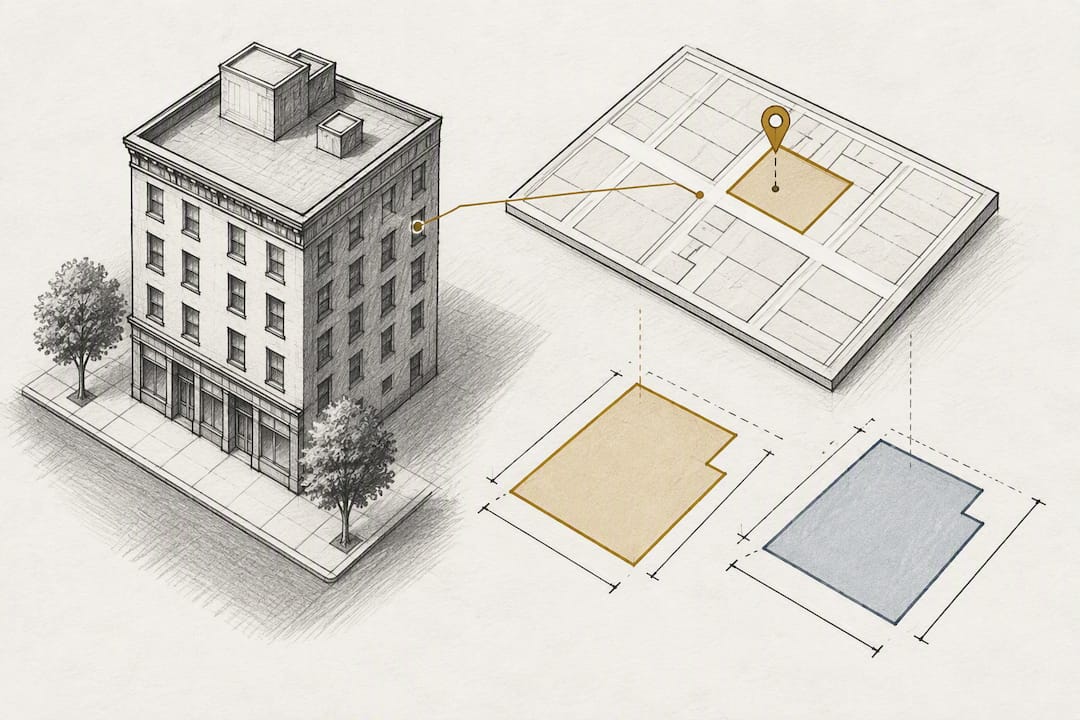
Combined reporting is one of the more useful, underused options on the CBL. For the 2024 through 2029 compliance period, DOB allows multiple buildings to file a single combined compliance report when they share the same owner, sit on the same or an adjacent lot, and follow the same compliance pathway. This can meaningfully cut down on paperwork for a campus-style property or a multi-building complex under single ownership.
Combined reporting is not free of tradeoffs, though. It simplifies filing volume, but it raises the evidentiary bar if the buildings do not actually share energy service. A shared boiler plant or shared electric service makes a combined report straightforward. Separate systems under one ownership structure make the combined submission harder to defend if DOB questions how emissions were allocated across the buildings.
When your recorded GSF or CBL status looks wrong, the dispute path runs through DOB directly, and it accepts a specific set of evidence:
- A certified re-measurement of the building's gross square footage
- A DOF correction to the underlying property record
- RDP certification confirming the building's actual configuration and use
File the dispute with supporting documentation rather than a general objection. DOB is working from records, and the fastest way to change a record is to hand it a better one, not to argue that the current one feels wrong.
What Does the BEAM Filing Process Actually Require?
Every Local Law 97 compliance report goes through the BEAM reporting portal, the DOB NOW module built specifically for LL97 filings. The baseline rule is one report per BIN. Combined reports are the exception, not the default, and they only apply under the ownership and pathway conditions covered in the CBL section above, and only for the initial 2024 through 2029 compliance period.
The templates you will encounter depend on your building's fuel mix and compliance pathway:
- Prescriptive Energy Conservation Measure (PECM) templates, required for buildings on the Article 321 prescriptive pathway rather than the standard emissions-limit pathway.
- CCD1 forms, required whenever a building uses non-standard fuels, since these establish the emissions coefficients DOB applies to that fuel source.
- Time-of-use (TOU) methodology documentation, relevant for buildings claiming adjustments tied to variable electricity pricing or load-shifting.
- Distributed energy resource (DER) documentation, for buildings with on-site generation, cogeneration, or renewable systems feeding into the building's energy profile.
- Beneficial electrification deduction templates, for owners who have converted fossil-fuel systems to electric and want that conversion credited against their emissions calculation.
A simple report covers most standard buildings: utility bills, a straightforward fuel mix, and no adjustment claims. That report moves through BEAM with the RDP attesting to accuracy and little else attached.
A complex report is a different animal. It applies to buildings claiming a 320.7 adjustment, using combined reporting, or relying on non-standard fuel or DER calculations. These filings need metering diagrams, hourly utility data, and, for TOU or DER claims, technical specifications that go well beyond a basic energy bill. If your building fits any of these categories, budget real time for gathering evidence, not just for the RDP's sign-off at the end.
Before submission, run through this checklist with your RDP: confirmed ESPM property type, complete twelve-month utility data, any required CCD1 or PECM templates attached, adjustment evidence packaged separately if applicable, and the RDP attestation itself signed and dated against the correct reporting year.
When Are Local Law 97 Filing Deadlines, and What Are the Penalties?
Reporting deadlines track the compliance year, not the calendar year you happen to be filing in. Calendar year 2024 data was due by May 1, 2025 for buildings on the standard Article 320 pathway, and that same May 1 filing rhythm carries forward for each subsequent compliance year under Article 320. Buildings on Article 321's 2026 or 2035 prescriptive tracks follow a separate timeline tied to their compliance milestone rather than the standard annual emissions report, though many still owe interim filings along the way.
An approved exception or adjustment does not necessarily mean no filing at all. Some excepted buildings, and buildings mid-demolition, still owe an annual attestation confirming their status, including confirmation that energy-using systems ceased operation by the end of the calendar year demolition began. Treating an exception as a reason to ignore BEAM entirely is exactly how owners end up contesting a penalty they didn't need to earn.
Buildings that exceed their annual emissions limit face a financial penalty calculated per ton of carbon dioxide equivalent above the allowed cap. That per-ton structure means the penalty scales directly with how far over the limit a building runs, not a flat fine, which is exactly why an adjustment that trims your effective limit by even a modest margin can be worth the documentation effort.
If your filing window is close and you are unsure whether an exception or adjustment applies, the priority order is simple: confirm CBL status first, engage an RDP second, and file something rather than nothing while the adjustment application is still in review.
Practical Steps for Claiming an Exemption or Adjustment
Getting from "I think we might qualify for something" to a BEAM-ready submission follows a fairly consistent sequence, regardless of which exception or adjustment you are pursuing.
- Confirm your BIN's status on the Covered Buildings List and cross-check the recorded GSF against your own property records before assuming coverage or exemption either way.
- Map your building to the correct Energy Star Portfolio Manager property type. DOB's 2026 shift to ESPM-based emissions limits means a misclassified property type can land you a tighter cap than your building actually operates under, and NYC Accelerator specifically flags this as one of the most common owner errors.
- Assess your regulatory status, including rent-stabilization percentage, any HPD regulatory agreement, and federal project-based assistance, since these determine whether Article 321's alternative pathways even apply to you.
- Engage a registered design professional early, not after a denial. An RDP's technical read on your building often reveals whether you have a real adjustment case or just a hope of one.
- Collect supporting documentation: utility data, meter diagrams, financial statements for hardship claims, and any LPC correspondence if landmark status is part of your argument.
- Prepare the BEAM upload with the correct templates attached and the RDP attestation finalized against the actual reporting year, not a placeholder date.
Several Bazini Engineering services map directly onto these steps. A compliance assessment can confirm CBL status and ESPM mapping before you file anything. RDP attestation and BEAM packaging support the technical documentation an adjustment application demands. Where a building needs equipment upgrades to actually reduce its emissions profile rather than just document a constraint, boiler and HVAC plant upgrade planning and permit filing support carry the project from paper to physical retrofit.
Pro Tip: Budget more calendar time than you think you need. RDP review of a complex adjustment application often takes several weeks on its own, LPC coordination for landmarked buildings can add months, and CPA financial attestations require two full years of statements assembled and reconciled before anyone signs off.
Why Owners Should Treat LL97 Exemptions as the Exception, Not the Plan
Too many owners approach Local Law 97 hoping their building fits some category that makes the whole problem disappear. It almost never does. DOB built this law around narrow exceptions and a documented adjustment process precisely because a blanket exemption would gut the emissions targets the law exists to hit. Treating an assumed exemption as your compliance strategy is a bet against DOB's own recordkeeping, and that is a bet you tend to lose after the filing deadline has already passed.
The owners who come out ahead are the ones who get an engineering review early and let the evidence determine the pathway, rather than deciding on an outcome and searching for paperwork to justify it. RDP-backed documentation is not a formality DOB tolerates. It is the entire mechanism by which an adjustment gets approved instead of rejected.
Keep a paper trail of every decision, every BEAM submission, and every piece of correspondence with DOB, HPD, or LPC. When an adjustment period ends or a pathway shifts, that record is what lets you argue your position again instead of starting from zero.
— Joseph
How Bazini Engineering Supports Your Local Law 97 Filing
Some firms offer comprehensive Local Law 97 filing support by managing the technical aspects in house across mechanical, electrical, plumbing, and fire protection disciplines, so that adjustment applications, RDP attestations, and retrofit scopes come from a single coordinated team rather than multiple separate vendors.
A typical engagement starts with a compliance assessment: confirming your CBL status, checking your ESPM property mapping, and identifying whether your building has a real case for an Article 320.7 adjustment or simply needs a standard filing. From there, Local Law 97 compliance services cover RDP attestation, BEAM template packaging, and coordination with DOB on the technical evidence a complex report requires. Where a building's actual path forward is a retrofit rather than an adjustment claim, the same team handles boiler and HVAC plant upgrade planning and permit filing.
Engagement scope and cost vary by building size and the complexity of the filing, so pricing runs on a per-project basis rather than a flat rate. If your filing window is approaching or you are not sure which pathway applies, reach out through the Local Law 97 compliance page to start a building assessment.
This article is general information, not a substitute for advice from a qualified lawyer. Consult a qualified legal professional about your own circumstances before acting on anything here.
FAQ
Who Does Local Law 97 Apply To?
Local Law 97 applies to buildings over 25,000 gross square feet, or multiple buildings on one tax lot exceeding 50,000 GSF combined. Coverage is based on DOF property records, so owners near either threshold should verify their building's recorded square footage rather than assume coverage status.
Is Local Law 97 Still in Effect?
Yes, Local Law 97 is active and enforced, with emissions limits currently running through the 2024 to 2029 compliance period under Article 320. A tighter set of limits takes effect for 2030 through 2034, and affordable housing under Article 321 follows separate 2026 and 2035 milestone tracks.
How Do I Apply for a Local Law 97 Adjustment?
Adjustments under Article 320.7 require an RDP or CPA attestation, supporting documentation specific to your claimed constraint, and submission through the BEAM portal. Engage a registered design professional before applying, since DOB validates every claim against the technical evidence submitted and can request additional documentation during review.
What Is the Difference Between Local Law 87 and Local Law 97?
Local Law 97 sets actual emissions limits with financial penalties for exceeding them, while its predecessor established requirements to identify energy efficiency opportunities, making the earlier law a diagnostic requirement and Local Law 97 the enforceable compliance law that follows from it.
Can a Building Be Fully Exempt From Local Law 97?
A small number of categories, including city-owned buildings, NYCHA properties, and houses of worship, fall outside LL97's emissions limits. Most other buildings that assume they qualify for an exemption actually need to pursue a documented adjustment under Article 320.7 instead of a true exception.