
If your building is not classified R-3 (one- or two-family homes), Local Law 152 gas inspections almost certainly apply to you. The immediate move is simple: find your community district's inspection year, hire a Licensed Master Plumber (LMP), and track your GPS1 and GPS2 filing windows before they close.
TL;DR:
- Buildings outside the R-3 classification must conduct gas piping inspections every four years, with specific deadlines based on community district schedules.
- Owners must hire a qualified Licensed Master Plumber, verify their credentials, and ensure the inspection report and certification are submitted on time to avoid penalties.
- Inspections only cover exposed gas piping and do not include concealed, buried, or private tenant space piping, which can cause misunderstandings and scheduling issues.
- Missing the 30-day GPS1 report delivery or the 60-day GPS2 submission deadlines exposes owners to enforcement actions, penalties, and future permit delays.
- Corrective actions for leaks or illegal connections require immediate notification, proper documentation, and completion within a 120-180 day correction window.
Table of Contents
- What Is Local Law 152 and Does Your Building Need a Gas Inspection?
- What Do Gas Piping Inspections Actually Cover?
- When Are GPS1 and GPS2 Due, and What Happens if You Miss the Deadline?
- Who Is Qualified to Perform Local Law 152 Inspections?
- How Do You File GPS1 and GPS2 Without Getting Rejected?
- What Happens if an Inspection Finds a Gas Leak or Illegal Connection?
- What Are the Most Common Compliance Mistakes Owners Make?
- How Bazini Engineering Supports Building Owners Through LL152
- The Playbook Beats the Panic
- Get Help Completing Your Local Law 152 Compliance
- Official Resources Worth Bookmarking
- Sources
What Is Local Law 152 and Does Your Building Need a Gas Inspection?
Local Law 152 of 2016 requires periodic gas piping inspections for nearly every occupancy type in New York City. Only one- and two-family homes and other R-3 occupancies are excluded. If your property is a multifamily building, mixed-use structure, commercial building, or institutional facility, you're on the hook.
The standard industry term for this work is a "periodic gas piping system inspection," though most owners and vendors just call it an LL152 or LL152 gas inspection. Whatever you call it, the underlying legal requirement is the same: gas piping systems in covered buildings must be inspected at least once every four years according to a schedule tied to your community district.
Here's the compliance sequence in full, so you can hand it to a property manager or contractor without translation:
- Confirm applicability. Pull your building's Certificate of Occupancy or check your Department of Finance property classification. If it lists anything other than a one- or two-family R-3 designation, Local Law 152 requirements apply to you.
- Determine your cycle year. The Department of Buildings assigns each community district a four-year inspection window. Check the DOB's published schedule for your district so you know which calendar year your building falls into. Missing your assigned year doesn't erase the obligation. It just makes you late.
- Hire a Licensed Master Plumber. This is not optional and not interchangeable with a general contractor or handyman. Verify the LMP's license status, confirm active insurance, and ask directly whether they've handled LL152 gas piping inspections before. A firm that's filed dozens of GPS2 certifications will move faster and make fewer mistakes than one filing its first.
- Schedule the inspection and leak survey. The LMP (or a qualified technician working under their supervision) physically walks the exposed gas piping and runs a combustible gas detector survey.
- Receive your GPS1 report. The LMP must deliver this report to you, the owner, within 30 days of completing the inspection.
- Submit GPS2 to the DOB. You, the owner, are responsible for submitting the GPS2 certification within 60 days of the inspection, signed and sealed by the LMP who performed or supervised the work.
- If there's no gas piping, file the exemption certification. Buildings with no gas piping at all still need documentation. A Registered Design Professional (RDP) or LMP can certify "no gas piping" status, and that certification also runs on a four-year cycle.
Two deadlines matter more than any others in this whole process: the 30-day GPS1 delivery and the 60-day GPS2 submission. Miss either one and you're already exposed to a compliance gap, even if the inspection itself went fine.
What Do Gas Piping Inspections Actually Cover?
Local Law 152 gas inspections have a specific, limited scope, and understanding it saves owners from unnecessary tenant disruption and wasted coordination effort.
Exposed gas piping is piping visible from the point where gas enters the building through public areas, hallways, mechanical rooms, and rooftops. Inspectors trace this piping and note its condition, corrosion, unauthorized modifications, and connection integrity.
What the inspection does not cover matters just as much:
- Piping concealed inside walls, floors, or ceilings is excluded from the visual inspection.
- Piping located entirely within a tenant's private space is excluded, so inspectors generally don't need apartment access unless piping runs through a shared or exposed area within that unit.
- Buried or underground piping outside the building envelope falls outside LL152's inspection scope.
- The leak survey uses a combustible gas detector and terminates at the point where piping enters a tenant's private space, not beyond it.
That tenant-space boundary trips up a lot of owners. Many assume LL152 means inspectors walking through every apartment, and that assumption alone has caused avoidable friction with tenants and unnecessary scheduling headaches. The DOB's own guidance clarifies that tenant space piping is excluded, so there's no need to promise building-wide unit access to get this done.
If the LMP finds an active gas leak or an illegal connection classified as a Class A hazardous condition, that's not something that waits for the GPS1 paperwork. It requires immediate notification to the utility and the Department of Buildings, on the spot.
When Are GPS1 and GPS2 Due, and What Happens if You Miss the Deadline?
The entire compliance clock runs on a few fixed windows, and missing any one of them creates real financial exposure.
Every covered building sits inside a four-year inspection cycle assigned by community district. Once your inspection happens, two deadlines kick in automatically: the LMP owes you a GPS1 report within 30 days, and you owe the DOB a GPS2 certification within 60 days of the inspection date.
If the inspection turns up deficiencies, correction timelines follow a separate clock.
1 RCNY §103-10 governs the full set of these rules: inspection schedule, scope, submission windows, and correction timelines. It's the actual regulatory text behind everything the DOB's FAQ pages summarize, and it's worth bookmarking if you manage more than one property.
The penalty side is where owners get caught off guard. Failing to file on time doesn't just risk a warning. Owners who miss the applicable due date can receive a Notice of Deficiency and face civil penalties for failure to file. Those penalties accumulate the longer a building stays unfiled, and a Notice of Deficiency on record complicates future permit applications and sales.
Who Is Qualified to Perform Local Law 152 Inspections?
Not just anyone with a plumbing background can sign off on a gas piping inspection, and verifying credentials before hiring saves you from a rejected filing months later.
- The Licensed Master Plumber (LMP) is the only professional authorized to certify a full gas piping inspection under Local Law 152.
- A qualified technician can perform the physical inspection, but only while working directly under an LMP's supervision. The LMP still signs and seals the final report.
- A Registered Design Professional (RDP) can sign the "no gas piping" certification for buildings without gas piping systems, as an alternative to an LMP.
- Before hiring, run a license lookup through the DOB's license search tool to confirm the LMP's status is active and check for any disciplinary history.
- Ask for proof of current liability insurance and direct experience with LL152 gas authorization filings specifically, not just general plumbing work.
A license that looks valid on paper but carries an open disciplinary action is a red flag DOB reviewers will catch eventually, even if you don't catch it first.
How Do You File GPS1 and GPS2 Without Getting Rejected?
Filing mechanics trip up more owners than the actual inspection does. Here's the sequence that avoids the most common rejections.
- Confirm the GPS1 format. The GPS1 report must be typewritten, not handwritten, and it must document the LMP's observed conditions accurately. Falsifying or carelessly submitting incorrect information on this form carries real professional and legal consequences for the signing LMP.
- Verify the report includes every required field. Inspection date, LMP license number, building address, and the LMP's signature and seal all need to be present before submission. A missing seal is one of the most common reasons filings bounce back.
- Submit GPS2 through the DOB's online portal. The DOB's eRenewal system handles GPS2 certification submissions directly. Upload the signed, sealed documentation exactly as the LMP prepared it.
- Request the 180-day extension early if you need it. Owners can apply for one 180-day extension of the inspection deadline per cycle through the same DOB channel. Waiting until the deadline has already passed to request this defeats the purpose.
Pro Tip: Save a scanned copy of the sealed GPS1 report the moment you receive it. Portal uploads fail more often over corrupted or incorrectly formatted files than over missing information, and having a clean backup file saves a same-day resubmission scramble.
What Happens if an Inspection Finds a Gas Leak or Illegal Connection?
A clean inspection report is the goal, but plenty of buildings turn up something that needs fixing before GPS2 can be filed as complete.
- If the LMP finds an active gas leak or a Class A illegal connection, notify the gas utility and the DOB immediately. This isn't a "note it and move on" situation.
- The GPS1 report documents every condition found, including deficiencies, and that documentation becomes the baseline for what GPS2 needs to show as corrected.
- Once repairs are identified, hire a contractor, secure any required permits, and complete the corrective work inside the 120-day standard window (or up to 180 days when the DOB grants extra time for justified circumstances).
- Submit a follow-up GPS2 confirming the correction once the work is done and inspected again.
- Keep every permit, invoice, and contractor communication tied to the correction in one file. If DOB ever questions the certification timeline, that paper trail is your proof.
Owners who treat a deficiency finding as a scheduling emergency, rather than paperwork to handle "eventually," are the ones who stay inside the 120 or 180-day window without penalty exposure.
What Are the Most Common Compliance Mistakes Owners Make?
The building owner carries ultimate legal responsibility for Local Law 152 compliance, even when a super, property manager, or outside contractor handles the actual coordination. That responsibility doesn't transfer just because someone else touched the paperwork.
- Access failures cause more failed certifications than actual gas piping problems. LMPs are not permitted to certify an inspection as complete if they couldn't access the areas they needed to inspect, so a locked mechanical room or an uncooperative tenant can stall your entire filing.
- Retain every GPS1 and GPS2 form, permit, and receipt. DOB audits happen, and reconstructing a compliance history two years later from memory is far harder than pulling a labeled folder.
- Scheduling too close to the deadline is the single most avoidable mistake. Booking an LMP with weeks to spare, rather than days, gives you room to fix access issues or deficiencies without blowing past your window.
- Confirm credentials before, not after, the inspection happens. An uncertified or improperly supervised inspection can force a full redo, costing you both the fee and the calendar time.
Pro Tip: Notify your superintendent and post tenant notices about the inspection date at least a week ahead. Access coordination, not the technical inspection itself, is where most LL152 filings stall out.
How Bazini Engineering Supports Building Owners Through LL152
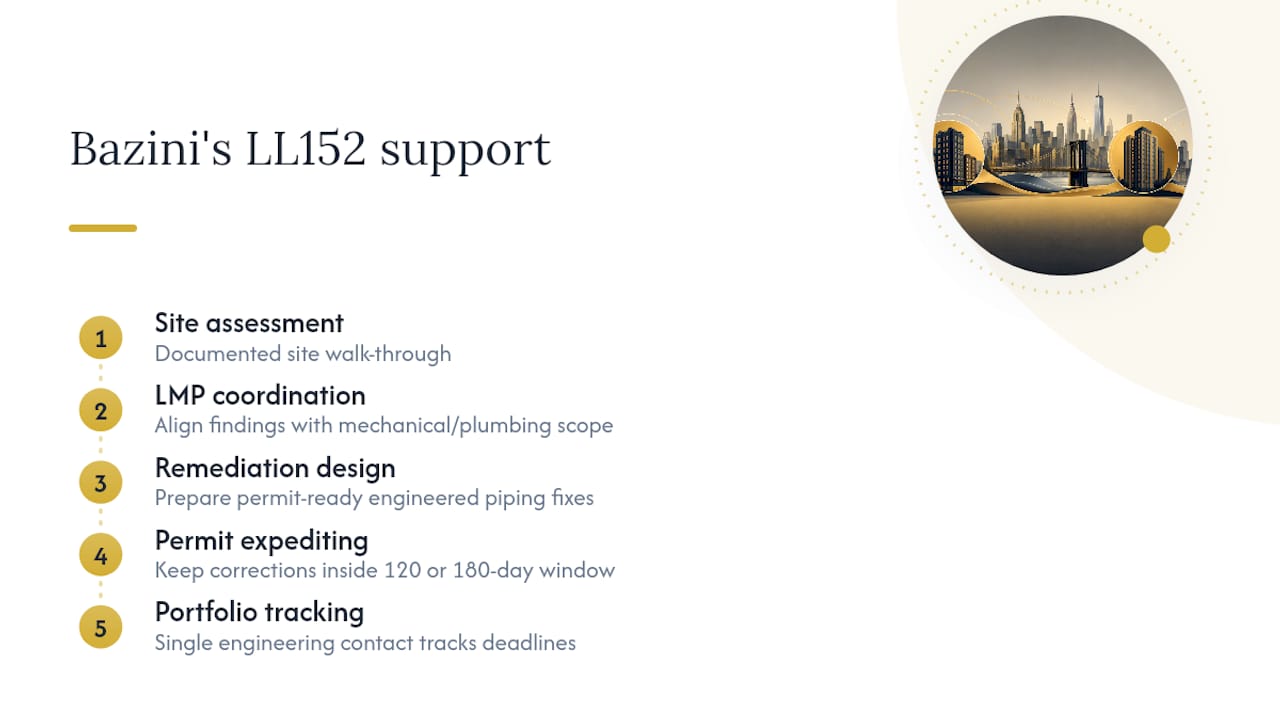
Coordinating a Local Law 152 gas inspection often surfaces issues that go beyond what an LMP alone can resolve, particularly when corrections require permit-ready design work. Baziniengineering supports owners through site assessments, coordination with the LMP performing the inspection, and preparation of remediation designs when corrective piping work needs an engineered solution before a contractor can pull a permit.
A typical engagement includes a documented site walk-through, coordination between the LMP's findings and any required mechanical or plumbing scope changes, and permit expediting support to keep corrections inside the 120 or 180-day certification window. For owners managing multiple properties across different community district cycles, having one engineering point of contact tracking deadlines across a portfolio removes a significant coordination burden.
The Playbook Beats the Panic
Most owners treat Local Law 152 like a one-time fire drill: scramble when the letter arrives, hire whoever answers the phone first, and hope the paperwork clears. That approach is backwards. The four-year cycle is public information, and any owner who checks their community district's schedule early has months, not days, to line up a qualified LMP and build slack into the correction timeline if something turns up.
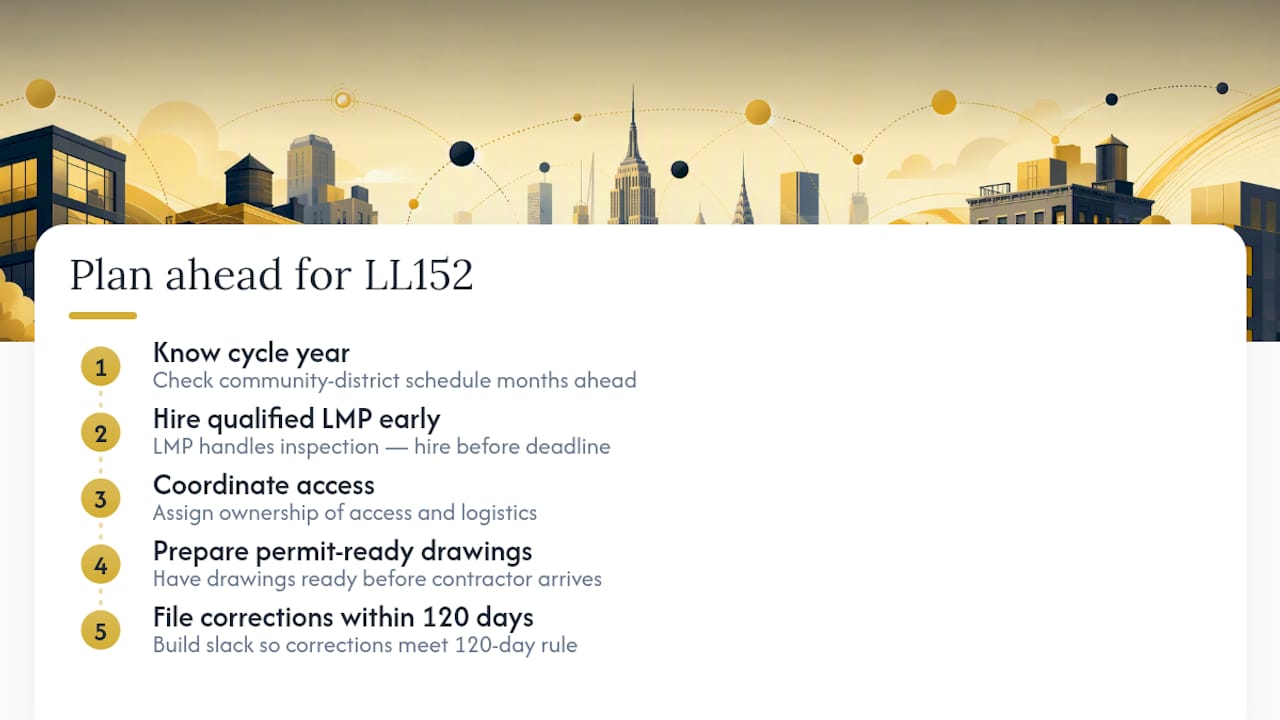
The conventional advice tends to stop at "hire a licensed plumber and file on time." That's necessary but incomplete. The real risk sits in the gaps between steps: access coordination that nobody owns, GPS1 reports that arrive typewritten but incomplete, and corrections that stall because nobody lined up permit-ready drawings before the contractor showed up. A qualified LMP handles the inspection. Getting from a flagged deficiency to a filed correction inside 120 days usually takes more coordination than a plumber alone provides.
If there's one thing owners should prioritize first, it's this: know your cycle year before the DOB has to remind you. Everything else on this checklist gets easier once that single fact is locked in.
— Joseph
Get Help Completing Your Local Law 152 Compliance
Handling GPS1 documentation, LMP coordination, and correction deadlines on top of everything else running a building demands is a lot to carry alone, especially when a deficiency finding suddenly puts you on a 120-day clock. Baziniengineering works alongside the LMP performing your inspection to handle the piece that often stalls corrections: permit-ready design work.
When an inspection turns up a condition that needs more than a repair, a corroded run that needs rerouting, a connection that needs re-engineering, having a firm that can produce permit sets and coordinate directly with the Department of Buildings keeps your correction window from slipping. Baziniengineering's plumbing engineering services cover exactly this kind of remediation design, and the firm's broader engineering services include permit expediting support so corrective work doesn't stall waiting on DOB review. If your building has an upcoming inspection cycle or a deficiency that needs an engineered fix, reach out to Baziniengineering to scope an assessment before your correction deadline gets tight.
Official Resources Worth Bookmarking
Keep these on hand for the life of your building's compliance cycle. The DOB's gas piping inspections page covers the cycle schedule and general requirements. The LL152 FAQ PDF walks through GPS1 and GPS2 timing in plain language. 1 RCNY §103-10 is the actual rule text governing scope and deadlines. The GPS1 form guidance explains formatting requirements, and the DOB eRenewal portal is where GPS2 certifications and extension requests actually get filed.