
LEED certification is a third-party verified green building rating issued by Green Business Certification Inc. (GBCI) under standards set by the U.S. Green Building Council (USGBC), and it proves that a building meets defined thresholds for energy, water, materials, and occupant health. To earn any level of certification, a project must score a minimum of 40 points on the LEED scorecard.
Three things worth knowing before you go further:
- What it proves: That your building's design and operations meet independently verified sustainability benchmarks, not just a self-reported claim.
- Who verifies it: GBCI conducts the technical review; USGBC sets the credit standards and maintains the rating system.
- Typical next step: Pick the right rating system for your project type, then register on the correct platform (LEED Online or Arc) to lock in your version and begin building a scorecard.
Table of Contents
- Who manages LEED and how does the system work?
- Which LEED rating system fits your project?
- How does LEED scoring work, and what are the certification levels?
- What does the LEED certification process actually look like?
- What platforms and tools do LEED project teams use?
- What credit categories make up the LEED scorecard?
- What are the real benefits of LEED, and where does it fall short?
- How do you get a LEED project started?
- How MEP/FP engineering supports LEED success
- Key Takeaways
- Why the conventional wisdom on LEED misses the point
- Baziniengineering supports your LEED project from design through certification
Who manages LEED and how does the system work?
The USGBC and GBCI play distinct roles that are worth keeping straight. USGBC writes the standards, maintains the LEED credit library, and publishes the reference guides that define what qualifies for each point. GBCI is the independent certification body that actually reviews submitted documentation and issues the certificate. Think of USGBC as the rule-maker and GBCI as the auditor.
LEED is a voluntary, market-driven rating system, not a building code. Most projects pursue it because owners, tenants, or investors want the market signal. That said, some U.S. federal projects and a growing number of state and municipal programs either require LEED or accept it in place of equivalent green building compliance. The distinction between "voluntary" and "effectively required" depends heavily on your project's funding source and jurisdiction.
The system is organized into distinct rating systems (more on those below), and it has gone through several major versions. LEED v4 and v4.1 are the current active versions for most project types. LEED v5 was finalized in April 2025, with an explicit focus on operational performance, climate resilience, and circular-economy principles. Version selection matters because it determines which platform you use, which prerequisites apply, and how credits are structured.
Which LEED rating system fits your project?
Choosing the wrong rating system early is one of the most common and costly mistakes a project team can make. Each system has its own prerequisites, credit weightings, and documentation requirements.
- BD+C (Building Design and Construction): For new construction and major renovations. This is the most commonly used system and includes specialty tracks for schools, healthcare, data centers, warehouses, and core-and-shell projects.
- ID+C (Interior Design and Construction): For interior fit-outs where the tenant or designer controls the space but not the base building. Retail, commercial interiors, and hospitality projects typically land here.
- O+M (Operations and Maintenance): For existing buildings focused on improving operational performance. Recertification under O+M requires a 12-month performance period to validate operational data.
- Homes: For single-family and low-rise multifamily residential projects. Uses a different point scale and a different review process than commercial tracks.
- ND (Neighborhood Development): For land development projects and mixed-use neighborhoods, integrating smart growth and new urbanist principles.
- Cities and Communities: For broader planning efforts at the district or municipal scale, covering infrastructure, transportation, and quality-of-life metrics.
BD+C and ID+C projects currently run on LEED v4 or v4.1 using LEED Online. LEED v5 projects use the Arc platform. If you are starting a new BD+C project today, confirm with your team whether to register under v4.1 or v5, since that decision shapes every documentation step that follows.
How does LEED scoring work, and what are the certification levels?
The LEED scorecard has two types of requirements: prerequisites and credits. Prerequisites are mandatory. You cannot earn any certification level without satisfying every prerequisite in your chosen rating system, and they carry no points. Credits are optional, each worth a defined number of points, and your team selects which ones to pursue based on project design, budget, and feasibility.
A minimum number of points is required for basic LEED certification. Points accumulate across credit categories, and the total determines your certification level.
The four certification levels under LEED v4/v4.1 BD+C are:
| Level | Points Required |
|---|---|
| Certified | 40–49 |
| Silver | 50–59 |
| Gold | 60–79 |
| Platinum | 80+ |
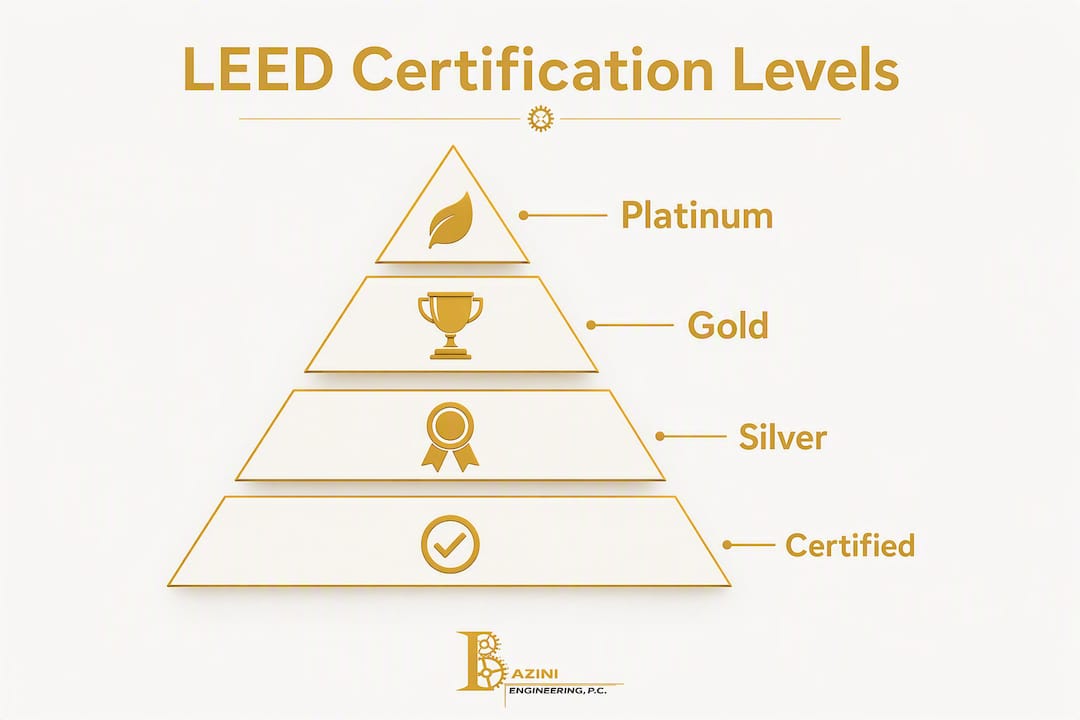
Point thresholds can vary slightly across rating systems and versions; always check the LEED Reference Guide for your version. A team targeting Gold should build a scorecard with a buffer of 5–8 points above the threshold to account for credits that may be denied in GBCI's review.
What does the LEED certification process actually look like?
The LEED certification process for commercial projects follows four primary stages: register, apply, review, and certify. Here is what each stage involves in practice:
- Select your rating system and confirm Minimum Program Requirements (MPRs). MPRs define basic eligibility: the building must be a permanent structure, occupy a permanent location, and meet minimum floor area and occupancy thresholds. Confirm these before spending a dollar on registration.
- Register the project. Pay the registration fee on LEED Online (v4/v4.1) or Arc (v5). Registration locks in your rating system, version, and project team. Fee amounts vary by project size and rating system.
- Build the LEED scorecard and assign credits. Each credit gets assigned to a responsible team member. This is where MEP engineers, architects, and the commissioning agent divide documentation responsibilities.
- Collect documentation and submit your application. For BD+C projects, teams typically submit a design review (covering design-phase credits) and a construction review (covering construction-phase credits) separately, or combine them. Documentation includes energy models, commissioning reports, material specifications, construction records, and MPR compliance evidence.
- GBCI technical review. GBCI performs a preliminary review and issues a preliminary decision on each credit. Teams can respond to denied credits with clarifications before the final review is issued.
- Supplemental or appeal review if needed. If a credit is denied after the final review, teams can request a supplemental review for an additional fee. One practical note: if a denied credit is tied to a prerequisite, addressing the prerequisite first can reduce administrative back-and-forth and speed resolution.
- Accept certification and market it. Once GBCI issues the certificate, the project can use the LEED plaque and logo in marketing materials. An optional precertification pathway is also available for select BD+C and v4.1 O+M projects before construction completes, valid for three years, which helps attract tenants and financing early.
On budget: soft costs to pursue LEED have historically ranged from roughly 1%–6% of total project cost, with many projects landing near the lower end of typical cost ranges. Registration and certification review fees scale with gross floor area and rating system. Build in time for preliminary review responses; a typical BD+C design review can take several weeks, and construction review adds additional time on top.
What platforms and tools do LEED project teams use?
Platform selection is not optional. It follows directly from your version choice, and the workflows are meaningfully different.

LEED Online is used for v4 and v4.1 projects. It is where teams register, upload documentation, track credit status, and submit applications for GBCI review. Most active commercial projects in the U.S. today still run through LEED Online.
Arc is the platform for LEED v5 projects and also supports performance tracking for O+M recertification. Arc collects ongoing operational data (energy, water, waste, transportation, human experience) and translates it into a performance score. For teams pursuing v5, Arc is not just a submission portal; it is an active data management tool throughout the building's life.
Beyond the platforms, two resources belong on every project team's desk: the LEED credit library on the USGBC website, which contains the authoritative credit language, compliance paths, and submittal templates for every credit; and the LEED Reference Guide for the applicable rating system and version, which provides detailed technical guidance, calculation methods, and documentation examples. When a reviewer denies a credit, the Reference Guide is where you find the compliance path you may have missed.
What credit categories make up the LEED scorecard?
LEED credit categories cover the full range of building performance, from energy use to occupant comfort. Each category contains prerequisites and optional credits.
| Category | What It Rewards | Example Credits |
|---|---|---|
| Energy & Atmosphere | Reduced energy use, renewable energy, commissioning | Optimized energy performance (energy model), enhanced commissioning, on-site renewables |
| Water Efficiency | Reduced potable water use, metering | Outdoor water reduction, building-level water metering, indoor fixture efficiency |
| Materials & Resources | Reduced waste, responsible sourcing, reuse | Construction waste management, recycled content, building product disclosure |
| Indoor Environmental Quality (IEQ) | Occupant health, comfort, air quality | Enhanced ventilation, low-VOC materials, thermal comfort, daylight and views |
| Sustainable Sites | Site ecology, stormwater, heat island | Rainwater management, heat island reduction, light pollution reduction |
| Integrative Process | Early cross-discipline coordination | Discovery process credit for pre-design analysis |
| Innovation | Exemplary performance, pilot credits | Innovation in design, LEED Accredited Professional on team |
| Regional Priority | Location-specific environmental priorities | Varies by ZIP code; USGBC designates 4 credits per region |
One distinction that affects MEP scope directly: prescriptive credits require meeting a defined specification (a particular product standard, a minimum efficiency rating), while performance-based credits require modeling or measured data to demonstrate a quantified outcome. Energy modeling for the Optimized Energy Performance credit is the most resource-intensive example of the latter, and it drives a significant portion of the MEP engineering scope on most BD+C projects.
What are the real benefits of LEED, and where does it fall short?
Benefits worth knowing:
- Market differentiation: LEED-certified buildings tend to command higher rents and occupancy rates in competitive markets, particularly for Class A office and multifamily.
- Tenant and investor attraction: sustainability credentials increasingly appear in corporate real estate requirements and ESG reporting frameworks.
- Potential incentives: some U.S. jurisdictions offer tax abatements, density bonuses, or expedited permitting for LEED-certified projects. New York City is one example where green building performance intersects with regulatory programs like Local Law 97.
- Improved occupant health: IEQ credits targeting ventilation, low-VOC materials, and thermal comfort have measurable effects on occupant productivity and satisfaction.
- Lifecycle cost alignment: when design and operations are coordinated from the start, energy and water savings often offset soft costs over a 5–10 year horizon.
Limitations to weigh honestly:
- LEED has historically allowed certification based on modeled rather than measured performance. A building can earn Platinum on paper and underperform operationally if the energy model assumptions do not reflect actual use patterns.
- Point-chasing is real. Teams sometimes pursue credits that are easy to document but have minimal environmental impact, while skipping harder credits with greater real-world benefit.
- Regional and climate specificity gaps exist. A credit that makes sense in Phoenix may be irrelevant in Minneapolis, and the Regional Priority category only partially addresses this.
LEED v5's intent to close the gap between design-intent scoring and actual operational performance directly addresses the first two criticisms. Whether it succeeds in practice will depend on how project teams and reviewers apply the new performance requirements.
How do you get a LEED project started?
The decisions made in the first four weeks of a project determine roughly 80% of what is achievable on the LEED scorecard. Here is a practical starter checklist:
- Pick the rating system and version before any design work begins. Confirm with your team whether LEED v4.1 or v5 applies to your project type.
- Verify MPRs for the specific building: floor area, occupancy, and site permanence requirements must be met before registration.
- Register on the correct platform (LEED Online for v4/v4.1; Arc for v5) and pay the registration fee.
- Set a preliminary scorecard with a target level and a 5–8 point buffer. Identify which credits are "likely," "possible," and "stretch."
- Assign credit ownership to specific team members: architect, MEP engineers, commissioning agent, contractor, and owner's representative each carry defined documentation responsibilities.
On team roles: the owner or developer sets the certification target and budget. The architect leads site, materials, and IEQ credits. MEP engineers own energy modeling, mechanical system design, plumbing efficiency, and commissioning documentation. The commissioning agent is a separate, independent role required for certain EA prerequisites. The general contractor manages construction-phase documentation for waste management, material sourcing, and indoor air quality during construction.
Budget guidance: allocate soft costs for energy modeling, commissioning, and documentation management early. These are not optional line items for a serious LEED project. Also plan schedule buffers for preliminary review responses, typically several weeks per review cycle.
Pro Tip: Bring the commissioning agent and MEP engineers into the project at schematic design, not after design development. Credits that require early energy analysis or cross-discipline coordination cannot be retroactively earned, and late engagement is the single most common reason projects miss their target level.
How MEP/FP engineering supports LEED success
MEP and fire protection engineering sit at the center of LEED credit achievement, not at the edges. The credits with the highest point values in most BD+C scorecards are energy-related, and energy credits are almost entirely driven by mechanical system selection, controls strategy, and the quality of the energy model.
Baziniengineering's scope on a LEED project typically covers:
Energy & Atmosphere credits: HVAC system selection (variable refrigerant flow, dedicated outdoor air systems, high-efficiency chillers and boilers) directly determines the energy model baseline and the achievable points under Optimized Energy Performance. Controls strategies, including demand-controlled ventilation and occupancy-based setbacks, are documented through the commissioning process.

Water Efficiency credits: Plumbing fixture selection and domestic water system design drive indoor water use reduction credits. Plumbing engineering that specifies WaterSense-labeled fixtures and submetering at the building level satisfies both prescriptive and metering credits simultaneously.
Commissioning: Enhanced commissioning is a prerequisite or high-value credit in most BD+C projects. Baziniengineering coordinates commissioning scope with the independent commissioning agent, ensuring that HVAC, plumbing, and electrical systems are tested and documented to LEED's requirements.
Materials & Resources: MEP specifications for equipment and materials contribute to building product disclosure credits when manufacturers provide Environmental Product Declarations (EPDs) and Health Product Declarations (HPDs).
Local Law 97 alignment: For New York City projects, Local Law 97 compliance work and LEED energy credits often overlap. An energy audit and retrofit scope that reduces carbon emissions under LL97 typically also improves the energy model performance for LEED purposes, making the two programs complementary rather than duplicative.
Baziniengineering has been providing MEP/FP engineering services since 2010, licensed in New York and Florida, with direct experience coordinating permit filings with the NYC Department of Buildings and FDNY. That regulatory familiarity matters on LEED projects, where documentation errors caught late in the process can delay certification by months.
Key Takeaways
LEED certification requires a minimum of 40 points, third-party verification by GBCI under USGBC standards, and careful credit selection matched to your project type, version, and team capabilities.
| Point | Details |
|---|---|
| Minimum score to certify | A project must earn at least 40 points; Silver starts at 50, Gold at 60, Platinum at 80. |
| Rating system selection matters | Choose BD+C, ID+C, O+M, Homes, ND, or Cities based on project type before registering. |
| Platform follows version | Use LEED Online for v4/v4.1 projects; use Arc for LEED v5 projects. |
| MEP engineering drives top credits | Energy, water, and commissioning credits represent the highest-value points on most scorecards. |
| Baziniengineering as your MEP partner | Baziniengineering provides HVAC, plumbing, commissioning coordination, and LL97 services that map directly to LEED credit achievement. |
Why the conventional wisdom on LEED misses the point
Most articles about LEED certification treat it as a documentation exercise. Get the paperwork right, hit 40 points, hang the plaque. That framing produces exactly the kind of projects LEED v5 was designed to correct: buildings that score well on paper and perform poorly in operation.
The more useful frame is this: LEED is a coordination discipline. The projects that achieve Gold or Platinum without cost overruns are the ones where the owner set a target at project kickoff, the MEP engineers were in the room during schematic design, and the commissioning agent was scoped before design development. The certification follows from that coordination. It does not create it.
Three pitfalls I see repeatedly on projects that struggle:
Late commissioning engagement. Commissioning agents brought in after construction documents are issued cannot influence system design. They can only verify what was built. Bring them in at schematic design.
Inconsistent documentation. A credit denied because the energy model used different assumptions than the mechanical specifications is not a technical failure. It is a coordination failure. Assign one person to own the credit matrix and reconcile documentation across disciplines before submission.
Misaligned energy model assumptions. The energy model is only as good as the inputs. If the mechanical engineer's equipment selections change after the model is run, the model must be updated. Teams that treat the energy model as a one-time deliverable rather than a living document routinely lose points they thought they had.
LEED v5's stronger emphasis on measured operational performance will raise the stakes for all three of these. The teams that build good coordination habits now will be better positioned when v5 becomes the standard.
Baziniengineering supports your LEED project from design through certification
MEP/FP engineering is where most LEED points are won or lost, and Baziniengineering delivers the full scope of services that map directly to credit achievement: HVAC and mechanical system design, plumbing engineering, fire suppression, energy code compliance, commissioning coordination, and Local Law 97 audits for New York City projects.
The firm has been working on commercial, residential, institutional, and industrial projects since 2010, licensed in New York and Florida, with direct experience filing with the NYC Department of Buildings and FDNY. That means your LEED documentation and your permit drawings come from the same engineering team, reducing the coordination gaps that derail certification timelines.
If you are planning a new construction, renovation, or existing building recertification and want MEP engineering that is scoped to your LEED target from day one, review Baziniengineering's services or reach out directly at baziniengineering.com to request a project consultation.