
TL;DR:
- Negotiating an engineering services contract aligns scope, risk, and responsibilities to protect project budgets and legal exposure.
- Using standard frameworks like AIA B101 or EJCDC 2026, property owners should clarify scope, standard of care, compensation, and fault-based indemnity.
Negotiating an engineering services contract is the process of aligning scope, compensation, risk, and responsibilities between a property owner and an engineering firm before work begins. Property owners and developers who skip this process often face cost overruns, scope disputes, and unresolved liability gaps. The industry standard term for this process is "engineering services contract negotiation," and it draws on established frameworks including the AIA B101, AIA C401, and EJCDC 2026 document families. Getting this right protects your project budget, your timeline, and your legal exposure from day one.
What essential terms should you negotiate in an engineering services contract?
The most important terms to negotiate in any engineering service agreement are scope of services, standard of care, compensation structure, risk allocation, and dispute resolution. Each one directly affects what you get, what you pay, and who is responsible when something goes wrong.
Scope of services defines every deliverable the engineer must produce. Vague scope language is the single most common cause of scope creep and billing disputes. Spell out phases, drawing sets, site visits, and coordination meetings explicitly.
Standard of care is the legal benchmark for how well an engineer must perform. AIA B101 §2.2 defines this as "professional skill and care ordinarily provided" by similarly situated professionals. This is not a guarantee of perfection. Accepting contract language that promises an absolute result or a warranty exposes the engineer to uninsurable liability, which ultimately becomes your problem when their insurer denies a claim.
Compensation structure covers fee type, payment schedule, and statutory limits. Under DFARS Part 236, design fees are capped at 10% of estimated construction costs for U.S. federal architect-engineer contracts. That ceiling shapes expectations even on private projects where similar benchmarks apply.
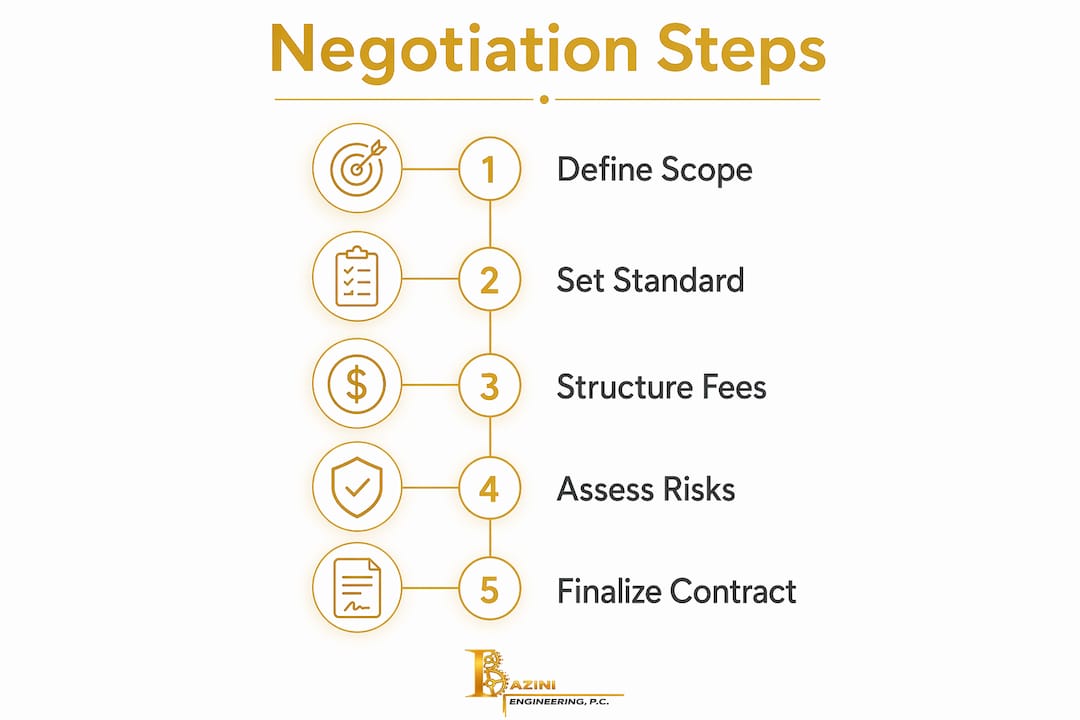
Risk allocation covers indemnity clauses, liability caps, and insurance requirements. Broad-form indemnity provisions often exceed what design professionals can insure against. Negotiate fault-based indemnity language that ties each party's exposure to their actual percentage of fault.
Dispute resolution should specify the sequence: negotiation first, then mediation, then arbitration or litigation. Agreeing on this upfront avoids expensive procedural fights later.
- Scope of services: define phases, deliverables, and exclusions explicitly
- Standard of care: reject warranty language; accept professional skill standard only
- Compensation: confirm fee type, schedule, and any statutory caps
- Indemnity: limit to fault-based exposure aligned with insurance coverage
- Dispute resolution: set a clear sequence before signing
Pro Tip: Request a copy of the engineer's professional liability insurance certificate before finalizing any contract. Confirm the coverage limit matches or exceeds your project's estimated construction cost.
How should you prepare before starting contract negotiations?
Preparation is the difference between a negotiation that closes in two weeks and one that drags on for months. The first step is an internal review that covers three lenses: legal, commercial, and project delivery. A three-lens review process aligns contract terms with execution realities, liability limits, and pricing before you sit down with the engineer. Skipping any one lens creates blind spots that surface as disputes mid-project.

The second step is choosing the right project delivery model. Design-Bid-Build and Design-Build require different contract structures. Design-Bid-Build separates design and construction into sequential phases, making AIA B101 the natural anchor agreement. Design-Build combines both under one entity, making the EJCDC 2026 Traditional Design/Build family the better fit.
| Delivery Model | Recommended Framework | Primary Use Case |
|---|---|---|
| Design-Bid-Build | AIA B101 + C401 | Owner hires architect, then contractor separately |
| Design-Build | EJCDC 2026 Traditional Design/Build | Single entity responsible for design and construction |
The third step is freezing your contract document set early. Informal emails or verbal orders that authorize work before the contract is signed create ambiguity about which terms govern. Freeze the document set before any work begins.
Pro Tip: Build a negotiation checklist that maps each contract clause to a specific project risk. This keeps discussions focused and prevents you from agreeing to terms that look standard but carry hidden exposure.
What step-by-step approach leads to a successful negotiation?
A clear sequence prevents the most common negotiation failures: misaligned scope, unresolved risk, and last-minute surprises.
-
Issue a detailed Request for Proposal (RFP). The RFP defines project scope, deliverables, timeline, and evaluation criteria. A strong RFP anchors the entire negotiation and prevents engineers from submitting proposals that are impossible to compare.
-
Anchor on the primary agreement. For Design-Bid-Build projects, AIA B101 defines scope, phases, compensation, responsibilities, and dispute resolution. Start here. Modifications are easier when both parties recognize the base document.
-
Align consultant agreements using flow-down clauses. When a prime architect hires MEP or structural consultants, the AIA C401 agreement should mirror the B101 terms. Flow-down clauses tie consultant duties to the architect's commitments under B101, creating a continuous chain of responsibility. Gaps in this chain become your liability.
-
Negotiate scope, timeline, and fee structure first. Resolve the commercial terms before addressing risk allocation. Parties are more flexible on risk language once they have agreed on what the project actually involves and what it costs.
-
Address indemnity and liability caps directly. Do not leave these to boilerplate. New York Senate Bill 2025-S4591 bans broad indemnity clauses without proof of negligence or willful misconduct. Know your state's current law before you negotiate.
-
Confirm dispute resolution upfront. Agree on the sequence: direct negotiation, then mediation, then binding arbitration. Write it into the contract before signing.
-
Document every negotiated change in writing. Every agreed modification to a standard form should appear as a written amendment. Verbal agreements about contract terms are unenforceable in most jurisdictions.
- Confirm the RFP is specific enough to generate comparable proposals
- Use AIA B101 or EJCDC 2026 as the base document, not a custom template
- Check that C401 consultant terms mirror B101 obligations exactly
- Verify indemnity language complies with current state law
- Get every modification in writing before authorizing any work
What are the most common pitfalls in engineering contract negotiations?
The most damaging mistakes in engineering contract negotiation are ones that look harmless at signing but create serious exposure later.
Accepting warranty language is the most frequent error. Standard professional liability insurance covers negligence, not warranties. When a contract says the engineer "warrants" a specific outcome, the insurer can deny the claim. Reject warranty language and replace it with the professional skill standard from AIA B101 §2.2.
Overbroad indemnity provisions are the second major risk. Broad-form indemnity makes design professionals' exposure uninsurable. When the engineer cannot insure the obligation, you lose your practical remedy if something goes wrong. Negotiate fault-based indemnity tied to each party's actual contribution to the loss.
Ignoring delay risk allocation creates disputes when site access, permits, or utility connections fall behind schedule. The contract must specify who bears the cost of delays caused by factors outside the engineer's control, including owner-caused delays and regulatory approval timelines.
Failing to coordinate architect and consultant agreements leaves gaps in responsibility. Mirroring the consultant contract to the prime agreement creates consistent deliverable review and liability standards. Without this alignment, consultants may operate under different scope definitions than the architect, producing coordination failures.
"Signing a contract without reflecting the actual project realities is the fastest path to costly disputes." Delivery dates, scope, and liability must reflect actual site control and dependency risks rather than default template language.
Skipping the integrated review compounds all of the above. A contract that passes legal review but fails commercial or delivery review still produces disputes. Run all three reviews before you sign.
How do AIA and EJCDC contracts support negotiation and risk management?
AIA and EJCDC contracts are the two dominant standard form families in U.S. engineering and construction. Using them reduces negotiation time because both parties recognize the base terms, and courts have interpreted their language extensively.
The AIA B101 governs the owner-architect relationship on Design-Bid-Build projects. It covers scope, phases, compensation, and dispute resolution in a single document that requires fewer modifications than custom agreements. The AIA C401 extends those terms to consultants through flow-down clauses, creating a consistent chain of responsibility from owner to architect to MEP engineer.
The EJCDC 2026 Traditional Design/Build Family includes 25 documents covering contracts, administrative forms, bonds, and project tools for single-source responsibility projects. It integrates design and construction obligations under one entity, which simplifies coordination but concentrates risk. Choose it when you want one party accountable for both design quality and construction performance.
| Framework | Best For | Key Strength |
|---|---|---|
| AIA B101 + C401 | Design-Bid-Build with separate consultants | Clear chain of responsibility from owner to consultants |
| EJCDC 2026 Design/Build | Single-source design and construction | Integrated risk and responsibility under one contract |
Both frameworks address licensing, regulatory compliance, liability, and insurance as core contract elements, not optional additions. Treating these clauses as boilerplate is a mistake. They define the boundaries of each party's professional and financial exposure.
Key takeaways
Effective engineering services contract negotiation requires aligning scope, standard of care, compensation, and risk allocation before any work begins, using recognized frameworks like AIA B101 or EJCDC 2026 as the base document.
| Point | Details |
|---|---|
| Start with the right framework | Use AIA B101 for Design-Bid-Build or EJCDC 2026 for Design-Build projects. |
| Define scope explicitly | Vague scope language is the leading cause of billing disputes and scope creep. |
| Reject warranty language | Accept professional skill standard only; warranty language voids professional liability coverage. |
| Negotiate fault-based indemnity | Broad-form indemnity is often uninsurable; tie exposure to each party's actual fault. |
| Run a three-lens review | Review every contract through legal, commercial, and project delivery lenses before signing. |
What I've learned from watching owners sign the wrong contract
The most expensive mistake I see property owners make is treating contract negotiation as a formality. They focus on the fee proposal, agree to the standard form, and sign without reading the indemnity section. Six months later, they are in a dispute over who owns a design error, and the contract they signed gives them almost no leverage.
The second thing I've noticed is that flow-down clauses are underused and misunderstood. Owners negotiate a solid agreement with the prime architect and then assume the consultants are bound by the same terms. They are not, unless the C401 explicitly mirrors the B101. I've seen MEP consultants operating under scope definitions that were three revisions behind the architect's current drawings. That gap produces coordination failures that delay permits and increase construction costs.
My honest advice: treat indemnity negotiation as a financial modeling exercise, not a legal one. Ask what your actual exposure is if the engineer makes an error. Then ask whether their insurance covers that exposure under the indemnity language in the contract. If the answer to the second question is no, renegotiate the language before you sign. The evolving indemnity laws in New York, including Senate Bill 2025-S4591, are moving in the right direction. But the law only protects you if your contract reflects it.
— Joseph
Engineering contract support from Baziniengineering
Property owners and developers working on commercial, residential, or institutional projects in New York need an engineering partner who understands both the technical and contractual sides of a project.
Baziniengineering provides MEP and fire protection engineering services for projects across New York City, Long Island, and Westchester County. The firm's team works directly with owners and developers to define scope, align deliverables with contract terms, and coordinate with the NYC Department of Buildings and FDNY from the start. Whether you need mechanical engineering design or full MEP coordination, Baziniengineering delivers code-compliant work structured to support clean contract execution. Contact the team to discuss your project's engineering and contract requirements.
FAQ
What is an engineering services contract?
An engineering services contract is a formal agreement between a property owner and an engineering firm that defines scope, deliverables, compensation, standard of care, and risk allocation for a specific project.
What does "standard of care" mean in an engineering contract?
Standard of care means the professional skill and care ordinarily provided by similarly situated engineers. AIA B101 §2.2 uses this definition, and it is not a guarantee of a perfect outcome.
What is the difference between AIA B101 and EJCDC 2026?
AIA B101 governs the owner-architect relationship on Design-Bid-Build projects. EJCDC 2026 Traditional Design/Build documents cover single-source projects where one entity is responsible for both design and construction.
What is a flow-down clause in an engineering agreement?
A flow-down clause ties a consultant's duties and standards to the prime architect's commitments under the owner-architect agreement, creating a consistent chain of responsibility across all project parties.
How do I protect myself from overbroad indemnity clauses?
Negotiate fault-based indemnity language that limits each party's exposure to their actual percentage of fault. New York Senate Bill 2025-S4591 bans broad indemnity clauses without proof of negligence or willful misconduct.