
TL;DR:
- Building HVAC replacement evaluation involves assessing equipment condition, system capacity, and compliance. Starting early helps prevent budget overruns and ensures code adherence, especially due to recent refrigerant phasedowns and energy rules.
A building HVAC replacement evaluation is the structured process of assessing equipment condition, system capacity, regulatory compliance, and total project cost before committing to a heating and cooling replacement. Building owners and managers who skip this process routinely underestimate project scope by 50% or more, triggering budget overruns and compliance violations. The AIM Act refrigerant phasedowns, updated National Energy Codes, and the 50% capacity rule have made this evaluation more consequential than ever. Getting it right requires a systematic HVAC system assessment that covers every layer of your building's mechanical infrastructure.
How to evaluate building HVAC replacement: the key factors
The most reliable starting point is equipment age and remaining useful life. Commercial HVAC equipment carries a typical service life of 15–25 years depending on type and maintenance history. A rooftop unit installed in 2005 is not just old. It is likely running on a refrigerant that is being phased out and consuming energy at a rate that modern equipment would cut significantly.
Five factors drive every credible evaluation:
- Equipment age and remaining useful life. Units past 15 years warrant replacement analysis even if they are still running. Reactive repair costs on aging equipment compound quickly.
- Operating condition and performance testing. Measure actual output against rated capacity. A unit delivering 70% of its rated cooling load is not performing. It is failing slowly.
- Refrigerant type. R-410A is being phased down under the AIM Act. Legacy refrigerant costs have risen 40–70% since 2022, shifting the math decisively toward replacement for any system still using it.
- Maintenance records and reactive cost history. Three or more major repairs in the past two years is a clear signal. Calculate cumulative repair costs against replacement cost to find the crossover point.
- Capacity versus actual building load. Oversized or undersized equipment creates comfort problems and energy waste. A proper load calculation using ASHRAE Manual J or equivalent methodology is not optional. It is the foundation of any credible building HVAC upgrade.
Pro Tip: Request a full maintenance log from your service contractor before starting any evaluation. Gaps in service records often reveal deferred maintenance that will surface as hidden costs during replacement.
How do compliance rules and energy codes affect your evaluation?
Compliance is where most building owners get surprised. The 50% capacity rule is the single most important regulatory threshold to understand before you begin.
When a replacement project exceeds 50% of a building's total HVAC capacity, current energy codes require a full system upgrade. That means ductwork, insulation, controls, and sometimes electrical service. An equipment swap budgeted at $80,000 can legally escalate to $150,000 once compliance-driven upgrades are triggered. That is not a cost overrun. It is the code doing exactly what it was designed to do.
Refrigerant compliance adds a second layer of urgency. The AIM Act has accelerated the phasedown of high-GWP refrigerants. R-410A equipment is no longer manufactured for new systems in the United States as of 2025. Replacement options now center on R-32 and R-454B, both of which require different handling procedures and compatible equipment. Refrigerant phasedown costs have risen 40–70% since 2022, making continued maintenance of R-410A systems increasingly expensive and strategically indefensible.
Permitting timelines add a third constraint. Large-scale commercial HVAC replacements typically require 18 to 24 months of planning, with permitting alone taking 2–4 weeks in most jurisdictions. That timeline means a replacement decision made today may not result in installed equipment until late 2027. Building managers who treat HVAC replacement as a reactive decision consistently miss their own budget cycles.
The practical compliance checklist for any evaluation includes:
- Determine whether the project crosses the 50% capacity threshold.
- Identify all refrigerants currently in use across the building.
- Confirm local permit requirements and expected review timelines.
- Assess whether ductwork, controls, and electrical panels meet current code.
- Coordinate with your jurisdiction's building department early, not after design is complete.
What practical steps should building managers follow to evaluate options?
A structured evaluation follows a clear sequence. Skipping steps creates gaps that surface as cost surprises during construction.
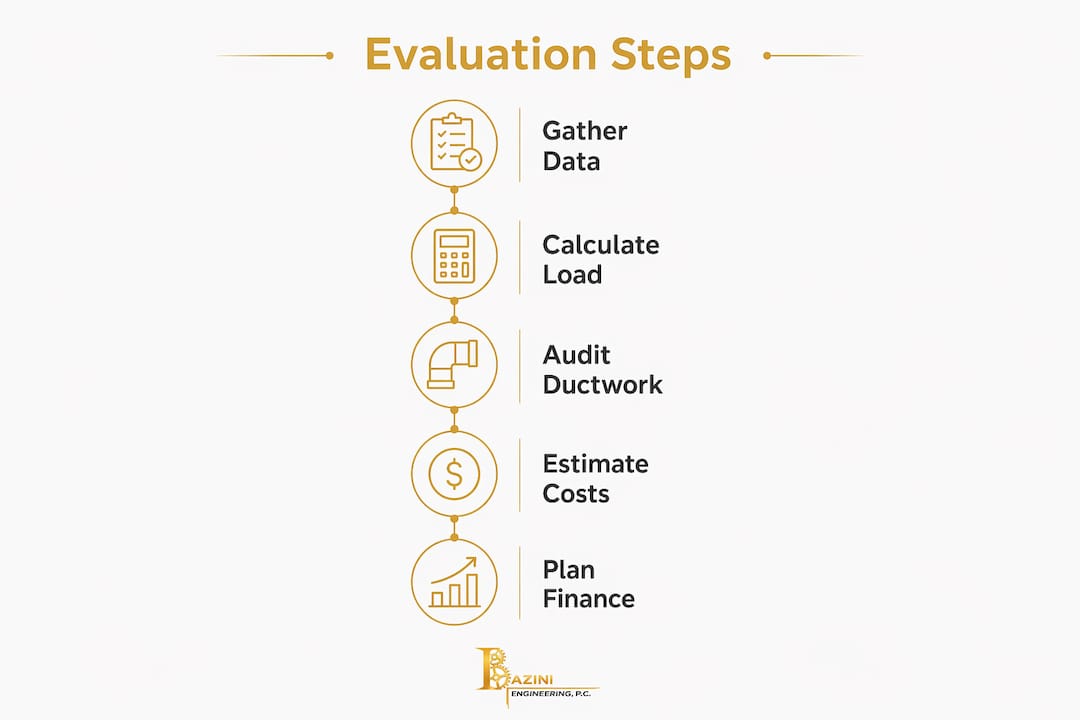
Step 1: Gather building and equipment data. Collect equipment schedules, maintenance logs, original design drawings, and utility bills for the past three years. Utility data reveals actual energy consumption patterns that nameplate ratings never show.
Step 2: Commission load and capacity calculations. Do not rely on existing equipment size as a proxy for building load. Buildings change. Occupancy shifts, envelope improvements, and added equipment all alter the thermal load. A current load calculation is the only reliable basis for sizing replacement equipment.
Step 3: Audit ductwork and distribution infrastructure. Ductwork remediation accounts for a 30–40% swing in total project costs and is the most commonly overlooked expense in HVAC replacement projects. A new air handler connected to leaking or undersized ductwork will never meet its rated efficiency. The audit must happen before you finalize any equipment specification.
Step 4: Estimate total replacement costs, including hidden budget factors. Electrical service upgrades are the most common hidden cost in building electrification projects. Partial gas retention for peak loads can achieve near-total electrification while avoiding the capital cost of a full electrical service overhaul. Large air handler replacements alone can cost $400,000–$500,000 per unit. Budget planning must account for equipment, installation, ductwork, controls, electrical, and permitting as separate line items.
Step 5: Coordinate with finance and plan across fiscal years. HVAC retrofit projects routinely take 1.5 to 2 years from consultant engagement to installation completion. That timeline crosses multiple budget cycles. Finance teams need early visibility to allocate capital correctly.
| Evaluation step | Key output |
|---|---|
| Equipment and building data collection | Baseline condition report |
| Load and capacity calculation | Correct equipment sizing |
| Ductwork and infrastructure audit | Hidden cost estimate |
| Total cost estimation | Realistic project budget |
| Finance and timeline coordination | Multi-year capital plan |
Pro Tip: Break large replacement projects into phases tied to fiscal year budgets. Replacing systems by zone or floor allows capital to be spread across two or three years without leaving the building exposed to a single large expenditure.
What are common mistakes in HVAC replacement evaluation?
The most expensive mistakes in HVAC replacement evaluation share a common root. They all involve underestimating scope.
- Ignoring the 50% rule. Owners who plan an equipment-only swap without checking the capacity threshold routinely discover mid-project that compliance upgrades increase costs by over 50% beyond initial estimates. This is not a contractor problem. It is a planning failure.
- Skipping the ductwork audit. New equipment installed on degraded ductwork delivers degraded performance. The efficiency rating on the equipment spec sheet becomes irrelevant when 25% of conditioned air leaks before reaching occupied space.
- Prioritizing efficiency ratings over installation feasibility. A high-efficiency system that requires structural modifications, crane access, or electrical service upgrades may cost more to install than a moderately efficient system that fits the existing infrastructure. Installation practicality must be weighted alongside efficiency ratings in every evaluation.
- Underestimating lead times. Equipment lead times for commercial HVAC units now extend to 20–40 weeks for some product categories. Starting procurement after permit approval guarantees delays.
- Planning without a phased strategy. Buildings with multiple systems benefit from a phased replacement plan that prioritizes the highest-risk or least-efficient equipment first. This approach manages both budget and operational risk.
Treating HVAC replacement as a single procurement decision rather than a multi-year capital program is the most common and most costly mistake building managers make.
Key takeaways
A successful building HVAC replacement evaluation requires assessing equipment condition, compliance thresholds, ductwork infrastructure, and total project cost before any procurement decision is made.
| Point | Details |
|---|---|
| Start with a load calculation | Never size replacement equipment based on existing unit capacity alone. |
| Know the 50% rule | Crossing this threshold triggers full system upgrades and can double your budget. |
| Audit ductwork first | Ductwork remediation drives a 30–40% swing in total project cost. |
| Plan for 18–24 months | Large commercial replacements require long lead times and multi-year budget coordination. |
| Factor in refrigerant compliance | R-410A phase-out makes continued maintenance of legacy systems increasingly costly. |
What I've learned from evaluating HVAC replacements in complex buildings
The clients who come to us in the best position share one trait. They started the evaluation process at least two years before they needed new equipment. That timeline sounds excessive until you account for load calculations, ductwork audits, permit submissions, equipment lead times, and finance approvals. Two years is not padding. It is the minimum for a large commercial project done correctly.
The second lesson is harder to accept. Energy efficiency ratings are not the primary decision variable. I have seen building managers reject a practical, code-compliant replacement in favor of a higher-efficiency system that required $200,000 in electrical upgrades to install. The efficiency gain never paid back the infrastructure cost within any reasonable horizon. The better decision was the one that fit the building.
Ductwork is where evaluations most often go wrong. Every building manager I have worked with underestimates it the first time. The ductwork audit is not a formality. It is the single most important data point for projecting total project cost accurately.
Finally, compliance planning cannot be reactive. The 50% capacity rule, AIM Act refrigerant requirements, and Local Law 97 energy targets in New York City all intersect in ways that require coordinated engineering and legal review. The building managers who handle this well treat compliance as a design input, not an afterthought.
— Joseph
How Baziniengineering supports your HVAC replacement planning

Baziniengineering provides mechanical engineering consulting for building owners and managers navigating HVAC replacement decisions across New York City, Long Island, and Westchester County. The firm's licensed engineers conduct full HVAC system assessments, load calculations, ductwork audits, and compliance reviews covering Local Law 97, AIM Act refrigerant requirements, and current energy codes. Baziniengineering also manages permit coordination with the NYC Department of Buildings, reducing the timeline risk that derails most large-scale replacement projects. If you are planning a heating and cooling replacement and need a clear scope, accurate budget, and code-compliant design, the full services overview at Baziniengineering is the right starting point.
FAQ
What triggers the 50% capacity rule in HVAC replacement?
The 50% capacity rule is triggered when a replacement project covers more than half of a building's total HVAC system capacity. Once triggered, current energy codes require full system upgrades including ductwork, insulation, and controls, which can more than double initial equipment-only cost estimates.
How long does a commercial HVAC replacement project take?
Large-scale commercial HVAC replacements typically require 18–24 months from initial planning to installation completion. Permitting alone takes 2–4 weeks, and equipment lead times for commercial units can extend to 20–40 weeks.
Is R-410A still available for replacement systems?
R-410A is no longer manufactured for new HVAC equipment in the United States as of 2025. Replacement systems now use lower-GWP refrigerants such as R-32 or R-454B. Continued maintenance of existing R-410A systems is possible but increasingly expensive due to refrigerant cost increases of 40–70% since 2022.
What is the biggest hidden cost in an HVAC replacement project?
Ductwork remediation is the most common hidden cost, accounting for a 30–40% swing in total project cost. Electrical service upgrades required for full electrification are the second most common unexpected expense.
When should a building manager start the HVAC replacement evaluation process?
Building managers should begin a formal HVAC system assessment at least two years before the target replacement date. This timeline accommodates load calculations, ductwork audits, permit submissions, equipment procurement, and multi-year budget coordination.