
The FDNY inspection process runs on two tracks: scheduled inspections you request through the FDNY Business portal for permits, witness tests, and re-inspections, and unannounced enforcement visits that can happen any time. The outcome of either is a pass, a Notice of Defect, or a more serious enforcement action. Here's what to do right now:
- Who requests: The building owner, their authorized agent, or a licensed contractor submits all scheduled inspection requests through FDNY Business (NYC.ID required).
- Where: The FDNY Business portal handles all requests, cancellations, and re-inspection filings.
- Lead times: Plan for a standard lead time for a normal request, and a shorter lead time for overtime or expedited requests. Choose a date beyond those minimums to give FDNY room to review your submission.
- RVI option: Remote Video Inspections are available for certain fire alarm re-inspections, not for initial visits.
- Do today: Confirm your FDNY Business account is active, pull any open Notices of Defect, and verify that required documents are physically on-site.
Key Takeaways
The FDNY inspection process requires scheduled requests through FDNY Business for permit tests and re-inspections, with 20 business days of normal lead time, complete documentation, and a designated Certificate of Fitness holder on-site to pass without delays or violations.
| Point | Details |
|---|---|
| Schedule through FDNY Business | All inspection requests, cancellations, and re-inspections must be submitted via the FDNY Business portal with an active NYC.ID account. |
| Lead times are minimums | Allow at least 20 business days for normal requests; incomplete paperwork or missing TM approvals resets the clock. |
| Documentation must be on-site | As-built drawings, acceptance test reports, COF cards, and monthly logs must be physically accessible the moment an inspector arrives. |
| Violations carry legal deadlines | Each Notice of Defect is a legal document; uncorrected violations can result in compounding daily fines and, in serious cases, a Vacate Order. |
| Baziniengineering handles the process | From FDNY Business filings to on-site acceptance test coordination, Baziniengineering manages the full inspection workflow for NYC property owners. |
Table of Contents
- What types of FDNY inspections will you actually face?
- How to request, schedule, or expedite an inspection through FDNY Business
- What FDNY inspectors actually check, system by system
- What happens after the inspection: violations, corrections, and re-inspections
- Required records and the paperwork that causes the most delays
- How long inspections take and what they cost
- Bazini Engineering's 10-step pre-inspection checklist
- Legal penalties for ignoring FDNY violations
- Why chasing inspections costs more than staying ready
- How Baziniengineering supports FDNY inspections and approvals
- Essential FDNY resources for NYC property owners
- Sources
What types of FDNY inspections will you actually face?
Not every FDNY visit follows the same script, and knowing which category you're dealing with determines how you prepare.
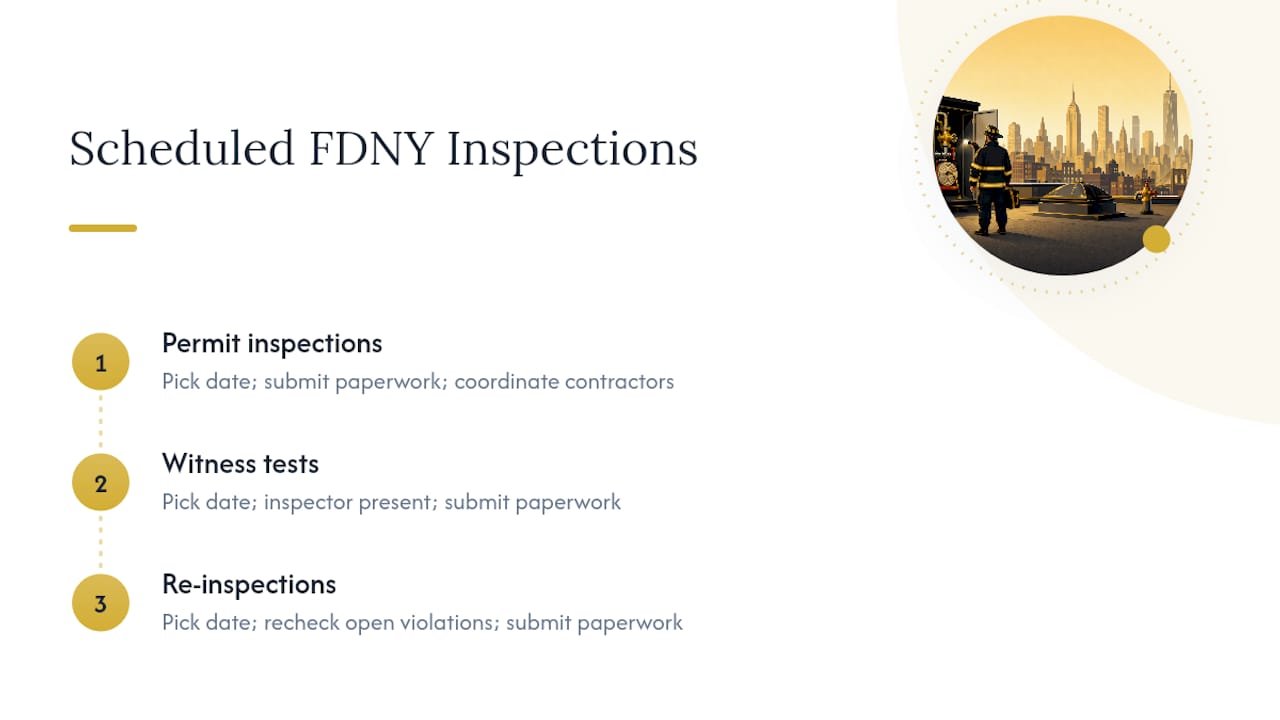
Scheduled inspections cover three main situations: permit inspections (required before a new or altered system goes into service), witness tests (where an FDNY inspector must be physically present to observe a system test), and re-inspections of open violations. These are the visits you initiate. You pick the date, submit the paperwork, and coordinate your contractors accordingly. The NYC Business guide on inspections and testing confirms that permits, witness tests, and re-inspections can all be scheduled in advance, while other inspections can occur without notice.
Unannounced inspections are enforcement-driven. A complaint from a tenant, a referral from another city agency, or a routine sweep by a Fire Prevention unit can trigger one. You get no advance warning, which is exactly why your documentation and systems need to be inspection-ready at all times, not just in the days before a scheduled visit.
Which unit handles what matters for your filings. The Fire Alarm Inspection Unit manages fire alarm-related tests and re-inspections. Fire Prevention units handle general fire safety enforcement. The Fire & Life Safety Director program covers high-rise buildings with specific staffing requirements. Each unit has its own filing rules and form requirements, so submitting to the wrong unit wastes time.
Remote Video Inspections (RVI) are available for re-inspections of previously issued fire alarm Notices of Defect and for certain consolidated fire alarm form processes in the B-45 series. They are not a substitute for initial inspections, and they require solid video capability and strict procedural compliance to succeed. If your video setup or internet connection is marginal, schedule an in-person re-inspection instead.
Pro Tip: If you receive a complaint-driven inspection, do not attempt to delay or obstruct the inspector. Cooperate fully, present available records immediately, and document everything that occurs during the visit.
How to request, schedule, or expedite an inspection through FDNY Business
Getting the scheduling right is where most owners lose time. A rejected or delayed request often comes down to a missing document or an incomplete Technology Management (TM) approval, not the inspection itself.
- Create or verify your NYC.ID account. FDNY Business requires an active NYC.ID login. If your account is dormant or your authorized agent has changed, fix this before you need it urgently.
- Log into FDNY Business and select the correct inspection or test type. The portal lists inspection categories by system and unit. Choosing the wrong type routes your request to the wrong team.
- Complete any required Technology Management plan review first. If your project involves a new or modified fire protection system, TM approval must be in place before FDNY will schedule the inspection. Submitting without it is the single most common cause of rejected requests.
- Attach all required documents. The FDNY document and applicant requirements guide lists exactly what each inspection type requires. For fire alarm inspections, this typically includes the B-45 series forms. For sprinkler acceptance tests, you'll need contractor certifications and as-built drawings.
- Choose a date beyond the recommended lead time. FDNY recommends allowing sufficient lead time for normal and expedited requests. Selecting a date too soon after the request date almost guarantees a scheduling problem.
- Submit and record your FDNY request number. This number is your tracking reference for every follow-up communication. Write it down immediately.
- Confirm the overtime option if you need it. Overtime/expedited inspections are available but may require two inspectors for certain test types, which affects cost. Request this option explicitly in the portal if your timeline demands it.
Starting in late 2025, the Fire Alarm Inspection Unit will require all follow-up inspections and cancellations to be submitted through FDNY Business. The B-45 series forms and the FA-20 re-test guide are available on the FDNY site and must be used for fire alarm-related filings.
| Request Type | Recommended Lead Time | Notes |
|---|---|---|
| Normal inspection/test | Recommended lead time for scheduling | Additional notes |
| Overtime/expedited | Shorter recommended lead time | May require 2 inspectors; additional fees apply |
| RVI (fire alarm re-inspection) | Confirm with FDNY Business | Limited to specific Notice of Defect re-inspections |
| Cancellation | Submit via FDNY Business | Failure to cancel properly can affect future scheduling |
What FDNY inspectors actually check, system by system
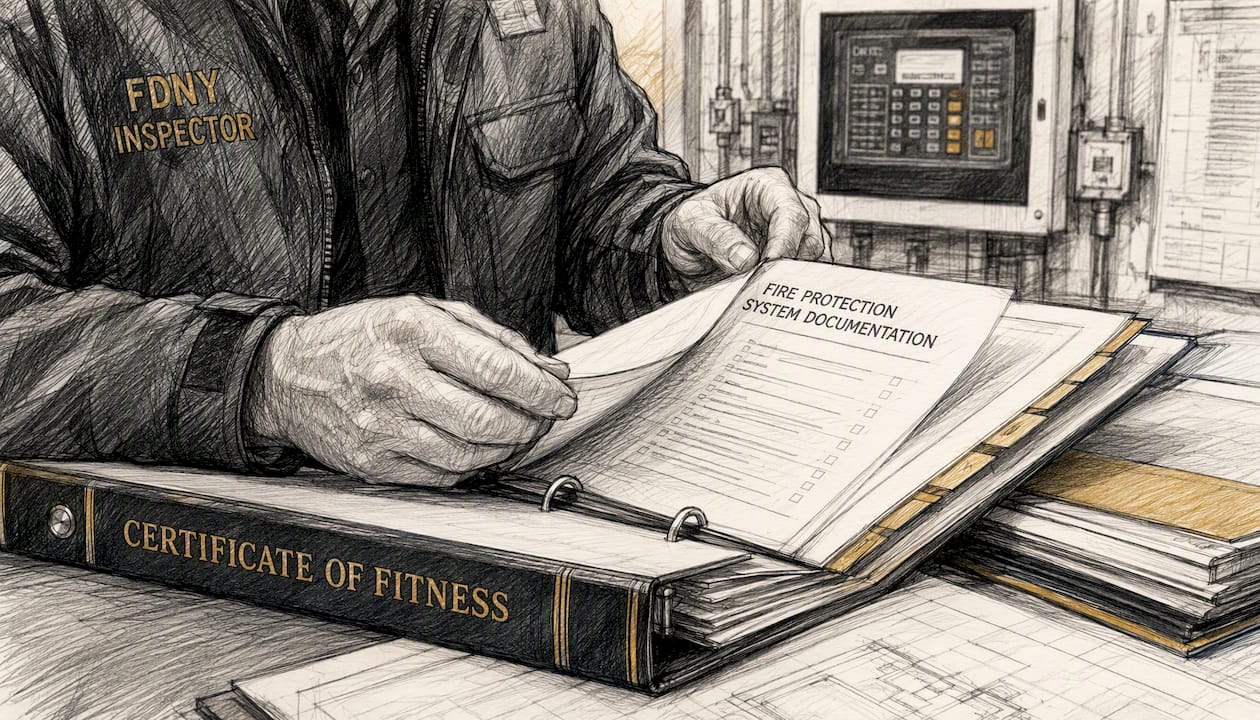
Inspectors arrive expecting immediate access to documentation and proof of regular maintenance. The NYC Fire Code Chapter 9 (FC 901.6) requires inspection, testing, and maintenance of fire protection systems per referenced standards, with records maintained under FC 107.7 and Certificate of Fitness supervision for listed systems.
| System | What Inspectors Examine | Documents/Records Expected On-Site |
|---|---|---|
| Fire alarm | Panel condition, detector placement, pull station function, notification devices | Acceptance test report, monthly inspection logs, Certificate of Fitness holder name |
| Sprinklers/standpipes | Head clearance, pipe condition, control valve positions, flow test results | Contractor certification, quarterly/annual test records, as-built drawings |
| Fire pump | Pressure readings, automatic start, weekly churn test logs | Weekly run logs, annual flow test report, Certificate of Fitness |
| Fire department connections | Caps, signage, accessibility, pressure | Inspection records, last test date |
| Portable extinguishers | Charge, pin, tag, placement, annual service | Annual service tags, monthly inspection initials |
| Means of egress | Door hardware, corridor width, stair enclosures, exit signs | No specific form, but violations are common and immediate |
| Emergency/exit lighting | Battery backup function, illumination levels | Monthly test log, annual test log |
| Hazardous materials storage | Quantity limits, labeling, separation, ventilation | Storage permits, Material Safety Data Sheets |
| Elevator fire service | Phase I/II recall function, firefighter operation | Annual test records, elevator inspection certificate |
The most common Notice of Defect triggers: missing or expired Certificate of Fitness, no monthly inspection logs for sprinklers or fire pumps, blocked egress paths, and fire alarm panels showing trouble or supervisory conditions that haven't been cleared.
Pro Tip: Designate your Certificate of Fitness holder as the primary contact for the inspection. Under FC 901.6.3, FDNY expects this person to be present, to present logs, and to supervise system checks during the visit.
What happens after the inspection: violations, corrections, and re-inspections
A Notice of Defect is not a fine, but ignoring it creates one. Here's the sequence to follow after any violation is issued.
- Read the Notice carefully. Each item specifies the violated code section, the system or location, and the correction required. Life-safety items (blocked egress, non-functional alarms) must be addressed immediately, not on a convenient schedule.
- Prioritize by risk. Egress and alarm deficiencies carry the highest enforcement risk. Paperwork deficiencies (missing logs, expired tags) are correctable quickly and should be resolved within days.
- Schedule corrective work with licensed contractors. For fire alarm and sprinkler corrections, the contractor must hold the appropriate FDNY license. Keep all work orders and completion records.
- Determine whether professional certification applies. Under FDNY rules, professional certification in lieu of re-inspection is permitted for certain fire alarm systems when specific conditions are met: the design was previously approved, an acceptance test was completed, and the identified defects have been corrected. This option saves time but requires a licensed professional to certify the corrections in writing through FDNY Business.
- Request a re-inspection or submit professional certification. If professional certification doesn't apply, submit a re-inspection request through FDNY Business using the same process as the original request. For fire alarm re-inspections, the RVI option may be available.
- Post your permit. Permits must be posted at the premises per NYC rules. Permits run up to two years and are not transferable to a new owner or a different location.
- Retain all correction records on-site. FDNY may verify correction documentation during any subsequent visit.
Required records and the paperwork that causes the most delays
The inspection itself rarely fails because of a system defect that couldn't be anticipated. It fails because a document isn't on-site, a TM approval wasn't completed, or a form was uploaded incorrectly.
| Document | Where to Keep It | Why Inspectors Need It |
|---|---|---|
| As-built drawings | Building management office or mechanical room | Confirms installed system matches approved design |
| Acceptance test reports | On-site binder, copy in FDNY Business | Required for permit inspections and re-inspections |
| Monthly/weekly inspection logs | Near the system (pump room, panel room) | Proves ongoing maintenance under FC 107.7 |
| Letters of Approval / TM approvals | On-site binder | Confirms FDNY reviewed and approved the system design |
| Certificate of Fitness (COF) | Carried by the COF holder; copy in office | Required for supervision of specific systems |
| Contractor sign-off sheets | On-site binder | Confirms licensed contractor performed work |
| Permit/record IDs | Posted at premises; recorded in FDNY Business | Required for permit posting and tracking |
The most common scheduling delays come from three sources. First, missing TM approvals: if your system design hasn't cleared Technology Management plan review, FDNY won't schedule the inspection. Second, incomplete uploads: the portal requires specific file formats and complete document sets. A partially uploaded application sits in limbo. Third, wrong applicant type: certain inspections can only be requested by the owner, the owner's licensed contractor, or a specific Certificate of Fitness holder. Submitting under the wrong account type triggers a rejection.
Pro Tip: The minimum documentation set that prevents a scheduled inspection from being deferred: as-built drawings, the current TM approval letter, the most recent acceptance test report, and the Certificate of Fitness for each applicable system. Have these in a single binder at the front desk before the inspector arrives.
How long inspections take and what they cost
On-site duration varies significantly by system complexity. Type and size of the system affect inspection time; plan your contractor and COF holder availability accordingly.
The FDNY lead-time guidance is clear: 20 business days for normal requests, 10 business days for overtime/expedited. Those are minimums, not guarantees. Incomplete paperwork resets the clock.
Cost factors to budget for:
- Overtime inspector fees: Expedited inspections carry additional FDNY fees, which vary by inspection type. Confirm current rates through FDNY Business before selecting this option.
- Re-inspection fees: A failed inspection that requires a return visit generates a re-inspection fee. Multiple re-inspections compound quickly.
- Emergency correction costs: Life-safety violations that require immediate contractor response outside business hours carry premium labor rates.
- Permit fees: New permits and renewals carry filing fees set by FDNY.
- Shutdown risk: A building or system placed out of service pending correction generates operational costs that dwarf any inspection fee.
Pro Tip: Overtime inspections may require two FDNY inspectors, which doubles the inspector fee for that visit. If your timeline allows even a few extra days, the normal-track request is almost always the better financial choice.
Bazini Engineering's 10-step pre-inspection checklist
Run through these steps in the 48–72 hours before any scheduled FDNY inspection.
- Pull all open Notices of Defect from FDNY Business and confirm each has been corrected and documented.
- Verify your Certificate of Fitness holders are available on the inspection date and have their COF cards with them.
- Assemble your on-site document binder: as-built drawings, TM approval letters, acceptance test reports, monthly logs, contractor sign-offs, and permit/record IDs.
- Walk every means of egress. Check that all exit doors open freely, corridors are clear, and exit signs are illuminated.
- Test emergency lighting. Press the test button on each unit and confirm the light activates. Log the test with date and initials.
- Check fire alarm panel status. Clear any trouble or supervisory conditions. If a condition can't be cleared before the inspection, have the contractor on-site to explain it.
- Inspect portable extinguishers. Confirm charge, pin, and current annual service tag on every unit. Replace any that are expired or discharged.
- Verify sprinkler control valve positions. All control valves should be in the open position and locked or supervised. Check that inspector's test valves are accessible.
- Brief your building staff. The inspector will ask questions. Your superintendent, COF holder, and any on-site contractors should know the inspection scope and their role.
- Place your document binder at the front desk or building management office, not in a locked room. Inspectors expect immediate access. A delay in producing records reads as a documentation failure.
Legal penalties for ignoring FDNY violations
Failing an FDNY inspection is manageable. Ignoring the resulting Notice of Defect is where the legal exposure becomes serious.
FDNY has authority under the NYC Fire Code and the NYC Administrative Code to issue civil penalties, order systems or buildings out of service, and refer cases to the Environmental Control Board (ECB) for adjudication. Civil penalties for fire code violations can reach thousands of dollars per violation, and each day a violation remains uncorrected can be treated as a separate offense. A building with multiple open Notices of Defect that are not addressed within the required timeframe faces compounding fines.
Beyond fines, FDNY can issue a Vacate Order for conditions that pose an immediate life-safety risk. A Vacate Order removes occupants and closes the building until the condition is corrected and FDNY signs off. For a commercial property, that means lost revenue, emergency contractor costs, and potential lease liability.
Owners remain legally responsible for maintaining safe premises at all times, not just during scheduled inspections. That responsibility is explicit in FDNY guidance and in the NYC Fire Code. A building that passes a scheduled inspection but allows systems to degrade afterward is still subject to enforcement during any unannounced visit.
The practical takeaway: treat every Notice of Defect as a legal document with a deadline, not an administrative suggestion.
Why chasing inspections costs more than staying ready
Most building owners treat FDNY compliance as a periodic event: something to scramble for when an inspection is scheduled, then set aside until the next one. That approach is more expensive than it looks.
Every re-inspection generates a fee. Every emergency contractor call to fix a violation before a deadline costs more than the same work done on a planned schedule. Every failed acceptance test delays a certificate of occupancy or a system going into service, which has its own downstream costs. The pattern is predictable, and it's avoidable.
Continuous compliance, meaning regular system maintenance, current documentation, and an active relationship with a licensed engineer who knows your building's systems, changes the math. When documentation is current and systems are maintained to code, scheduled inspections become confirmations rather than audits. Unannounced inspections stop being a source of anxiety because the building is ready for them on any given day.
The engineering perspective that gets overlooked: FDNY inspectors are not trying to fail your building. They are checking whether the systems that protect occupants actually work and whether someone is accountable for maintaining them. A building that demonstrates organized records, a present COF holder, and systems in proper condition gets through inspections faster and with fewer citations, regardless of the inspector assigned.
The owners who spend the most on FDNY compliance are almost always the ones who deferred maintenance and documentation until an inspection forced the issue.
How Baziniengineering supports FDNY inspections and approvals
Baziniengineering's fire protection and MEP engineering services are built around exactly the compliance workflow this guide describes. The firm handles permit expediting, FDNY Business filing support, system acceptance testing coordination, and professional certifications where FDNY rules permit them.
The engagement flow is straightforward: Baziniengineering scopes the inspection requirements for your building, collects and organizes the required documentation, coordinates acceptance tests with your licensed contractors, and provides on-site engineering support during the inspection itself. When a Notice of Defect requires a design correction, the firm handles the engineering and re-filing. For fire suppression systems specifically, Baziniengineering's fire suppression engineering services cover sprinkler and standpipe design, acceptance test coordination, and FDNY-facing deliverables from initial filing through final approval.
If you're managing open violations, preparing for a scheduled acceptance test, or building out a new system that requires FDNY sign-off, contact Baziniengineering through the services page to scope your project and get the process moving.
Essential FDNY resources for NYC property owners
The information in this guide draws directly from FDNY's published guidance, the NYC Fire Code, and the NYC Business portal. The key source documents are:
- The FDNY Business inspections page, which defines which inspections are scheduled versus unannounced and how to submit requests.
- The FDNY Document and Applicant Requirements by Inspection Type PDF, which lists required lead times, required documents, and who may request each inspection type.
- NYC Fire Code Chapter 9 (FC 901.6 and FC 107.7), which establishes the legal basis for inspection, testing, maintenance, and recordkeeping requirements.
- The FDNY Rules PDF, which governs professional certification in lieu of re-inspection and electronic portal submission requirements.
- The NYC Business inspections and testing summary, which explains permit posting, permit duration (up to two years), and non-transferability rules.
- The FDNY Business request/cancel inspection page, which covers RVI procedures and the B-45 series fire alarm form requirements effective November 7, 2025.
These documents are publicly available through the FDNY and NYC websites. If you need help locating a specific form, retrieving your building's FDNY record ID, or interpreting a code requirement for your system type, contact Baziniengineering directly. The firm maintains current working knowledge of FDNY Business portal requirements and can pull the relevant guidance for your specific inspection type.