

When an RFI signals a potential MEP design change, your first move is to flag it as a design-change candidate, freeze any affected work that carries a safety or schedule risk, and start building your evidence package before anyone issues a verbal directive.
Do these immediately:
- Tag the RFI with elevated priority in your log and note "potential design change" in the subject line
- Capture field photos, BIM views, and marked-up drawing sheets that show the conflict or gap
- Log every related sheet number, specification section, and prior submittal that touches the issue
- Notify the affected discipline lead and the design lead in writing, not by phone
- Set a provisional response-due date based on the schedule impact, not the standard queue
- Hold off on any verbal field instructions that could be interpreted as modifying scope
Triage decision: clarification or design change?
An RFI is a pure clarification when it asks the team to interpret existing design intent without altering geometry, capacity, or scope boundaries. It becomes a design change when any of these apply:
- The answer would alter installed or planned geometry (pipe routing, duct path, equipment location)
- Equipment capacities or system performance parameters would change
- Scope boundaries between trades shift
- A code-compliance path changes
- The response requires issuing revised drawings or a new specification section
Never issue a verbal design directive that modifies scope. Put it in writing, flag the CO potential, and route it correctly from the start.
Table of Contents
- 1. How to tell whether an RFI requires a design revision
- 2. A step-by-step workflow for handling MEP design-change RFIs
- 3. What documentation must accompany the RFI response and revisions
- 4. How to process a change order after an RFI confirms a design revision
- 5. Top MEP RFI mistakes that turn clarifications into claims
- 6. RFI tracking tools: when a spreadsheet is enough and when it is not
- 7. Baziniengineering's recommended RFI protocol and a case example
- Key Takeaways
- Why documentation discipline is the real project risk management
- Baziniengineering handles MEP design-change RFIs so your project stays on track
- Recommended references for RFI and design-change management
1. How to tell whether an RFI requires a design revision
The clearest decision rule: if answering the RFI requires the design team to change what is shown on the construction documents, it is a design change, not a clarification. A clarification closes in the RFI log only; a design-change response requires an Architect's Supplemental Instruction (ASI) or equivalent formal document, and it opens a separate cost and schedule negotiation track.

The contract implications are significant. A clarification answer does not change contract scope. A scope-change response that is mislabeled as a clarification can create latent cost claims against the design team or owner later, because the contractor may argue they built to a changed condition without receiving a change order. Keeping those two categories cleanly separated is one of the most important disciplines in MEP RFI management.
Same field symptom, two different outcomes:
A mechanical contractor submits an RFI noting that a supply duct shown on the drawings conflicts with a structural beam. If the design intent was always to route around that beam and the drawings simply lacked the offset detail, the response is a clarification: the design lead issues a note confirming the intended routing, and the RFI closes. If the routing change requires resizing the duct, adjusting the diffuser layout, or relocating an AHU connection, that is a design revision. The design team issues an ASI with revised drawings, and the contractor submits a cost and schedule impact notice.
Owner notice matters here. Most U.S. construction contracts (AIA A201, ConsensusDocs 200) require the contractor to give written notice of a potential change in contract time or price within a defined window, often 21 days from when the condition was discovered. Missing that window can waive the claim. When you flag an RFI as a potential design change, note the discovery date in the log and confirm the notice deadline with the PM the same day.
2. A step-by-step workflow for handling MEP design-change RFIs
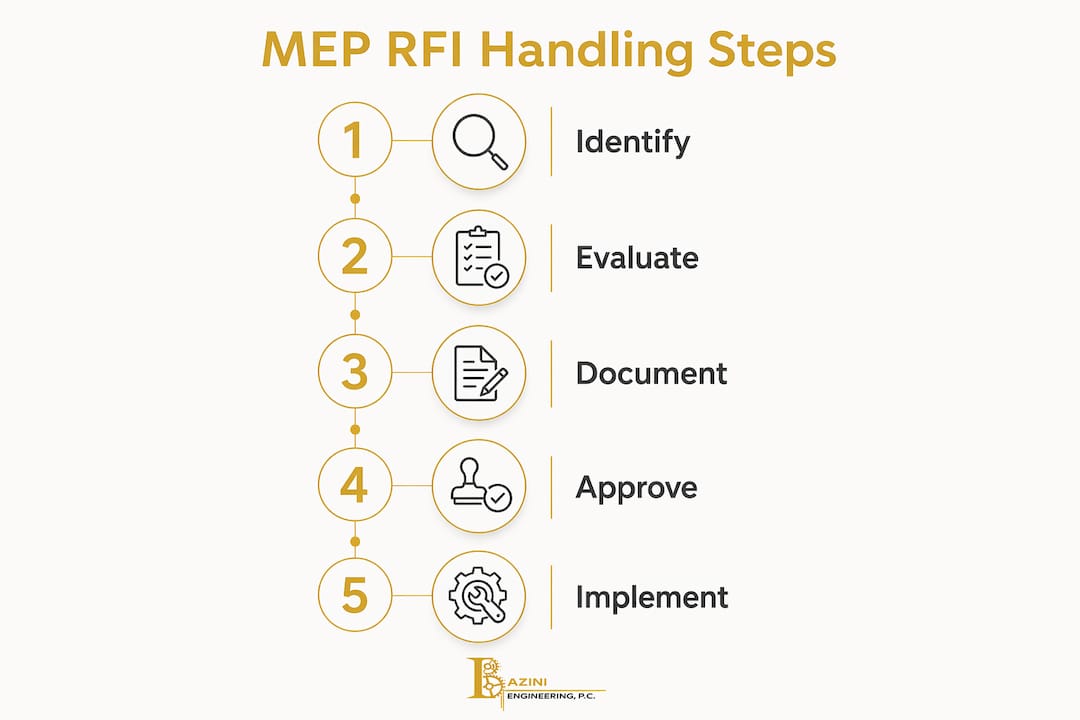
The workflow in one sentence: triage the RFI, build an evidence package, route to the correct discipline, reach a design decision, initiate the ASI or change order, implement the revision, and update the common data environment (CDE).
Step-by-step:
- Receipt and triage (0–24 hours) — GC reviewer + PM. Log the RFI, assign priority, flag design-change potential, and confirm the response-due date.
- Evidence package assembly (24–48 hours) — Submitting contractor. Attach field photos, BIM views, marked-up drawings, and related spec sections.
- Discipline routing (within 48 hours) — PM or design lead. Route to the correct discipline engineer, not the general inbox. Structural, MEP, and architectural questions go to separate leads.
- Design review and decision (3–14 days depending on complexity) — Discipline engineer + design lead. Assess whether a revision is needed. If yes, draft the ASI or sketch. If no, draft the clarification response.
- ASI or CO initiation (within 24 hours of design decision) — Design lead + PM. Issue the ASI with revised drawings. Notify the owner and GC of cost and schedule impact in writing.
- Contractor cost and schedule submission (per contract terms) — GC. GC submits a formal cost proposal and schedule impact statement referencing the RFI number and ASI.
- Change order negotiation and execution — PM + owner rep. Negotiate and execute the CO before work proceeds on the revised scope.
- Implementation and CDE update (concurrent with CO execution) — Discipline engineer + BIM coordinator. Revise the model, update drawing sheets, and close the RFI in the log with ASI and CO references.
The industry average RFI resolution time is 9.7 days, and unresolved RFIs contribute to 37% of schedule overruns in construction projects. Design-change RFIs almost always run longer than the average, which is why the triage step and provisional due date matter so much.
Roles and responsibilities:
| Role | Drafts | Approves | Signs cost/schedule notice | Updates BIM/docs |
|---|---|---|---|---|
| Submitting contractor | RFI text, attachments | — | Cost proposal | Shop drawings |
| GC reviewer | RFI log entry | Routes RFI | Schedule impact notice | — |
| Discipline engineer | ASI sketch, clarification | Design lead | — | Model revision |
| Design lead | ASI document | Owner rep (if required) | Scope-change statement | Drawing sheets |
| PM | CO initiation notice | Owner rep | CO cost/schedule | RFI log closure |
| Owner rep | — | CO execution | CO signature | — |
Pro Tip: Set discipline-specific routing rules in your RFI platform before the project starts. A routing protocol by discipline cuts handoff latency and prevents the common failure where a mechanical question sits in an architectural inbox for three days before anyone notices.
3. What documentation must accompany the RFI response and revisions
When a design change is confirmed, always produce a complete evidence package: marked-up drawings, a scope-impact statement, and a change-notification flag. That package is what protects the design team, the contractor, and the owner if the change order is disputed six months later.
Minimum RFI template fields:
| Field | Purpose |
|---|---|
| RFI number | Unique identifier for log and cross-reference |
| Discipline | MEP, structural, architectural, civil |
| Submitter | Company and contact name |
| Date submitted | Starts the response clock |
| Affected drawing sheets | Specific sheet numbers, not "see drawings" |
| Specification sections | Relevant spec divisions |
| Issue summary | Clear, one-paragraph description of the conflict |
| Proposed options | Contractor's suggested resolution(s) |
| Cost/schedule flag | Yes/No with preliminary estimate if known |
| CO potential flag | Yes/No |
| Attachments | List of attached files |
RFI log required columns (per standard tracking guidance):
- RFI number, subject, discipline
- Date submitted, submitter, assignee
- Priority level
- Response-due date
- Date answered
- Current status (open, pending, closed)
- CO flag
- ASI reference number
- Related drawing sheets
What to attach to the RFI package:
- Marked-up PDFs showing the conflict location
- BIM screenshots or exported views with clash coordinates
- Field photos with date stamps
- Shop drawings or submittals that relate to the issue
- Spec excerpts from the relevant division
- Prior RFIs or submittals that bear on the same condition
- Provisional instruction record if a temporary field fix was issued
When capturing BIM-derived evidence, export the view with the model file name, revision number, and date visible in the title block. That metadata is what ties the BIM snapshot to the specific drawing revision in force at the time the RFI was submitted, and it matters when a change order is disputed.
4. How to process a change order after an RFI confirms a design revision
The moment a design change is confirmed, flag the formal change-order path and preserve the RFI package as the initiating document. That RFI number becomes the anchor reference for every CO document that follows.
Standard steps to initiate a change order:
- Issue written owner notification referencing the RFI number, the nature of the design change, and the preliminary cost and schedule impact.
- Issue the ASI or design sketch with revised drawings. The ASI is the design team's formal authorization for the contractor to proceed with revised scope.
- The GC prepares a formal cost proposal and schedule impact statement, referencing the ASI and RFI.
- The design lead issues a scope-change certification confirming the revision is outside the original contract documents.
- The PM negotiates and executes the CO before the contractor begins work on the revised scope.
Timing and notice checklist:
- Notify the owner in writing within the contract's notice window (check your contract; AIA A201 §15.1.3 sets a 21-day default)
- Do not allow the contractor to proceed on revised scope without a signed CO or written authorization from the owner
- If schedule pressure requires work to begin before the CO is executed, issue a Provisional Field Instruction (PFI) in writing, signed by the design lead, with an explicit statement that it does not constitute final scope authorization
- Document any temporary fixes with photos and a written record of who authorized them and when
Risk-control points. Never accept field-installed changes without a signed CO. If a subcontractor installs revised MEP work based on a verbal direction, the design team and owner lose the ability to negotiate the cost. The RFI response itself does not change contract scope; only an executed CO does. Keep that boundary clear in every communication.
Sample CO initiation notice language (frame):

5. Top MEP RFI mistakes that turn clarifications into claims
Most RFI-driven claims do not start with a genuinely ambiguous design. They start with a procedural failure: the wrong person got the question, the evidence was thin, or someone said yes verbally before the paperwork caught up.
The five most common mistakes and how to prevent them:
-
Vague RFI text. An RFI that says "duct conflicts with beam — please advise" gives the design team nothing to work with. Prevention: require the submitter to identify the specific sheet, detail, and proposed resolution before the RFI leaves the contractor's office. A validated RFI checked against drawings, specs, and prior RFIs avoids most avoidable submissions.
-
Wrong-discipline routing. A plumbing question routed to the architect sits unanswered while the plumber waits. Prevention: publish a discipline routing matrix at project kickoff and enforce it in your RFI platform.
-
Inadequate evidence package. An RFI with no photos, no marked-up drawings, and no BIM view forces the design team to guess at the field condition. Prevention: make the attachment checklist a required field in your RFI template.
-
Not flagging CO potential. A design-change response issued without a CO flag gives the contractor grounds to claim the change was absorbed into the base contract. Prevention: add a mandatory CO flag field to every RFI template and require the PM to review it before the response is issued.
-
Verbal design directives. A field engineer tells the foreman to reroute the pipe. No paper trail, no CO, no protection. Prevention: enforce a written-only rule for any communication that could be interpreted as modifying scope.
Discipline routing matrix (how questions should flow):
MEP questions (duct routing, pipe sizing, equipment clearances, fire protection layout) go directly to the MEP design lead. Structural questions (beam penetrations, slab openings, load-bearing conditions) go to the structural engineer of record. Architectural questions (ceiling heights, wall types, door clearances) go to the architect of record. When a question crosses disciplines, the PM assigns a primary responder and copies the secondary discipline lead.
Pre-IFC MEP coordination is the highest-return activity for reducing RFI volume before construction begins. Pre-IFC coordination checks can reduce MEP RFI volume by 35–50% on projects where they are run, because they surface the routing conflicts, equipment access issues, and clearance problems that would otherwise generate field RFIs.
6. RFI tracking tools: when a spreadsheet is enough and when it is not
Pick the tool that matches your project's complexity and risk profile. A spreadsheet works for a small, single-trade project with a short schedule and a handful of RFIs. A multi-trade commercial project with active MEP coordination, concurrent submittals, and a live change-order log needs an integrated platform.
Spreadsheets are fast to set up and require no training. The failure mode is version control: when two people edit the same log simultaneously, or when the PM's copy diverges from the GC's copy, the log stops being a reliable record. For projects generating more than 20–30 RFIs, the manual effort of aging reports and CO cross-referencing becomes a real risk.
Lightweight cloud logs (shared spreadsheets with form-based entry) solve the version-control problem without requiring a full PM platform. They work well for mid-size projects where the team is comfortable with shared document environments. The gap is integration: they do not connect to the BIM model, the submittal log, or the schedule, so the PM has to maintain those cross-references manually.
Integrated PM platforms like Procore handle discipline tagging, attachment metadata, automated routing, CO flagging, aging reports, and schedule-risk integration in a single environment. Automated drafting and prioritization features in higher-end platforms free engineers to focus on the non-routine judgment calls that actually require expertise. The tradeoff is setup time and licensing cost, which only pays off on projects large enough to generate the RFI volume that justifies it.
Must-have features for MEP design-change RFI management:
- Discipline tagging on every RFI
- Attachment and metadata support (file name, revision, date)
- BIM snapshot linking or screenshot attachment
- Automated routing by discipline
- CO flag field (mandatory, not optional)
- Aging report with response-due date tracking
- ASI and CO cross-reference fields
- Audit trail for all status changes
MEP BIM coordination run on a disciplined weekly cycle, including clash detection and resolution assignment, materially reduces field RFIs and coordination-driven change orders. Whatever platform you use, the RFI log and the BIM coordination log should reference each other.
7. Baziniengineering's recommended RFI protocol and a case example
Baziniengineering's protocol starts with one rule: every RFI that touches MEP scope gets a design-change flag assessment within 24 hours of receipt, before the response clock starts. That single gate prevents the most common failure mode, where a design-change RFI drifts through the standard queue and the CO window closes before anyone notices.
The Baziniengineering protocol in practice:
- Stage 1: Receipt and flag (0–24 hours). The PM logs the RFI, assigns discipline, and makes the clarification/design-change determination using the criteria above. If design-change potential exists, the CO flag is set immediately and the owner is notified.
- Stage 2: Evidence assembly (24–48 hours). The submitting contractor is required to provide marked-up drawings, BIM views, and field photos before the review begins. Incomplete packages are returned with a specific checklist of what is missing.
- Stage 3: Discipline routing (within 48 hours). The RFI goes to the named discipline lead, not a general inbox. For Baziniengineering projects, MEP questions route to the mechanical, electrical, or plumbing lead depending on the affected system.
- Stage 4: Design review and response (3–14 days). The discipline engineer reviews the evidence, consults the design lead, and drafts either a clarification response or an ASI with revised drawings.
- Stage 5: CO initiation and close (concurrent with ASI issuance). If a design change is confirmed, the PM initiates the CO process the same day the ASI is issued. The RFI log entry is updated with the ASI number and CO reference before the response is transmitted.
Baziniengineering RFI field names: RFI No., Discipline, Submitter, Date Submitted, Affected Sheets, Spec Sections, Issue Summary, Proposed Resolution, Cost Flag, CO Flag, ASI Reference, Response Date, Status, Attachments.
Anonymized case example. A mid-size commercial office fit-out in New York City generated an RFI from the mechanical subcontractor noting that the supply ductwork shown on the drawings conflicted with a new structural beam added during a late-stage architectural revision. The conflict affected three floors and would have required rerouting approximately 200 linear feet of ductwork per floor if handled as a field improvisation.
Baziniengineering received the RFI, flagged it as a design change within 24 hours, and notified the owner and GC in writing the same day. The discipline engineer assembled a BIM coordination model showing the conflict across all three floors, exported clash reports with coordinates, and issued an ASI with revised duct routing within eight days. The CO was initiated concurrently with the ASI and executed before any revised work began.
The outcome: the contractor received a fully documented scope change, the owner had a clear cost basis for the CO negotiation, and no work was installed without authorization. The project avoided what would have been a multi-week dispute over who was responsible for the rerouting cost.
Pro Tip: Baziniengineering's MEP engineering services include pre-IFC coordination as a standard project phase. Running clash detection before the IFC set is issued is the single most effective way to prevent the kind of late-stage conflict that generated this RFI in the first place.
Key Takeaways
Handling MEP RFI-driven design changes correctly requires triage within 24 hours, a complete evidence package, strict discipline routing, and a formal change-order path initiated the same day a design change is confirmed.
| Point | Details |
|---|---|
| Triage within 24 hours | Flag every RFI with design-change potential before the response clock starts, and notify the owner in writing the same day. |
| Discipline routing is non-negotiable | Route MEP, structural, and architectural questions to named leads, not general inboxes, to prevent handoff delays. |
| RFI does not equal CO | An RFI response, even one that includes an ASI, does not change contract scope; only an executed change order does. |
| Preserve the evidence package | Marked-up drawings, BIM views, field photos, and spec excerpts form the audit trail that defends CO negotiations and claims. |
| Baziniengineering's protocol | Baziniengineering applies a five-stage RFI protocol with a 24-hour design-change flag gate and concurrent CO initiation on confirmed revisions. |
Why documentation discipline is the real project risk management
The conventional wisdom in MEP project management is that faster RFI responses protect the schedule. That is true, but it is only half the story. The projects that end up in disputes are not usually the ones where responses were slow. They are the ones where responses were fast but undocumented, or where the distinction between a clarification and a scope change was blurred in the moment and never corrected.
What Baziniengineering sees repeatedly is this: a field condition gets resolved quickly through a phone call or a sketch on a napkin, the work gets installed, and six months later the contractor submits a claim for the cost of that work because there is no signed CO. The design team has no defense because there is no paper trail. The owner is stuck negotiating a claim they thought was already handled. That sequence is entirely preventable, and it is prevented by one discipline: writing things down before the work happens, not after.
Proper RFI handling also affects client relationships in ways that go beyond the immediate project. Owners who have been through a poorly documented change-order dispute are the ones who come back with tighter contract language, more aggressive CM oversight, and less tolerance for ambiguity. Owners who have been through a well-run RFI process, where every change was flagged early, documented completely, and resolved with a signed CO, tend to come back with the same team. That is the practical business case for the discipline this article describes.
Baziniengineering is licensed in New York and Florida and serves projects across New York City, Long Island, and Westchester County. The firm's MEP and fire protection engineering services include pre-IFC coordination, RFI support, and full design-change documentation as standard project deliverables.
Baziniengineering handles MEP design-change RFIs so your project stays on track
When a field RFI turns into a design revision, the cost is rarely the ductwork or the pipe. It is the two weeks of schedule float that disappears while the team figures out who owns the change, and the CO negotiation that drags on because the evidence package was thin. Baziniengineering's MEP engineering practice is built around preventing exactly that sequence.
The firm provides pre-IFC MEP coordination, RFI triage and response support, ASI preparation, and full change-order documentation for commercial, residential, institutional, and industrial projects in New York and Florida. Every project engagement includes the five-stage RFI protocol described above, with a 24-hour design-change flag gate and concurrent CO initiation built into the standard workflow.
If your project is generating MEP RFIs that are starting to look like design changes, contact Baziniengineering now through the services page to discuss project support or a protocol implementation engagement.
Recommended references for RFI and design-change management
These are the primary sources worth keeping on hand when handling RFIs and design revisions on U.S. construction projects.
-
AIA A201 General Conditions of the Contract for Construction. The governing contract language for RFI notice requirements, change-order procedures, and ASI authority. Check §7 (Changes in the Work) and §15 (Claims and Disputes) for the specific notice windows and procedures that apply to your project.
-
ConsensusDocs 200 Standard Agreement and General Conditions. An alternative to AIA A201 used on many commercial projects. ConsensusDocs clauses on changes and RFIs differ from AIA in important ways, particularly on notice timing and the contractor's right to proceed. Review Article 8 (Changes) before your project starts.
-
CMAA (Construction Management Association of America) guidance on RFI impact and control. CMAA has published research on the schedule and cost impact of unresolved RFIs on construction projects, useful for quantifying the risk exposure when RFI response times slip.
-
ASCC (American Society of Concrete Contractors) guidance on RFIs and rework. Practical field perspective on how RFI-driven rework accumulates and how documentation practices affect claims outcomes.
-
Procore's construction management platform help center. Best resource for workflow configuration, discipline routing setup, and CO flagging in an integrated PM environment. Use it for tool-specific implementation guidance, not contract interpretation.
-
Relevant code bodies: ICC (International Code Council), NFPA, ASHRAE. When an RFI touches code compliance, the answer has to come from the applicable code, not from field judgment. Keep the current editions of IBC, NFPA 13, NFPA 72, and ASHRAE 90.1 accessible for MEP design-change reviews.
Baziniengineering maintains RFI templates and log formats as part of its standard project documentation package. To request a copy or discuss implementation on your project, contact the firm through the services page.