
TL;DR:
- Fire protection codes regulate how buildings prevent, detect, and suppress fires to protect occupants and property. Compliance involves understanding specific standards like NFPA 13, NFPA 72, and NFPA 101, which are enforced by local authorities. Ongoing inspections, thorough documentation, and proactive management are essential to maintain safety and avoid penalties.
Fire protection code requirements are the mandated regulations governing fire prevention, detection, suppression, and evacuation measures in buildings to protect occupants and property. These rules draw from established standards including NFPA 13, NFPA 72, NFPA 101, and the International Fire Code (IFC), with local Authorities Having Jurisdiction (AHJ) enforcing them at the building level. Fire protection code requirements explained correctly means understanding not just what the codes say, but how they apply to your specific occupancy type, building construction, and local jurisdiction. Compliance protects lives, limits property damage, and shields property owners from fines, shutdowns, and legal liability.
What are the main components of fire protection codes for buildings?
Fire protection codes cover six distinct areas of building safety. Each area carries specific technical requirements that affect design, construction, and ongoing operations.
Fire prevention measures address how materials are stored, handled, and managed inside a building. Codes restrict flammable liquid storage quantities, require proper labeling, and set clearance distances from ignition sources.
Fire detection and alarm systems fall under NFPA 72, the National Fire Alarm and Signaling Code. NFPA 72 requires audible alarms to sound at least 15 dBA above average ambient noise, or 5 dBA above any sound lasting 60 seconds. That threshold exists because alarms that cannot be heard over background noise fail at the one job they are designed to do. Smoke detector spacing on smooth ceilings can extend up to 30 feet apart, but every ceiling point must fall within 21 feet of a detector under the 0.7 rule.

Automatic fire suppression systems are governed primarily by NFPA 13 for commercial buildings, with installation thresholds set by IBC Chapter 9. Sprinkler systems activate before fire departments arrive, which makes them the single most effective tool for limiting fire spread in occupied buildings.
Means of egress and emergency lighting requirements come from NFPA 101, the Life Safety Code. Emergency lighting must provide a minimum of 1 footcandle at floor level along exit paths, maintained for at least 90 minutes after a power failure. That 90-minute window gives occupants enough time to evacuate even in a complete blackout.
Passive fire protection includes fire-rated wall and floor assemblies, fire barriers, and firestopping at penetrations. These elements contain fire and smoke to specific compartments, buying time for evacuation and suppression.
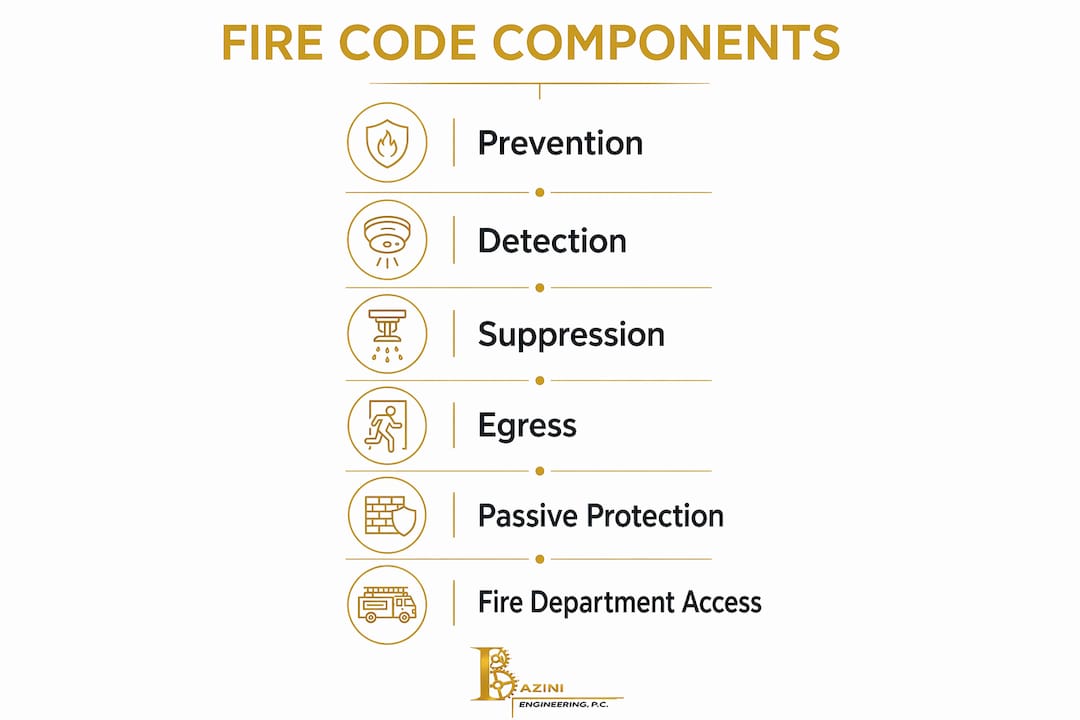
Standpipe and fire department connections give firefighters direct access to water inside large or high-rise buildings. Their placement and pressure requirements are set by NFPA 14 and coordinated with local fire departments.
Here is a quick reference for the primary standards and what they govern:
| Standard | Scope |
|---|---|
| NFPA 13 | Sprinkler system design and installation for commercial buildings |
| NFPA 72 | Fire alarm and signaling systems |
| NFPA 101 | Life safety, egress, and occupant protection |
| NFPA 25 | Inspection, testing, and maintenance of water-based systems |
| IBC Chapter 9 | Occupancy-based thresholds for sprinklers and alarms |
| IFC | Operational fire safety requirements enforced by local AHJ |
How are fire protection codes enforced and what are typical compliance requirements?
Local AHJs enforce fire codes by conducting inspections, reviewing plans, and issuing permits. The AHJ may be a city fire marshal, a county building department, or a state agency, depending on your jurisdiction. Their authority is final at the local level, even when national standards provide the baseline.
Inspection frequency depends on occupancy type. Hospitals and nightclubs typically face annual inspections, while office buildings may be reviewed every 1–3 years. Fire protection systems carry their own separate testing schedules: sprinklers require quarterly, annual, and five-year inspections per NFPA 25; fire alarms require annual testing per NFPA 72; portable extinguishers need monthly visual checks and hydrostatic testing on a 12-year cycle.
The financial consequences of non-compliance are direct. Fines range from $100 to $1,000 per violation per day, with higher penalties for serious or repeat offenses. Violation correction periods run 7–30 days before re-inspection, and unresolved violations can trigger cease-and-desist orders that shut down operations entirely.
Common violations that trigger fines include:
- Unsealed penetrations in fire-rated assemblies
- Blocked or improperly marked exit paths
- Expired or missing fire extinguisher inspections
- Sprinkler heads obstructed by storage or equipment
- Missing or non-functional emergency lighting
- Outdated fire alarm panel certifications
Pro Tip: Keep a compliance calendar that maps every ITM task to its required frequency under NFPA 25, NFPA 72, and NFPA 10. A missed quarterly sprinkler inspection is a violation even if the system itself is working perfectly.
Fire code compliance is a continuous, systematic process involving periodic inspections, testing, maintenance, and documentation. It is not a one-time event tied to a certificate on the wall. Building managers who treat compliance as ongoing operations rather than a periodic scramble before inspections consistently avoid the most costly violations.
What are the nuances and differences among fire protection codes and standards?
Understanding fire safety regulations means recognizing that multiple codes often apply to the same building simultaneously. The IFC, NFPA 1, and NFPA 101 each address fire safety but from different angles. The IFC focuses on operational fire safety and is widely adopted by municipalities with local amendments. NFPA 1 is a comprehensive fire code used in jurisdictions that prefer the NFPA framework. NFPA 101 centers on life safety, egress design, and occupant protection. Many jurisdictions adopt one as the primary code and reference the others for specific topics.
The sprinkler standard selection is where misapplication causes the most damage. NFPA 13, 13R, and 13D serve different building types, and choosing the wrong one creates code violations and expensive redesigns. NFPA 13R applies to residential buildings up to four stories and provides fewer protections than NFPA 13. NFPA 13D covers one and two-family dwellings. Only NFPA 13 delivers the full code benefits recognized by IBC Chapter 5 for commercial buildings. A property owner who installs an NFPA 13R system in a building that requires NFPA 13 will face mandatory redesign before occupancy approval.
Alarm system requirements carry similar nuances. Manual pull stations may not be required in buildings where sprinkler water flow automatically triggers occupant notification. That exception is occupancy and size-dependent under IBC 907.2. Applying it incorrectly in a building that does require pull stations is a common plan review failure.
Key points where building managers frequently encounter code conflicts:
- Occupancy classification changes trigger new sprinkler and alarm thresholds under IBC Chapter 9
- Renovation projects in older buildings may require bringing existing systems up to current standards
- Mixed-use buildings must satisfy the most restrictive requirements of each occupancy type present
- High-rise buildings face additional requirements beyond standard commercial code provisions
The practical lesson is that fire protection guidelines do not exist in isolation. Each standard references others, and a gap in one area can cascade into violations across multiple systems.
How can building managers and owners maintain fire code compliance?
Fire safety code compliance starts with a site-specific fire risk assessment. Generic checklists do not account for your building's construction type, occupancy mix, or operational patterns. A risk-based assessment identifies the actual hazards present and matches them to the correct code requirements. Fire safety regulation is shifting toward this risk-based approach, where the responsible person must conduct assessments tailored to each property rather than applying a universal template.
A structured ITM program is the operational backbone of ongoing compliance. Align every inspection, test, and maintenance task to its required schedule under NFPA 25, NFPA 72, and NFPA 10. Assign ownership for each task to a named staff member or contracted service provider. Gaps in ITM schedules are among the first things an AHJ inspector checks.
Documentation is not optional. AHJ inspectors review records during site visits, and missing logs are treated the same as missed inspections. Keep test reports, maintenance records, and deficiency correction notices organized and accessible. Many building managers use a dedicated facility management log for this purpose, which also supports periodic inspections and recordkeeping across other building systems.
Staff training closes the gap between having compliant systems and actually using them correctly. Train building staff on the fire safety plan, alarm response procedures, and evacuation routes at least annually. Document every drill and training session.
Pro Tip: Schedule a pre-inspection walkthrough with your fire protection engineer 60–90 days before your AHJ inspection. Identifying and correcting deficiencies before the official visit eliminates the fine cycle entirely.
The following practices define a well-managed compliance program:
- Maintain a master ITM schedule with assigned owners and completion tracking
- Store all fire protection system records in a single, accessible location
- Conduct annual fire drills and document attendance and outcomes
- Review occupancy classifications whenever building use changes
- Engage a licensed fire protection engineer for system modifications or permit work
Baziniengineering works with building managers and property owners throughout New York City, Long Island, and Westchester County to design, review, and document fire protection systems that meet current code requirements. Their engineers coordinate directly with the NYC Department of Buildings and FDNY to keep projects on schedule and in compliance.
Key Takeaways
Fire protection code compliance requires matching the correct NFPA standard to your building type, maintaining a documented ITM schedule, and treating compliance as an ongoing operational responsibility rather than a periodic event.
| Point | Details |
|---|---|
| Match the right standard | Use NFPA 13 for commercial buildings; NFPA 13R and 13D apply only to residential occupancies. |
| Know your AHJ | Local authorities enforce codes with amendments; always confirm which version applies to your jurisdiction. |
| Document everything | Missing ITM records are treated as violations during AHJ inspections, regardless of system condition. |
| Inspect on schedule | Sprinklers, alarms, and extinguishers each carry distinct testing frequencies under NFPA 25, 72, and 10. |
| Act before violations accumulate | Fines run $100–$1,000 per violation per day; early correction avoids compounding penalties. |
What I've learned from watching compliance go wrong
After working on fire protection projects across New York City and Long Island, the pattern I see most often is not ignorance of the codes. It is overconfidence in a system that was compliant five years ago. Buildings change. Tenants move in, walls get added, storage configurations shift, and nobody updates the fire protection drawings. Then an AHJ inspection reveals that the sprinkler coverage no longer matches the current layout, or that a renovation punched through a fire-rated wall without proper firestopping.
Unsealed penetrations appear in 53% of commercial inspections. That number is not a reflection of careless contractors. It reflects the reality that building modifications happen constantly, and fire protection is rarely the first thing anyone thinks about when cutting a hole for a new conduit or pipe.
The shift toward risk-based fire safety management is the right direction. Prescriptive checklists give you a floor, not a ceiling. A building that passes every checklist item but has a fundamentally flawed egress path is not safe. The responsible person needs to understand the intent behind the code, not just the letter of it.
My honest advice: treat your fire protection engineer as a standing resource, not someone you call when a permit is due. The managers who stay out of trouble are the ones who ask questions before they start work, not after.
— Joseph
Baziniengineering's fire protection engineering services
Building managers and property owners dealing with complex fire protection requirements need more than a code checklist. They need an engineer who understands how NFPA 13, NFPA 72, and local AHJ requirements interact with the specific conditions of their building.

Baziniengineering provides fire suppression system design and code compliance consulting for commercial, residential, and institutional properties across New York City, Long Island, and Westchester County. The firm's engineers coordinate directly with the NYC Department of Buildings and FDNY, handling permit submissions and plan reviews so building managers can focus on operations. Whether you need a new system designed, an existing system reviewed for code compliance, or support preparing for an AHJ inspection, Baziniengineering delivers practical, code-compliant solutions. Contact the team to discuss your building's specific requirements.
FAQ
What are fire protection code requirements?
Fire protection code requirements are the regulations governing fire prevention, detection, suppression, and egress in buildings. They draw from standards including NFPA 13, NFPA 72, NFPA 101, and the IFC, enforced locally by the AHJ.
How often do fire protection systems need to be inspected?
Sprinkler systems require quarterly, annual, and five-year inspections per NFPA 25. Fire alarms require annual testing per NFPA 72, and portable extinguishers need monthly visual checks.
What is the difference between NFPA 13 and NFPA 13R?
NFPA 13 applies to commercial buildings and provides full IBC Chapter 5 code benefits. NFPA 13R is limited to residential buildings up to four stories and offers fewer protections. Using NFPA 13R in a commercial building causes code violations and requires redesign.
What fines can result from fire code violations?
Fines range from $100 to $1,000 per violation per day, with higher penalties for serious or repeat offenses. Uncorrected violations within the 7–30 day correction window can result in cease-and-desist orders.
What does an AHJ do in fire code enforcement?
The AHJ is the local authority, such as a fire marshal or building department, that enforces fire codes through inspections, plan reviews, and permit approvals. AHJs may adopt the IFC or NFPA 1 with local amendments, so requirements vary by jurisdiction.