
Choose an ERV when your building needs year round humidity control, especially in mixed or humid climates and tightly sealed homes. Choose an HRV when you're in a cold, dry climate where winter moisture removal matters more than retention. Both systems recover heat from outgoing air, but the moisture question decides which one actually belongs in your mechanical room, and that decision still needs professional sizing before anyone signs a contract.
TL;DR:
- ERVs are preferable in mixed or humid climates where year-round humidity moderation is essential, especially in tightly sealed buildings.
- HRVs are better suited for cold, dry climates to avoid frost buildup since they do not transfer moisture and only recover sensible heat.
- Proper sizing based on measured air changes per hour and climate data is more critical than brand or core type for system performance and energy efficiency.
- Installers should ensure balanced airflow, frost control, and accessible filter and core service areas to prevent system malfunctions and reduce maintenance costs.
- Most installations range from $2,000 to $5,500, with duct complexities and controls affecting final costs more than core choice.
Table of Contents
- ERV vs HRV Comparison at a Glance
- How ERVs and HRVs Actually Move Air and Moisture
- Climate Rules for Choosing ERV vs HRV
- Sizing and Installation: Get the Airflow Right First
- What ERV and HRV Systems Actually Cost
- Maintenance Schedule and Mistakes That Shorten System Life
- What an MEP Engineer Checks Before Specifying Either System
- A Decision Checklist to Hand Your Contractor
- The Engineer's Take: Why Sizing Beats Brand Every Time
- Sources
ERV vs HRV Comparison at a Glance
The two systems share a job description: pull stale air out, bring fresh air in, and recover the energy that would otherwise go out the exhaust duct. Where they split is moisture.
An HRV brochure from the Home Ventilating Institute draws the line clearly: heat recovery ventilators transfer sensible heat only, while energy recovery ventilators transfer both sensible heat and a controlled amount of moisture. That single design choice cascades into everything else, from winter comfort to summer condensation risk.
Here's the quick rundown building owners actually need before getting into the mechanics:
- Heat transfer: Both HRVs and ERVs recover sensible heat from outgoing air and use it to precondition incoming fresh air.
- Moisture transfer: ERVs move a portion of the water vapor between airstreams; HRVs do not, which means HRVs pass dry winter air straight through unchanged.
- Humidity control: ERVs even out swings, keeping winter air from turning uncomfortably dry and reducing how much summer humidity gets pulled indoors.
- Condensation risk: HRV cores can frost up in extreme cold because they don't shed moisture the way ERV cores do, which is why frost control matters more on HRV installations.
- Upfront cost: The two run in a similar price band; the bigger cost swing comes from ductwork complexity, not core type.
- Maintenance: Both need filter changes and periodic core cleaning, but ERV cores demand closer inspection since organic buildup on a moisture-transferring surface behaves differently than on a dry HRV core.
One clarification worth repeating because contractors sometimes gloss over it: an ERV is not a dehumidifier. It moderates the moisture load that ventilation air brings in, but it won't dry out a genuinely wet basement or a chronically damp bathroom on its own.
How ERVs and HRVs Actually Move Air and Moisture
Every heat or energy recovery ventilator relies on a core, the heat exchanger sitting between the incoming and outgoing airstreams. The physics behind it comes down to two kinds of energy: sensible heat, which is temperature you can measure with a thermometer, and latent heat, the energy locked into water vapor that a thermometer can't see. HRV cores transfer sensible heat only. ERV cores transfer both, using materials engineered to let water molecules pass through microscopic pores while keeping the two airstreams physically separate.
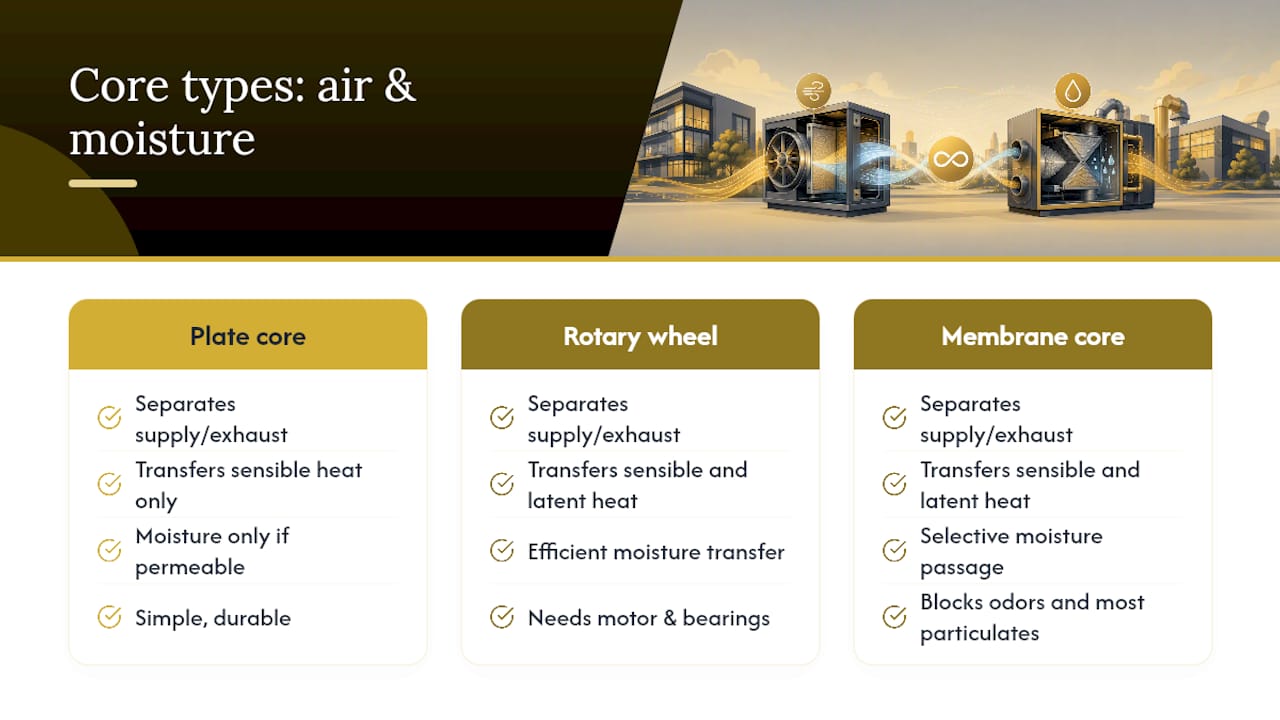
Three core types show up in most residential and light commercial installations. Plate cores use stacked aluminum or polymer sheets and are simple, durable, and cheap to manufacture, but they only handle sensible heat unless the plates themselves are moisture permeable. Rotary (enthalpy wheel) cores spin slowly between the two airstreams and transfer both heat and moisture efficiently, though they need a motor and bearings that eventually wear. Membrane cores, common in modern ERVs, use a selectively permeable material that moves water vapor while blocking odors and most airborne particulates, offering a good balance of performance and low mechanical complexity.
Balanced ventilation is the other piece decision-makers often skip past. Supply airflow has to roughly match exhaust airflow, or the building runs at a pressure imbalance that can pull in unfiltered air through cracks, backdraft a fireplace, or stress a building envelope over time. That balance depends on more than duct size. Fan wattage and delivered CFM at the actual design operating point, not the number printed on the spec sheet, determine whether the unit performs as advertised once static pressure from real ductwork enters the picture, a detail SupplyHouse's engineering breakdown flags as one of the most commonly overlooked variables in the field.
Climate Rules for Choosing ERV vs HRV
Climate is the single biggest variable in this decision, more than brand, more than core material, more than price. Here's how to apply it:
- Cold, dry climates (most heating degree days, low ambient humidity): An HRV tends to work well here because there's little indoor moisture to worry about losing, and the simpler sensible-only core avoids frost complications tied to moisture transfer in extreme cold.
- Hot, humid climates: An ERV is generally the stronger pick because it blocks a meaningful share of the outdoor humidity load before it ever reaches your indoor air, easing pressure on the air conditioning system.
- Mixed climates with real heating and cooling seasons: This is where Energy Vanguard's building science team argues most homeowners actually need an ERV, not an HRV, because it prevents bone dry winter air while still limiting summer humidity intake, covering both extremes with one unit.
- Tight, modern envelopes (low ACH50 blower door results): Airtight construction traps humidity from cooking, showering, and breathing, so an ERV's moisture moderation becomes more valuable as the building gets tighter.
- High occupancy or high internal moisture load spaces (gyms, indoor pools, multifamily corridors): These often need HRV plus a dedicated dehumidifier, since no ERV core is built to handle sustained heavy moisture generation on its own.
A climate comparison guide from HVAC Database backs this pattern across most U.S. climate zones, with ERVs winning on year round humidity balance and HRVs holding the edge only in consistently cold, dry regions.
Exceptions exist. Some multifamily and high-spec projects use models that support seasonal core swaps, running HRV performance through winter and switching to an ERV core for summer moisture control. Others pair either system with a standalone dehumidifier when the building's moisture load exceeds what any core can moderate.
Sizing and Installation: Get the Airflow Right First
Skip the flat per-square-foot rule of thumb. Sizing should run off air changes per hour or a space volume calculation, tied to occupancy and building tightness, and confirmed through engineering review rather than a rough estimate scribbled on a quote sheet. A unit sized off square footage alone routinely ends up over ventilating a tight, well-insulated home or under ventilating a leaky one, and either mistake costs money for years.
Before signing off on an installation, check these items:
- Intake and exhaust terminals are placed with enough separation to prevent short circuiting (exhaust air getting pulled straight back into the intake).
- Duct routing minimizes bends and total length to protect delivered CFM at the design static pressure.
- Fan selection matches the specified operating point, not just the maximum-rated CFM on the box.
- Controls include a boost function for bathrooms and kitchens tied to occupancy or humidity sensors.
- Condensate drains and dedicated electrical circuits are roughed in before drywall closes the walls.
Pro Tip: Ask your contractor for the fan watts per CFM figure at the actual design operating point, not the number on the box. A unit rated for 150 CFM at zero static pressure can deliver far less once it's fighting real duct losses.
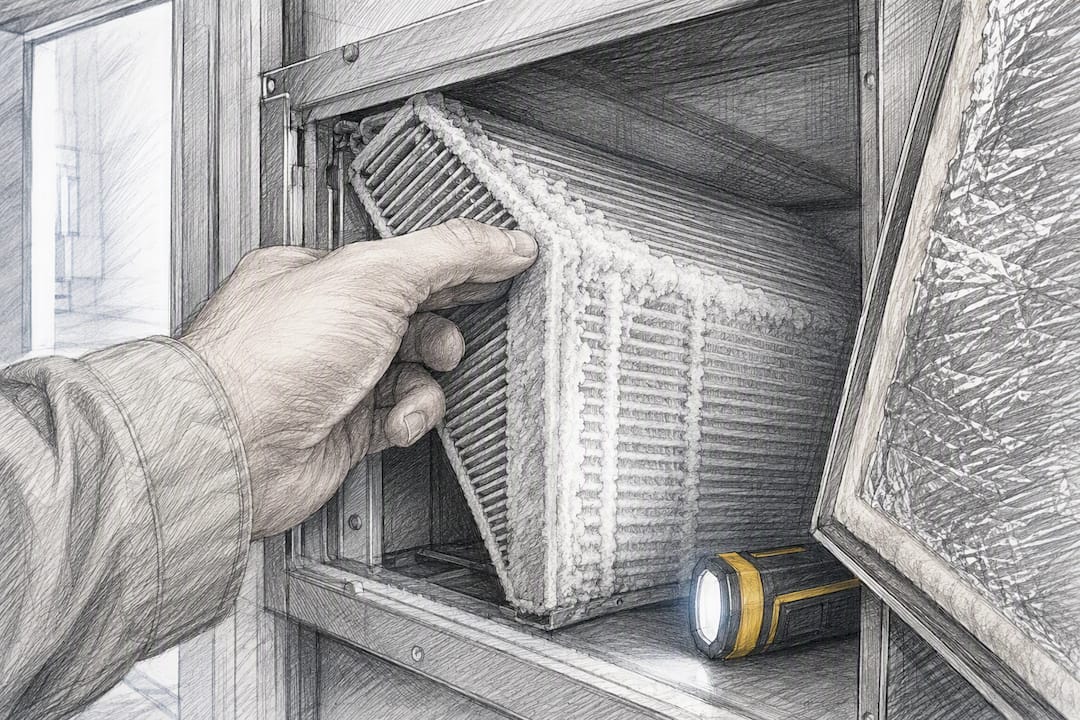
Frost control matters most for HRVs running in climates that dip well below freezing for extended stretches, since sensible-only cores can ice over without a defrost cycle or preheat strategy built into the control sequence.
What ERV and HRV Systems Actually Cost
Installed cost ranges typically fall between roughly $2,000 and $5,500 for a whole-house HRV or ERV system, according to HVAC Database's climate and cost guide. Retrofits into existing homes with limited duct access sit at the higher end because opening walls and rerouting ducts adds labor, while new construction with ducting planned into the design comes in cheaper.
A few things drive the final number:
- Ductwork complexity, particularly in retrofits where existing chases don't line up with where fresh air needs to go.
- Core type and unit capacity, since larger multifamily or commercial units cost more than a single-family residential model.
- Controls integration, especially if the system ties into an existing building automation platform.
On efficiency, sensible heat recovery typically runs 60 to 90 percent, while ERV latent (moisture) transfer effectiveness usually lands between 40 and 70 percent depending on core design and operating conditions, per SupplyHouse's sizing guide. Higher sensible recovery numbers translate directly into lower heating and cooling energy use, which is where the payback math starts.
Before buying, check ENERGY STAR certification status and local utility rebate programs. Certified units are independently verified for the performance numbers on the label, which matters when a rebate program requires proof of efficiency to release funds.
Maintenance Schedule and Mistakes That Shorten System Life
Filters need checking every one to three months depending on dust load and local air quality, with full replacement typically every six to twelve months. Cores should get a professional inspection annually, since buildup on an ERV's moisture-permeable surface behaves differently than dust on a dry HRV plate and can degrade transfer efficiency if ignored.
Common pitfalls worth screening out before they become expensive:
- Oversized units that short cycle and never run long enough to properly exchange air.
- Poor airflow balancing between supply and exhaust, which stresses the building envelope over time.
- Missing or poorly sloped condensate drains that back up and damage surrounding finishes.
- Units installed in locations with no real access panel for filter and core service.
Pro Tip: Request a written commissioning report at handoff showing measured supply and exhaust CFM, not just the design numbers from the submittal. That single document catches most balancing errors before they turn into a callback.
Remember, too, that neither system replaces dedicated bath or kitchen exhaust fans for peak moisture events like a long shower or a boiling pot, a point Panasonic's indoor air quality team emphasizes when explaining what balanced ventilation is and isn't designed to handle.
What an MEP Engineer Checks Before Specifying Either System
A professional MEP engineering firm verifies several things during design that a general contractor's quote sheet usually won't cover: measured airflow requirements against occupancy and code minimums, fan watts per CFM at the actual design operating point, physical access for future filter and core service, the control strategy for boost and humidity response, and frost control provisions for cold climate HRV installations.
Bring in an MEP engineer rather than relying solely on a general contractor when the project involves a tight building envelope, a retrofit with limited duct access, a multifamily or commercial scope, or any Local Law 97 compliance question tied to mechanical system upgrades. A qualified mechanical engineering review catches sizing and duct routing errors before they get built into drywall.
At minimum, request three deliverables from whoever designs the system: a documented airflow schedule showing supply and exhaust CFM by zone, a defrost or frost control strategy for cold climate installations, and a maintenance access plan showing where filters and cores can actually be reached once construction is finished.
A Decision Checklist to Hand Your Contractor
Print this out and use it before signing a proposal:
- Measure building tightness and occupant moisture profile. A blower door test (ACH50 result) combined with occupancy and typical daily activities tells you how much moisture the envelope is trapping.
- Apply the climate decision rules. Cold and dry leans HRV; hot, humid, or mixed climates and tight envelopes lean ERV; heavy internal moisture loads may need either system paired with a dedicated dehumidifier.
- Run ACH or volume-based sizing, not a flat per-square-foot estimate, and have a qualified engineer confirm fan selection against real duct static pressure.
- Specify frost control, drains, and filter class in writing. Don't leave these to verbal assurance.
- Require commissioning documentation and a maintenance access plan before final payment releases.
A homeowner researching indoor air quality basics before this stage will find general guidance on ventilation and IAQ helpful context, and contractors managing multiple retrofit bids might find a quoting tool built for HVAC contractors useful for keeping proposals organized across several properties.
The Engineer's Take: Why Sizing Beats Brand Every Time
Most of the debate online treats ERV vs HRV like a brand rivalry, when the real determining factor is climate data and building tightness math that never makes it into a sales brochure. I'd argue the industry spends too much energy arguing core type and not enough time pulling blower door numbers before quoting a system.
My actual recommendation: in the overwhelming majority of mixed and humid U.S. climates, default to an ERV unless you have a specific reason to go HRV, such as a genuinely cold, dry region or a building with minimal internal moisture generation. That's not a brand preference, it's what the climate data across most zones supports.
Where I'd push back on typical contractor advice is the sizing conversation. Too many quotes get built around square footage instead of measured air changes per hour, and that shortcut is exactly why some ERV and HRV installations underperform their spec sheet numbers within the first year. If you're weighing this decision for a real project, get an MEP engineering review or a site visit before signing anything. The core type matters less than whether anyone actually calculated your building's real airflow needs.
— Joseph