

Demand control ventilation (DCV) adjusts outdoor-air intake in real time based on occupancy signals, usually CO2 concentration, so a building only ventilates as much as the space actually needs. The payoff is lower heating and cooling energy tied to conditioning that outdoor air, while still meeting ventilation code minimums. Whether DCV makes sense for a given building depends on occupancy patterns, climate, and whether the IECC or ASHRAE thresholds actually require it in the first place.
TL;DR:
- DCV can reduce energy costs significantly in spaces with highly variable occupancy, especially in environments like auditoriums and event centers.
- Proper sensor placement in the occupied zone and annual calibration are crucial to prevent false readings that can lead to under- or over-ventilation.
- Meeting IECC 2015 or ASHRAE 62.1 thresholds triggers mandatory DCV systems, requiring documentation of occupant density, sensor specs, and control sequences for permits.
- In steady-occupancy settings, DCV offers minimal savings, and its benefits diminish unless occupancy patterns are unpredictable or highly variable.
- Combining CO2 sensors with VOC or occupancy sensors can improve indoor air quality management beyond occupancy-driven ventilation control.
Table of Contents
- What Demand Control Ventilation Actually Does for Indoor Air
- How DCV Systems Operate: Architectures and Control Logic
- Codes and Thresholds That Trigger DCV Requirements
- When DCV Actually Pays Off
- Sensor Placement, Calibration, and Maintenance That Keep DCV Honest
- Implementing DCV: From Feasibility Study to Commissioning
- How Bazini Engineering Approaches DCV Projects
- What DCV Does and Doesn't Fix in Your Air Quality Picture
- Real-World Patterns: Where DCV Delivers and Where It Struggles
- Sensors Beyond CO2: Occupancy, VOC, and Combined Approaches
- Connecting DCV to Your Building Automation System
- Author Perspective: Realistic Expectations for DCV Outcomes
- Get Your DCV Project Designed and Permitted Right the First Time
- Sources
- FAQ
What Demand Control Ventilation Actually Does for Indoor Air
Constant-rate ventilation systems supply a fixed amount of outdoor air regardless of how many people are in the room. A conference room ventilated for 50 occupants gets the same airflow at 2 p.m. with three people in it as it does during a packed 9 a.m. meeting. Demand control ventilation replaces that fixed rate with a variable one, using sensors to estimate occupancy and adjusting outdoor-air dampers or fan speeds accordingly.
CO2 sensors dominate this application because exhaled carbon dioxide correlates closely with how many people are breathing in a space. It's a practical, low-cost proxy for occupancy, not a full indoor air quality reading. That distinction matters for how you apply it:
- CO2 tells you how many people are present, not whether the air carries mold spores, formaldehyde, or particulate matter.
- A space can read "acceptable" on CO2 while still off-gassing volatile organic compounds from furniture, cleaning products, or nearby construction.
- Rooms with non-occupant pollutant sources, like print shops, labs, or garages, need dedicated exhaust or filtration regardless of what a CO2 sensor reports.
DCV manages the ventilation-for-people part of the equation. It's one control strategy inside a bigger indoor air quality plan, not a replacement for one.
How DCV Systems Operate: Architectures and Control Logic
Two basic architectures cover most commercial DCV installations. Central, or whole-zone, DCV uses a single sensor (or averaged group of sensors) to modulate outdoor air for an entire air handler serving multiple rooms. Local, or room-level, DCV places a sensor in each significant space and adjusts VAV boxes or dedicated dampers independently. Central systems cost less to install and maintain but blur out room-to-room differences. A packed training room and an empty adjacent office get treated the same if they share an air handler.
Control logic generally follows one of three patterns:
- Setpoint-based control, where the system holds CO2 near a fixed target (often 700 to 1,000 ppm above outdoor ambient) and modulates dampers to track it.
- Predictive or lag-compensated control, where the algorithm anticipates rising CO2 trends rather than waiting for steady-state readings, which NIST's technical review identifies as a meaningful improvement over simple reactive control.
- Anti-hunt logic, which dampens rapid back-and-forth actuator movement that wears out dampers and wastes fan energy.
These control loops interact directly with economizer dampers, VAV terminal boxes, and supply fan speed. A poorly tuned DCV sequence can fight your economizer logic, driving dampers open and shut in opposite directions within the same air handler.
Pro Tip: Have your controls contractor log damper position and CO2 trend data for at least two weeks after startup. Hunting shows up clearly as a sawtooth pattern in the trend graph, and it's far easier to catch there than to diagnose from occupant complaints months later.
Codes and Thresholds That Trigger DCV Requirements
The IECC 2015 (Section C403.2.6.1) requires demand control ventilation for spaces larger than 500 square feet when the space has an average occupant density of 25 people per 1,000 square feet or more, and the system serving it includes an economizer, a modulating outdoor air damper, or a design outdoor airflow exceeding 3,000 cfm. Miss any one of those conditions and DCV may not be mandated, though it can still make economic sense.
ASHRAE 62.1 frames DCV as one acceptable method for meeting ventilation rate requirements, tying outdoor air delivery to occupancy rather than fixed design load. It does not mandate a specific CO2 setpoint, but design guidance commonly references a differential of 700 ppm above outdoor conditions as a reasonable indoor target.
IECC 2015 sets the compliance bar at specific thresholds for floor area, occupant density, and design outdoor airflow. Meeting all those thresholds means DCV is a code requirement.
For permitting, keep documentation of occupant density calculations, sensor specification sheets, and sequence-of-operation narratives. Code officials reviewing energy compliance filings will ask for the same paper trail your commissioning agent needs anyway, so build it once and reuse it. Energycodes walks through common compliance pathways and exceptions in more detail.
When DCV Actually Pays Off
The energy case for DCV is real, but the range is wide. MDPI's optimization research found ventilation-related energy reductions up to roughly 40% in typical variable-occupancy scenarios, with optimized configurations reaching close to 52.6% in modeled cases. Those are ceiling numbers from favorable conditions, not a guaranteed outcome for every building.
LBNL's review of field studies shows one restaurant example with a payback period between 2.9 and 6.5 years, depending on operating hours and local climate. That spread illustrates the core variable: DCV saves the most energy where occupancy swings widely and unpredictably.
- Auditoriums, conference centers, and classrooms with heavy scheduling gaps see the strongest returns.
- Spaces with steady, near-constant occupancy (a 24-hour data center floor, for instance) gain little from demand control because there's no idle period to exploit.
- Hot, humid, or bitterly cold climates increase the energy cost of conditioning each cubic foot of outdoor air, which raises the value of every cfm that DCV avoids bringing in.
Run occupancy data before committing capital. A building with predictable, dense scheduling might not justify the sensor and controls investment DCV requires.
Sensor Placement, Calibration, and Maintenance That Keep DCV Honest
Where you mount the CO2 sensor determines whether the whole system works. Sensors belong in the occupied zone, typically wall-mounted at 4 to 6 feet, away from doorways, supply diffusers, and windows. Mounting a sensor in the return air duct is a common shortcut that dilutes the reading with air from unoccupied zones and delays the system's response to a filling room.
- Calibrate on a schedule, not a hunch. Most manufacturers recommend annual calibration verification against a known reference gas or a fresh-air baseline reading, though high-traffic spaces may warrant checking twice a year.
- Verify drift, not just function. A sensor that reports plausible numbers can still have drifted 100 to 150 ppm off true readings, which is enough to trigger under-ventilation without tripping any alarm.
- Tune control loops conservatively. Aggressive proportional gain settings cause dampers to hunt, and that constant motion accelerates actuator wear well before its rated cycle life.
- Log trend data during commissioning and again at the one-year mark to confirm the sequence still matches design intent after a full seasonal cycle.
Pro Tip: Budget for sensor replacement, not just calibration. Non-dispersive infrared CO2 sensors typically hold accuracy for 5 to 10 years, but the ones installed in high-humidity kitchens or pool enclosures degrade faster and deserve a shorter replacement cycle.
Implementing DCV: From Feasibility Study to Commissioning
- Run a feasibility study first. Pull occupancy schedules, existing airflow measurements, and baseline CO2 readings across a representative week, including at least one low-occupancy day.
- Set the design ventilation floor. Even at zero occupancy, code and good practice require a minimum outdoor-air rate to handle building-material off-gassing and infiltration control. Define that floor before writing the control sequence.
- Specify sensor and BAS integration requirements. Document sensor accuracy tolerances, mounting locations, communication protocol (BACnet is standard for most commercial BAS integrations), and alarm thresholds for sensor failure.
- Write the sequence of operations covering setpoint, ramp rates, anti-hunt logic, and fallback behavior if a sensor fails or reports out of range.
- Commission with functional testing, not just a punch-list walk-through. Verify the system actually modulates outdoor air correctly across a range of simulated occupancy levels, and confirm airflow measurements match design using field verification methods similar to those in Building America's commissioning protocols.
- Retain acceptance testing records for the code official and for your own operations team's future reference.
How Bazini Engineering Approaches DCV Projects
Mechanical design, code compliance review, and permitting work for DCV retrofit or new installation projects are coordinated under one roof rather than split across separate consultants. A well-scoped proposal should spell out feasibility analysis, sequence-of-operations design, BAS integration specifications, and commissioning support as separate line items, not a vague bundle.
The firm has experience handling Department of Buildings filing requirements on mechanical projects where ventilation strategy directly affects energy code sign-off. That regulatory familiarity matters when a DCV sequence needs to satisfy both ASHRAE 62.1 and a local jurisdiction's energy compliance path at the same time.
What DCV Does and Doesn't Fix in Your Air Quality Picture
CO2 concentration is a reasonable stand-in for occupancy, but it says nothing about humidity, particulate matter, or volatile organic compounds. A building can hold CO2 comfortably below 1,000 ppm while relative humidity climbs into the range that supports mold growth, or while a recent floor refinishing project off-gasses VOCs that a CO2-driven damper sequence has no reason to detect or respond to.
This is why demand control ventilation should sit inside a broader indoor air management strategy, not stand in for one. Humidity control typically runs on its own sensor loop tied to dehumidification equipment or economizer lockouts during high dew-point conditions. Particulate matter calls for filtration rated to the right MERV or HEPA standard for the space's use, independent of how much outdoor air is flowing. VOC-heavy spaces, like print rooms, nail salons, or areas near recent renovation work, need dedicated exhaust regardless of what the occupancy-driven ventilation rate says.
The practical risk is treating a good CO2 reading as a green light for indoor air quality broadly. Facility teams that lean entirely on DCV data for air quality reporting can miss humidity swings or pollutant events that a dedicated sensor would have caught. A more complete approach pairs CO2-based demand control with separate humidity and particulate monitoring, so the ventilation system optimizes energy while other sensors watch for the things CO2 can't see.
Real-World Patterns: Where DCV Delivers and Where It Struggles
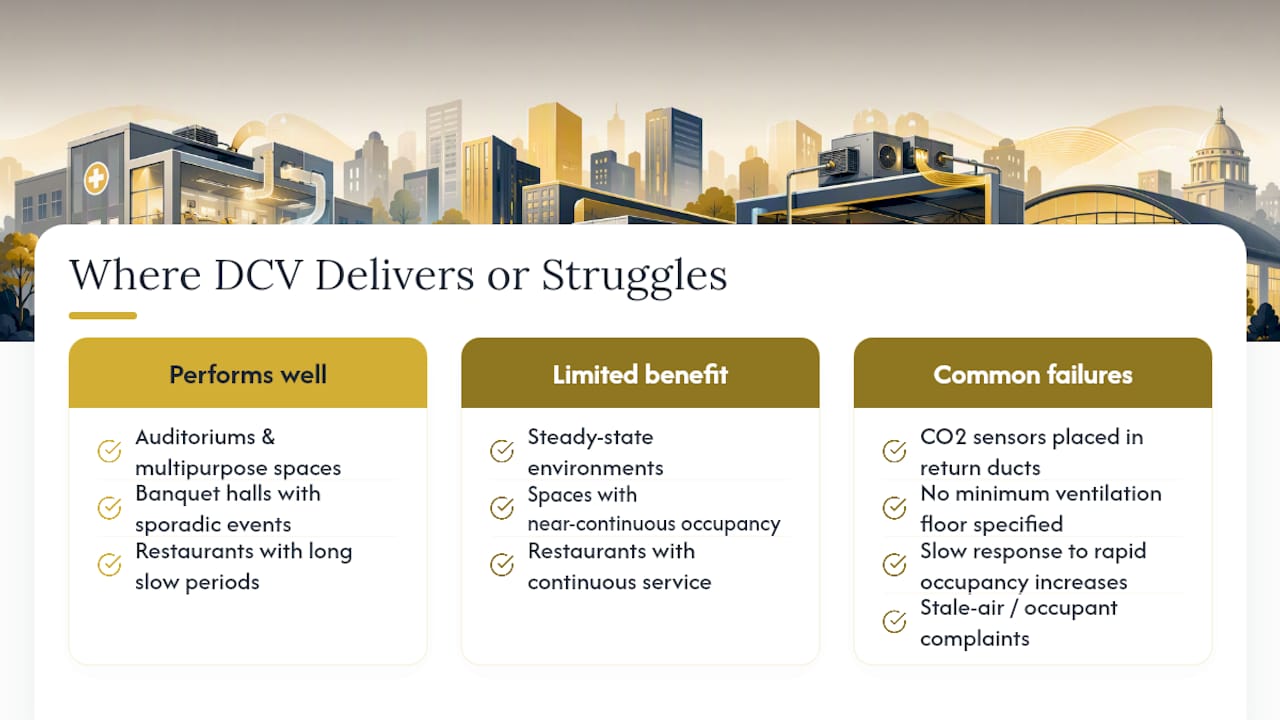
Field data collected across commercial buildings tells a consistent story: DCV performs best in spaces with irregular, unpredictable occupancy and struggles to justify itself in steady-state environments. Auditoriums and multipurpose event spaces are the clearest winners. A banquet hall that hosts a 400-person wedding on Saturday and sits empty on Tuesday morning wastes enormous conditioning energy under constant-volume ventilation. DCV lets that space ventilate for 400 people only when 400 people are actually there.
LBNL's field study synthesis documents a restaurant retrofit where payback landed between 2.9 and 6.5 years depending on the specific operating schedule and local climate, a wide enough range to show why a feasibility study matters more than a rule of thumb. Restaurants with long slow periods between meal rushes saw the faster paybacks; those running near-continuous service throughout the day saw less benefit.
The common failure mode across these projects isn't the concept, it's execution. Buildings that installed CO2 sensors in return ducts instead of occupied zones reported sluggish response and occupant complaints about stuffiness during rapid occupancy increases, like a classroom filling between periods. Others skipped the minimum ventilation floor specification entirely, which let outdoor air drop too low during low-occupancy periods and created stale-air complaints even though the CO2 sensor was technically working as designed. The lesson from these cases is consistent: DCV's return on investment depends far more on correct sensor placement and a properly set ventilation floor than on the sophistication of the control algorithm itself.
Sensors Beyond CO2: Occupancy, VOC, and Combined Approaches
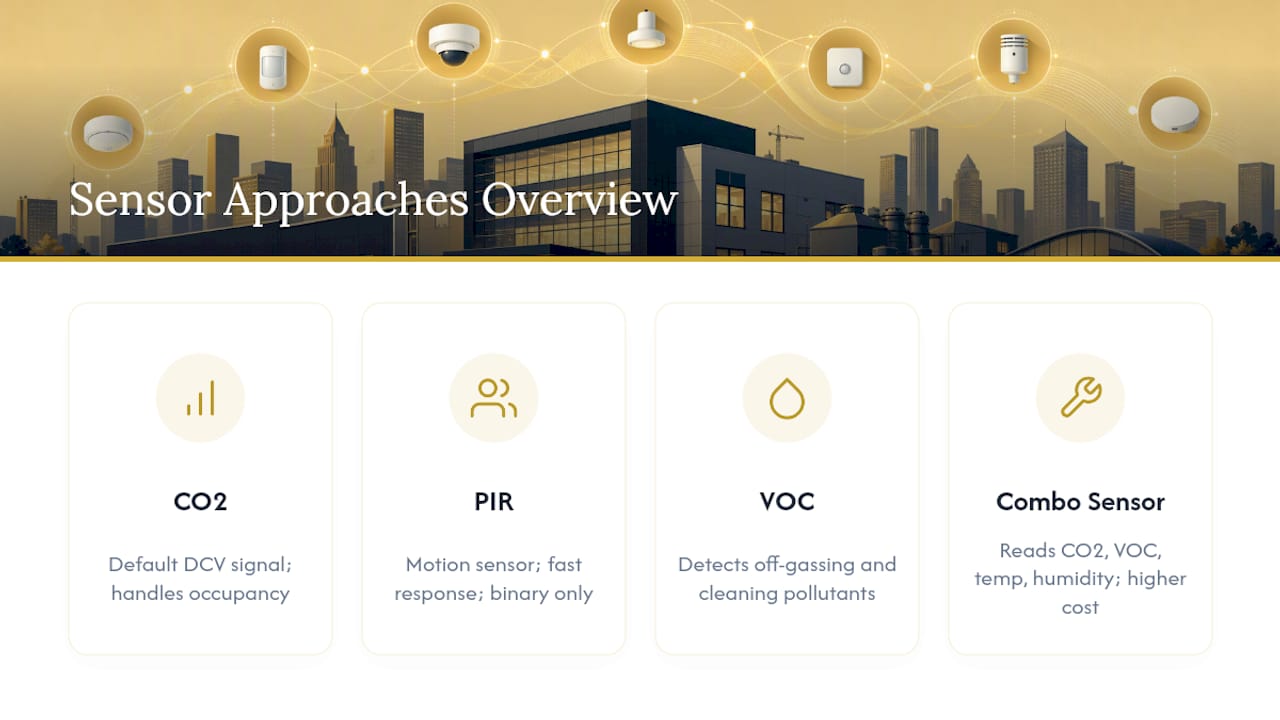
CO2 remains the default sensor for demand control ventilation, but it's not the only option, and combining sensor types often produces better outcomes than relying on one signal alone.
Passive infrared (PIR) occupancy sensors, the same technology used for lighting controls, detect motion and presence directly rather than inferring it from exhaled CO2. They respond faster to sudden occupancy changes, since they don't wait for CO2 to accumulate, but they can't distinguish between two people and twenty. That makes PIR sensors better suited to binary occupied/unoccupied control in small rooms than to proportional ventilation modulation in larger spaces.
Volatile organic compound (VOC) sensors detect a broader category of pollutants, including off-gassing from furnishings, cleaning chemicals, and building materials that CO2 sensors miss entirely. Some commercial systems now combine CO2 and VOC readings into a single air quality index that drives ventilation decisions, which addresses part of the gap between occupancy-based control and genuine indoor air quality management.
Combination sensors that read CO2, VOCs, temperature, and humidity from a single device have become more common in newer BAS installations, reducing the number of individual points a facility team has to maintain. The trade-off is cost. A combination sensor typically runs higher upfront than a standalone CO2 unit, and calibration requirements multiply since each measured parameter can drift independently. For most commercial applications, a straightforward CO2-based DCV system handles occupancy-driven ventilation well, with VOC or combination sensors reserved for spaces where pollutant sources beyond people are a known concern.
Connecting DCV to Your Building Automation System
DCV rarely operates as a standalone control loop. It typically integrates into a building automation system (BAS) that also manages temperature control, economizer operation, and scheduling, and that integration is where a lot of real-world performance gets won or lost.
Most commercial BAS platforms communicate over BACnet, which lets a CO2 sensor's reading feed directly into the same controller logic that manages VAV box positions and air handler fan speed. This integration allows DCV to work in concert with economizer free-cooling strategies instead of against them. If the economizer wants outdoor air open for free cooling on a mild day, while the DCV sequence wants it closed because the room is empty, the BAS needs clear priority logic to resolve that conflict, usually by allowing economizer cooling to override the DCV minimum whenever outdoor conditions are favorable.
Alarming is another integration point worth specifying explicitly. A failed CO2 sensor should trigger a BAS alarm and fall back to a safe default ventilation rate, not silently hold the last known value or default to zero outdoor air. Facility teams that skip this fallback logic risk under-ventilating a space for weeks before anyone notices a sensor has failed.
Trend logging through the BAS also turns DCV into a diagnostic tool, not just a control strategy. Reviewing CO2 trends against occupancy schedules over several months can reveal whether the current setpoint is too conservative, whether particular sensors are drifting, or whether a space's actual usage pattern has shifted away from its original design assumptions.
Author Perspective: Realistic Expectations for DCV Outcomes
DCV works when the design accounts for real occupancy variability and someone commits to maintaining it. The energy numbers in the research are genuine, but they assume calibrated sensors and correctly set ventilation floors. Get the minimum ventilation rate right first. Chase savings second. Pilot it in one zone, measure a full seasonal cycle, then decide whether to expand.
— Joseph
Get Your DCV Project Designed and Permitted Right the First Time
Retrofitting demand control ventilation touches code compliance, controls sequencing, and permitting all at once, and most facility teams don't have in-house staffed to coordinate all three. Bazini Engineering handles mechanical design, IECC and ASHRAE compliance review, and NYC Department of Buildings filing under a single scope, so a DCV project doesn't get stuck waiting on a separate controls contractor and a separate code consultant to sync up.

A solid proposal should include occupancy feasibility analysis, a documented sequence of operations, BAS integration specifications, and a commissioning plan with acceptance testing, not just an equipment list. If you're evaluating whether DCV makes sense for a building you manage, start by reviewing Bazini Engineering's mechanical engineering services or the broader services overview for building owners weighing a feasibility study before committing to design.
Sources
- A Review of Demand Control Ventilation (Lawrence Berkeley National Lab)
- Optimizing air conditioning / ventilation energy using advanced modeling (MDPI study)
- State-of-the-Art Review of CO2 Demand-Controlled Ventilation (NIST)
FAQ
What Is Demand Control Ventilation in Simple Terms?
It's a control strategy that adjusts how much outdoor air a building brings in based on real-time occupancy, most often measured through CO2 sensors, instead of ventilating at a fixed rate all day.
What Are the Risks of Running DCV in PCV Mode?
Proportional control valve style logic without anti-hunt safeguards can cause dampers to oscillate rapidly between positions, wearing out actuators early and creating unstable ventilation rates that either under-ventilate occupied spaces or waste the energy savings DCV is meant to deliver.
What Are the Four Types of Ventilation Strategies?
Commercial buildings typically use constant-volume ventilation, variable air volume (VAV) systems, natural or mixed-mode ventilation, and demand control ventilation, each suited to different occupancy patterns and building types.
Does DCV Work in Every Climate?
DCV delivers the strongest energy returns in hot, humid, or very cold climates where conditioning outdoor air is expensive, and less benefit in mild climates where outdoor air requires little heating or cooling.
Can Bazini Engineering Help With DCV Permitting in NYC?
Yes. Bazini Engineering is licensed in New York and handles NYC Department of Buildings filing and permit coordination for mechanical projects, including ventilation control retrofits, through its permit filing services.