
A dedicated outdoor air system, or DOAS, conditions 100% outdoor air on a separate path from your building's heating and cooling equipment. It exists to decouple ventilation from sensible temperature control, which is the single biggest reason it outperforms mixed-air systems on humidity management.
Three reasons drive most DOAS specifications:
- Humidity control that doesn't hinge on how hard the compressor happens to be running that hour
- Indoor air quality improvements from delivering a fixed, verifiable volume of outdoor air regardless of space load
- Code compliance, since ASHRAE 62.1 ventilation rates and model energy codes that increasingly assume a dedicated ventilation path
One variant, the direct expansion DOAS (DX-DOAS), has its own federal definition and performance thresholds worth understanding before you specify equipment. More on that shortly.
Key Takeaways
DOAS works by decoupling ventilation and latent load control from sensible heating and cooling, which is what makes humidity control and code compliance reliable regardless of occupancy swings.
| Point | Details |
|---|---|
| Definition drives design | A DOAS conditions 100% outdoor air separately from sensible systems, targeting a supply dew point around 50 to 55°F. |
| DX-DOAS has a federal threshold | 10 CFR 431.92 caps DX-DOAS moisture removal at 324 lb./h under Standard Rating Condition A. |
| Best-fit buildings | Healthcare, schools, labs, kitchens, and dense offices see the largest IAQ and humidity gains. |
| Commissioning prevents failure | Trend supply dew point and ERV effectiveness for at least two weeks post-commissioning, not a single reading. |
| Codes shape sizing | ASHRAE 62.1 sets ventilation rates and ASHRAE 90.1, along with code provisions like C406.6, push energy recovery adoption. |
Table of Contents
- What Are Dedicated Outdoor Air Systems and How Do They Work?
- Where DOAS Delivers the Biggest Payoff
- DOAS Equipment Options and How to Configure Them
- Sizing a DOAS: A Practical Design Checklist
- Codes and Standards Governing DOAS Design
- What Drives DOAS Cost and Payback
- Installation and Commissioning Priorities for DOAS
- Keeping DOAS Performing: Maintenance and Monitoring
- Why Bazini Engineering for Your DOAS Project
- What DOAS Actually Does for Indoor Air and Occupant Health
- Real-World Situations Where DOAS Earns Its Cost
- Common DOAS Problems and How to Fix Them
- Environmental Benefits and Certification Value of DOAS
- Why Regulatory Fluency Matters More Than System Preference
- Sources
What Are Dedicated Outdoor Air Systems and How Do They Work?
Picture two independent systems running in parallel instead of one unit trying to do everything. The DOAS handles 100% outdoor air, ventilation code compliance, and latent load (moisture) removal. A separate sensible-only system, whether fan coils, VRF, chilled beams, or radiant panels, handles the temperature swings caused by occupancy, solar gain, and equipment loads. Neither system compromises to cover for the other's job.
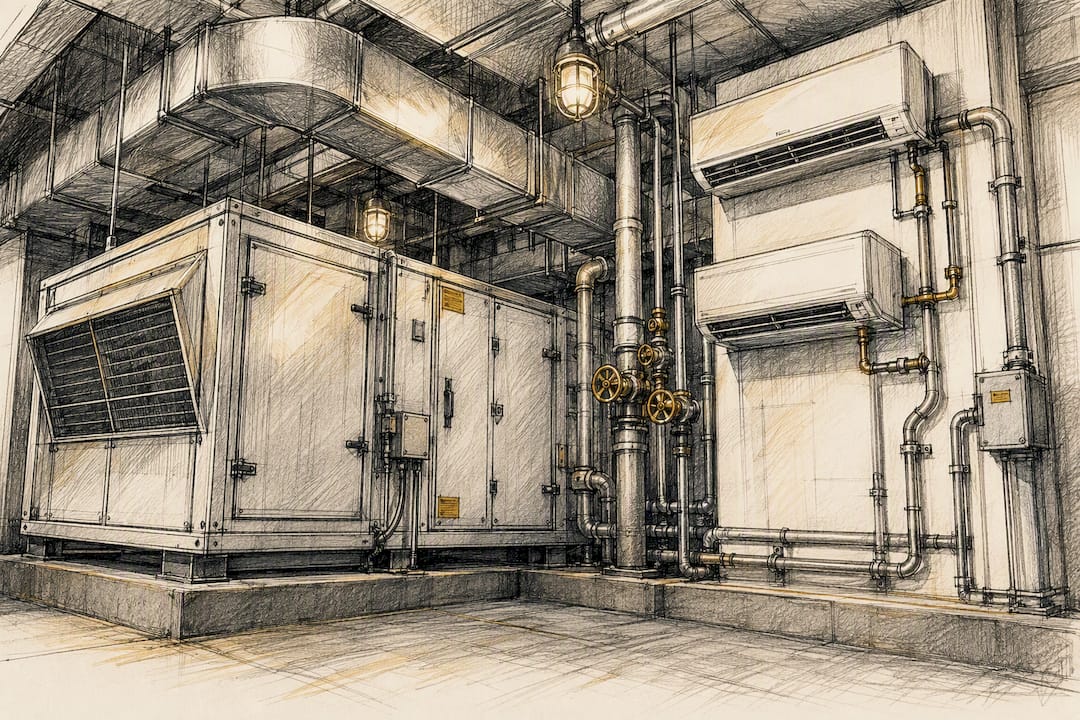
That separation solves a problem traditional rooftop units struggle with constantly: a conventional single-path system sized for peak sensible load frequently short-cycles at partial load, and short-cycling means the coil never runs long enough to pull adequate moisture out of the air. Humidity creeps upward even when the thermostat reads satisfied. A DOAS avoids this because its outdoor air stream is conditioned to a target supply-air dew point, typically in the 50 to 55°F range, independent of how the space's sensible system happens to be cycling that moment.
Energy recovery is where DOAS earns back most of its operating cost. Three approaches dominate:
- Enthalpy wheels transfer both heat and moisture between exhaust and incoming outdoor air streams, cutting the load the DOAS coil has to handle before conditioning even starts.
- Sensible heat wheels or plate exchangers transfer temperature only, useful where cross-contamination rules (labs, some healthcare spaces) prohibit moisture transfer between air streams.
- Run-around coils use a glycol loop to move energy between exhaust and supply without any direct air-to-air contact, the choice when code or infection-control requirements demand full separation.
Energy recovery ventilation, as Consulting-Specifying Engineer notes, often lets designers downsize the DOAS coil and the parallel sensible equipment simultaneously, since precooling or preheating incoming air before it hits the main coil shrinks the load both systems have to carry.
Where DOAS Delivers the Biggest Payoff
The core benefit is straightforward: reliable moisture removal that doesn't depend on sensible load coincidentally being high enough to keep a coil running long. That translates into fewer mold and mildew complaints, tighter humidity bands for sensitive occupancies, and ventilation air quality that holds steady whether a room is at 10% occupancy or 100%.
Pairing DOAS with a sensible-only system also shrinks equipment size across the board. Because the DOAS already handles latent load and fresh-air introduction, the parallel system only needs to chase temperature, which usually means smaller compressors, less ductwork, and lower fan energy overall.
Not every building type needs this. Some benefit dramatically more than others:
- Healthcare facilities, where infection control and precise humidity bands are non-negotiable
- Schools, where classroom occupancy density spikes ventilation demand on a schedule
- Laboratories, where pressure relationships and 100% outdoor air are often mandated outright
- Commercial kitchens, where makeup air requirements are substantial and constant.
- Dense open offices, where occupant-driven CO2 swings make fixed ventilation control valuable
Pro Tip: If your building has intermittent, high-density occupancy (auditoriums, gyms, conference centers), DOAS with demand-controlled ventilation tied to CO2 sensors will outperform a fixed-percentage outdoor air damper on both energy and IAQ.
DOAS Equipment Options and How to Configure Them
Every DOAS, regardless of size or building type, shares a core component list:
- Filtration ahead of the coils, typically MERV 13 or higher for occupied spaces
- Cooling and dehumidification coils sized to hit a target supply dew point, not just a supply temperature
- Reheat, electric, hot water, or a heat-recovery source, to avoid overcooling supply air on the way to the space
- Energy recovery device (wheel, plate exchanger, or run-around coil)
- Supply and exhaust fans, sized against the static pressure of dedicated outdoor air ductwork
- Motorized dampers and weatherproof louvers at the outdoor air intake, with low-leakage dampers specified where code demands tight shutoff
Configuration choice depends heavily on climate, space, and budget:
Packaged rooftop DOAS units bundle everything into one factory box. They're the fastest to install and commission but demand real roof structural capacity and clear rigging access.
Split systems separate the outdoor air handling unit from a remote condensing unit, useful when roof loading or space constraints rule out a packaged unit.
DX-DOAS units use direct expansion refrigeration instead of chilled water, and they carry a specific federal definition worth knowing before you compare cut sheets. 10 CFR 431.92 defines a direct expansion dedicated outdoor air system as unitary DOAS equipment rated to dehumidify air to a 55°F dew point under Standard Rating Condition A, with moisture removal capacity under 324 pounds per hour. That threshold matters because manufacturers reference it constantly in performance claims, and a unit rated above that moisture removal capacity falls outside the DX-DOAS category entirely.
Hydronic DOAS relies on chilled and hot water coils fed from a central plant, typically the choice on larger campuses that already have chiller and boiler infrastructure to tap into.
Pairing options for the sensible side matter just as much as the DOAS itself. Fan coil units are the default, VRF indoor units add zoning flexibility, chilled beams work well in spaces with tight humidity control already handled upstream, and radiant panels, as Penn State's DOAS-radiant research documents, pair particularly well with DOAS because radiant systems have zero dedicated need to handle latent load themselves.
Sizing a DOAS: A Practical Design Checklist
Sizing starts with ventilation rate, not tonnage. Work through it in this order:
- Pull required outdoor airflow from ASHRAE 62.1, using the occupancy category and floor area rates for each zone, then sum to a building total supply airflow.
- Calculate the latent load the DOAS coil must remove, based on your design outdoor air condition (typically a 1% or 0.4% design dew point from ASHRAE climate data) against your target supply-air dew point.
- Set the supply-air dew point target, usually 50 to 55°F for standard comfort applications, lower for spaces with strict humidity limits like operating rooms or archives.
- Choose energy recovery based on climate and code, since humid climates gain the most from enthalpy wheels, while dry climates may lean toward sensible-only recovery or skip it where energy code doesn't require it.
- Decide whether DX-DOAS fits the moisture removal profile, checking rated capacity against the 324 lb./h threshold in 10 CFR 431.92 before locking in equipment selection.
Get the dew point target wrong and everything downstream, coil sizing, reheat capacity, energy recovery selection, follows the wrong number.
Codes and Standards Governing DOAS Design
Three regulatory references shape almost every DOAS specification you'll write:
- ASHRAE Standard 62.1 sets the ventilation rates that drive DOAS airflow sizing in the first place. Every cubic foot per minute the DOAS delivers traces back to an occupancy category and area rate in this standard.
- ASHRAE Standard 90.1 governs energy performance, and its provisions increasingly push designers toward energy recovery on outdoor air systems above certain airflow thresholds.
- Model energy code provisions, including section C406.6 referenced by UpCodes, require independent ventilation systems capable of delivering 100% outdoor air with total energy recovery under specific conditions, which is effectively a code mandate toward DOAS architecture in qualifying buildings.
- 10 CFR 431.92, the federal definition covered above, matters any time a DX-DOAS unit's dehumidification or moisture removal performance claim needs to be verified against a standard test condition.
The DOE's guidance on DX-DOAS exists specifically to keep efficiency testing and equipment claims consistent across manufacturers, which matters when you're comparing cut sheets from different vendors during a bid process.
What Drives DOAS Cost and Payback
First cost concentrates in a few predictable places: the energy recovery device itself, controls integration with the building automation system, ductwork changes needed to route a second air path to every zone, and any structural or rooftop work required to support new equipment weight.
Operating cost, by contrast, is mostly a function of three levers:
- Energy recovery effectiveness, since a well-selected enthalpy wheel can offset a meaningful share of the coil's conditioning load
- Fan power, which scales with duct static pressure and needs careful attention in retrofit projects with limited chase space
- Reduced chiller and boiler load on the parallel sensible system, since it no longer carries latent duty
Payback varies by climate. Humid coastal and southern climates see faster returns because latent load reduction is worth more where outdoor dew points run high most of the year. Dry climates still gain IAQ and code-compliance value, but the energy story is less dramatic. Run the numbers against your actual utility rates before assuming a blanket payback figure applies.
Installation and Commissioning Priorities for DOAS
Get the controls sequence right before anything else. The DOAS needs dew point control on the supply air (not just temperature control), occupancy-based ventilation reset where CO2 sensors justify it, and a building automation sequence that coordinates the DOAS with the parallel sensible system rather than letting each run independently.
Commissioning should verify, in order:
- Airflow at each diffuser or grille matches the design ventilation rate, not just total unit airflow.
- Energy recovery device performance against rated effectiveness, since a wheel running below spec silently increases coil load.
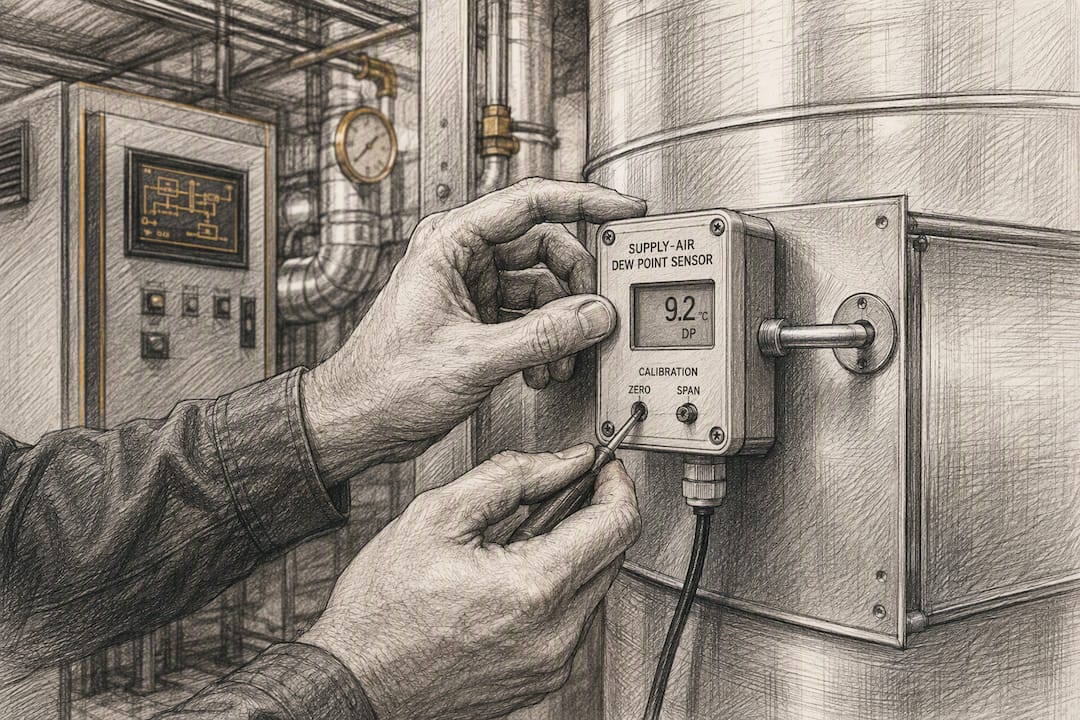
- Sensor placement and calibration, particularly the supply-air dew point sensor, which is the single point of failure for humidity control if it drifts uncalibrated.
The most common installation error is treating the DOAS supply duct like a standard mixed-air duct, undersizing it for the static pressure a dedicated 100% outdoor air path actually needs.
Pro Tip: Insist on a trend log of supply-air dew point for at least two full weeks post-commissioning, covering both a high-humidity and moderate day. A single-point reading tells you nothing about how the system behaves at partial load.
Keeping DOAS Performing: Maintenance and Monitoring
Routine maintenance keeps a DOAS delivering the humidity control it was designed for:
- Replace filters on a schedule matched to actual loading, not a generic calendar interval
- Inspect the ERV wheel or plate exchanger for fouling and seal wear at least twice yearly
- Clean coils regularly, since a fouled dehumidification coil loses latent capacity long before its sensible capacity visibly drops
- Service supply and exhaust fans, checking belt tension and bearing condition
Monitoring matters as much as physical maintenance. Track ventilation airflow against design setpoint, watch supply dew point trends over time rather than single readings, and set BAS alarms for dew point excursions so drift gets caught before occupants notice humidity problems. Keep critical spare parts, particularly wheel seals and sensor elements, on hand, and make sure unit access panels weren't boxed in by other rooftop work after installation.
Why Bazini Engineering for Your DOAS Project
Bazini Engineering, founded in 2010, specializes in mechanical, electrical, plumbing, and fire protection design across commercial, institutional, and industrial projects. The firm is licensed in both New York and Florida and regularly coordinates permit filings with agencies including the NYC Department of Buildings.
On DOAS projects specifically, Bazini Engineering handles HVAC system design from ventilation load calculations through equipment selection, verifies ASHRAE 62.1 and 90.1 compliance, and supports commissioning oversight to confirm the design intent, particularly supply dew point control, actually holds up in operation. That combination of code fluency and hands-on commissioning experience matters more on DOAS projects than on conventional HVAC work, since a miscalibrated dew point sensor or an undersized energy recovery wheel can quietly undo the humidity control the whole system was specified to deliver.
What DOAS Actually Does for Indoor Air and Occupant Health
Ventilation rate alone is a crude proxy for indoor air quality. What matters more is whether that ventilation air actually reaches occupants at a consistent rate, and DOAS is structurally better at this than a mixed-air system because outdoor air delivery doesn't compete with a thermostat's call for cooling or heating.
The EPA's indoor air quality guidance points to consistent, adequate ventilation as one of the most reliable levers for reducing indoor contaminant concentrations, everything from CO2 buildup to volatile organic compounds off-gassing from furnishings and cleaning products. A DOAS delivers that consistency by design, since its airflow is set by ventilation requirement rather than by whatever the sensible system happens to be doing that hour.
Humidity control carries its own health dimension separate from comfort. Sustained relative humidity above roughly 60% creates conditions where dust mites and mold thrive, and mixed-air systems running at partial sensible load are exactly the systems most prone to letting humidity drift into that range. A DOAS holding supply-air dew point steady avoids the humidity swings that let mold colonize wet coils, ceiling tiles, or carpet.
For occupants with asthma or other respiratory sensitivities, that stability isn't a marginal benefit. Buildings with erratic ventilation and humidity control see more occupant complaints tied to stuffiness, odor, and perceived air staleness, complaints that tend to disappear once a DOAS is delivering fresh air at a fixed, verifiable rate regardless of what the rest of the HVAC system is doing.
Real-World Situations Where DOAS Earns Its Cost
A school district retrofitting aging classroom unit ventilators runs into the same wall almost every time: occupancy swings from a packed classroom to an empty one within an hour, and single-path rooftop units simply can't track that swing while also holding humidity steady. Adding a DOAS with demand-controlled ventilation tied to classroom CO2 sensors lets the ventilation rate track actual occupancy instead of running at a fixed worst-case rate all day, cutting fan and reheat energy while still meeting ASHRAE 62.1 minimums during peak occupancy.
Commercial kitchens present a different problem entirely: makeup air requirements driven by exhaust hood volumes are large and constant, and that makeup air has to be conditioned regardless of what the dining room's comfort system is doing. A DOAS sized specifically to that makeup air load, with energy recovery capturing heat from the kitchen exhaust stream, handles this cleanly without forcing the dining room's rooftop unit to fight a load it was never sized for.
A lab needing precise dew point control on 100% outdoor air, without the cross-contamination risk of an enthalpy wheel, is exactly the profile that pushes designers toward sensible-only recovery paired with a DX-DOAS unit rated against the moisture removal thresholds in 10 CFR 431.92.
Common DOAS Problems and How to Fix Them
The single most frequent complaint on a commissioned DOAS is humidity drifting upward despite the system apparently running fine. Nine times out of ten, the root cause is a supply-air dew point sensor that drifted out of calibration months after commissioning and was never caught because nobody was trending the data.
Undersized ductwork causes a related but distinct problem.
Energy recovery wheels foul faster than most maintenance schedules account for, particularly in urban environments with heavier particulate loads. A fouled wheel silently loses effectiveness, which shows up as higher coil loads and higher energy bills long before anyone notices the wheel itself needs cleaning.
Coordination gaps between the DOAS and the parallel sensible system cause the fourth common failure. If the building automation system doesn't actually integrate the two, you end up with a DOAS delivering cold, dry air into a zone where the sensible system is simultaneously calling for heat, wasting energy fighting itself. The fix is a BAS sequence that treats both systems as one coordinated strategy from the start, not two systems bolted together after the fact. Partnering with firms experienced in commercial building system integration during design review catches most of these coordination gaps before they reach construction.
Environmental Benefits and Certification Value of DOAS
Energy recovery is where DOAS earns real sustainability credit, not just IAQ credit. An enthalpy wheel or run-around coil capturing exhaust energy before it goes outside directly reduces the fossil fuel or grid electricity the building's heating and cooling plant has to supply, which lowers the building's operational carbon footprint over its lifetime.
That energy reduction also plays directly into green building certification. LEED's energy and indoor environmental quality credit categories both reward the kind of measurable, verifiable ventilation performance a DOAS delivers, since fixed outdoor air rates with energy recovery are easier to document and verify than a mixed-air system's variable outdoor air fraction. Projects pursuing LEED or similar certifications increasingly specify DOAS not because it's trendy, but because it produces the kind of clean, auditable ventilation data certification reviewers actually want to see.
Smaller sensible-side equipment, a direct byproduct of decoupling latent load onto the DOAS, compounds the sustainability story further. Less refrigerant charge across smaller compressors means lower potential global warming impact if a leak ever occurs, and reduced equipment size generally means less embodied carbon in manufacturing and shipping that equipment in the first place. None of this replaces a full lifecycle assessment, but it's a real, cumulative advantage that stacks on top of the humidity and IAQ benefits DOAS was originally specified to solve.
Why Regulatory Fluency Matters More Than System Preference
Most DOAS advice online treats system selection as the hard part: packaged versus split, enthalpy wheel versus run-around coil, DX versus hydronic. That's the easy part. The harder, more consequential decision is whether your team actually understands what a manufacturer's performance claim means against the federal DX-DOAS definition in 10 CFR 431.92, and whether your commissioning plan verifies supply dew point performance rather than just airflow and temperature.
Conventional guidance underweights commissioning almost universally. A DOAS specified correctly on paper and commissioned poorly in the field produces the exact humidity complaints it was meant to eliminate, and by the time facility staff notice, the sensor drift or fouled wheel causing it has often been quietly degrading performance for months.
If there's one priority worth fixing first, it's building a trend log requirement into the commissioning scope before construction starts, not after occupants complain. Supply-air dew point, ERV effectiveness, and actual zone airflow against design values should all be verifiable data points, not assumptions carried over from the mechanical schedule. Get that discipline in place and the equipment selection debate becomes far less consequential than it usually gets treated.
— Joseph