

For most whole-house repipes, PEX is the more cost-effective, freeze-tolerant choice. Copper still wins when you need the longest proven lifespan, an exposed outdoor run, or a connection near high heat. The right call also shifts with your water chemistry and climate, so treat this as a starting point before the head-to-head breakdown below.
TL;DR:
- Copper pipes may last longer but are more expensive and require more complex installation compared to PEX, which is faster and cheaper to install.
- PEX handles freezing better by expanding, while copper can burst if exposed to low temperatures without protection.
- Water chemistry significantly impacts pipe longevity, with aggressive water causing copper pinhole leaks earlier and degrading PEX under high chlorine or heat conditions.
- For most renovations, using PEX for branch lines and vulnerable sections, and copper for exposed or high-heat areas, offers a balanced approach.
- Complex projects and multifamily buildings benefit from engineering guidance to ensure code compliance and proper integration with other systems.
Table of Contents
- Copper vs PEX: A Head-to-Head Comparison
- What Does a Copper vs. PEX Repipe Actually Cost?
- How Long Do Copper and PEX Pipes Actually Last?
- Does PEX or Copper Handle Freezing Better?
- How Do You Choose Between Copper and PEX for Your Project?
- When Should You Bring in an Engineer, Not Just a Plumber?
- The Real Trade-Off Nobody States Plainly
- Get Engineering-Level Guidance Before You Repipe
- Sources
Copper vs PEX: A Head-to-Head Comparison
Lifespan is where copper still leads on paper. Installed correctly, copper piping lasts roughly 50 to 70 years, compared with PEX's 40 to 50. That gap matters less than it sounds, though, because copper's failures tend to arrive early and unpredictably: aggressive water chemistry causes pinhole corrosion that PEX simply cannot develop, since PEX doesn't react with water the way metal does.
Statistic Callout: Copper's 50 to 70 year lifespan assumes stable water chemistry and correct installation. Soft, acidic, or high-velocity water can cut that number dramatically, sometimes to a fraction of the rated life.
Installation complexity is the other big divider. PEX uses heat-free fittings and snakes through finished walls far more easily than rigid copper, which needs soldering, more precise measuring, and more wall-opening to route. That difference shows up directly in labor hours and, eventually, in your bid.
Here's how the two stack up on the factors that actually decide most repiping decisions:
- Freeze resistance: PEX flexes and generally survives a freeze; copper is rigid and prone to bursting.
- Corrosion: PEX resists the chemical reactions that cause copper's pinhole leaks in aggressive water.
- UV and pests: Copper handles sun exposure and rodents better; PEX needs protection from both.
- Flow and pressure: PEX's inner diameter is often smaller for the same nominal size, so some jobs need a size up to match copper's flow.
- Code acceptance: Both are accepted under most plumbing codes, but PEX must meet NSF/ANSI 61 for potable water contact, and many jurisdictions still require a short copper stub at the water heater.
Insurance underwriters occasionally flag PEX in older homes during inspections, not because it fails more, but because inspectors are less familiar with it than copper. Ask your insurer directly rather than assuming either material creates a coverage problem.
What Does a Copper vs. PEX Repipe Actually Cost?
A whole-house repipe with copper commonly runs well above a PEX repipe of the same scope, largely because PEX costs less on both material and labor. Fewer fittings, no torch, and faster wall access all shrink the invoice.
Soldering is the single biggest cost driver on a copper job. Every joint needs a clean cut, flux, heat, and cooling time, and any mistake means re-cutting the pipe. Add drywall repair after the plumber closes up the walls, and copper labor costs stack quickly. PEX's push-fit, crimp, or expansion connections skip the torch entirely, which is why crews finish PEX repipes in less time.
Before you consider doing any of this yourself, know the risks:
- Soldering copper safely requires practice; a bad joint can leak for months before you notice.
- PEX crimp and expansion tools cost real money upfront and are useless for one job.
- DIY plumbing work can void manufacturer warranties or violate local permit requirements.
- Insurance claims tied to water damage sometimes get denied if unpermitted DIY work caused the failure.
How Long Do Copper and PEX Pipes Actually Last?
Lifespan numbers only tell part of the story. Copper's 50 to 70 year rating and PEX's 40 to 50 year rating both assume a well-installed system in reasonably normal water.
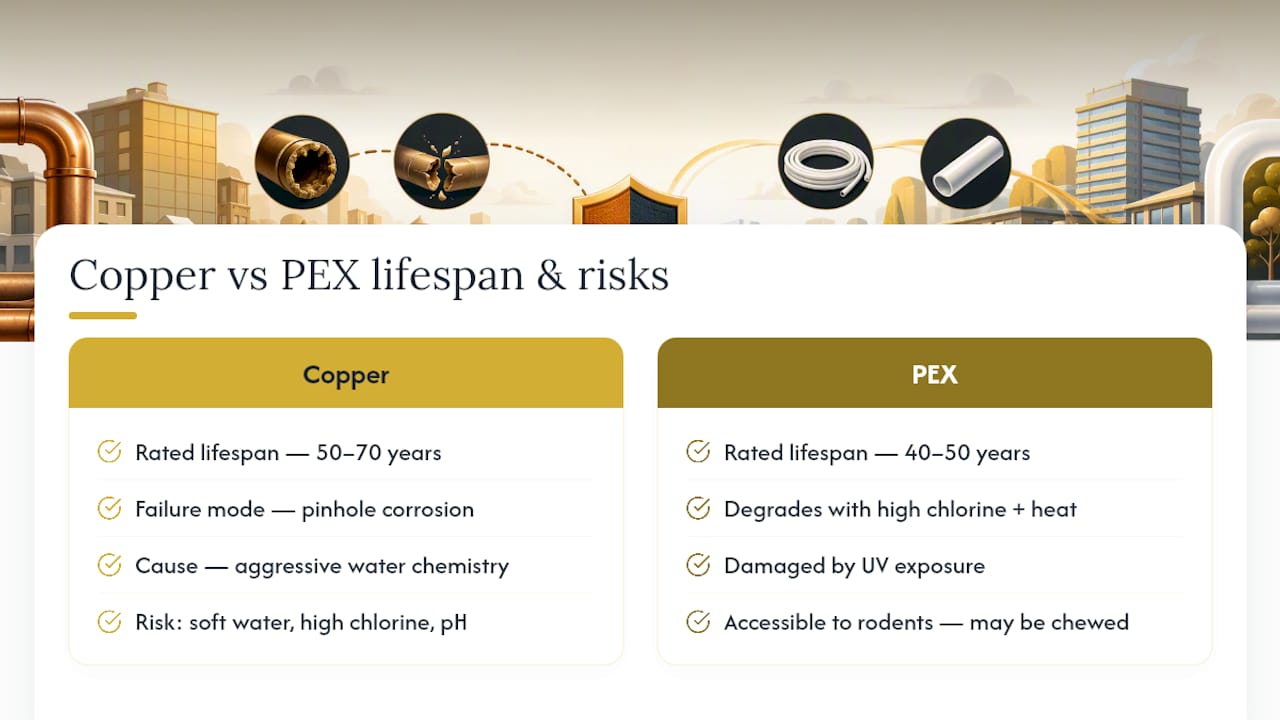
Statistic Callout: Copper's failure mode is pinhole corrosion, caused by aggressive water chemistry eating through pipe walls from the inside. Homes with soft water, high chlorine, or unusual pH see this years before the rated lifespan runs out.
PEX has its own limits. It degrades under prolonged combined exposure to high chlorine and high heat, breaks down under UV light if left exposed, and rodents will chew through it if it's accessible in a crawlspace or attic. NSF/ANSI 61 certification confirms the tubing is safe for drinking water contact, but it doesn't guarantee protection from these physical hazards.
If you're unsure what you're dealing with, get your water tested before choosing a material. A basic water chemistry report from a local lab or your utility tells you whether copper's corrosion risk is a real concern in your house.
Does PEX or Copper Handle Freezing Better?
PEX generally survives a freeze because it expands along with the ice inside it. Copper is rigid, so when the water inside freezes and expands, copper often splits, which is exactly why so many burst-pipe calls come from copper runs in unheated spaces.
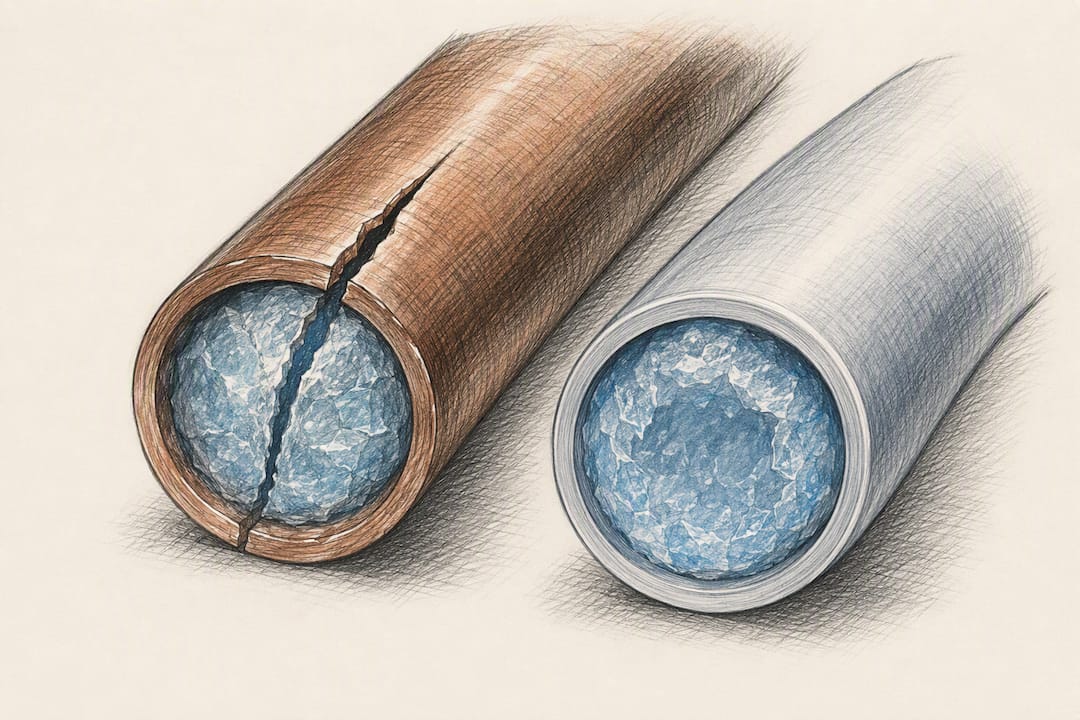
That said, copper still makes sense in situations where freeze isn't the main concern, such as exposed exterior runs that need UV and heat resistance rather than flexibility.
Protect either material in vulnerable spots with these steps:
- Insulate pipe runs in attics, crawlspaces, and exterior walls.
- Route new plumbing through conditioned space wherever the framing allows it.
- Install isolation valves so you can drain vulnerable sections before a hard freeze.
Pro Tip: If you own a vacation property that sits empty in winter, run PEX to any exposed or exterior-adjacent lines even if the rest of the house uses copper. It's cheap insurance against a burst pipe nobody catches for weeks.
How Do You Choose Between Copper and PEX for Your Project?
Match the material to the job, not to habit. A single leaking branch line rarely justifies ripping out a whole system, but a house with recurring pinhole leaks or old galvanized pipe usually calls for a full repipe.
Work through this checklist before signing a contract:
- Define your ownership horizon. If you're staying 20+ years, copper's longevity may justify the cost; if you're flipping or renting, PEX's lower price often wins.
- Check your water chemistry. Aggressive water pushes the decision toward PEX for corrosion resistance.
- Confirm insurance and code requirements. Ask your insurer about either material and confirm your local code's stance on the copper stub near water heaters.
- Ask contractors direct questions: What connection method do they use for PEX (crimp, expansion, or push-fit)? Do they run a manifold system? How do they handle the copper stub requirement?
- Watch for red flags. A quote with no mention of fittings, joint type, or permit filing is a quote you should question, since joint and fitting quality causes more failures than the base material itself.
When Should You Bring in an Engineer, Not Just a Plumber?
A licensed plumber handles most single-family repipes fine. Bring in an engineering consultant when the project touches multifamily buildings, unusual water chemistry, or integration with HVAC and fire protection systems, where a wrong material choice creates code violations or cross-system conflicts.
An engineering review should produce a code compliance check, stamped drawings where required, a specified materials list, and coordination support for permit filing. Bazini Engineering works directly with contractors and agencies including the NYC Department of Buildings to keep plumbing designs aligned with mechanical and fire suppression systems from the start. That upfront coordination is what prevents the change orders that show up mid-construction when nobody checked whether the plumbing plan matched the fire sprinkler layout.
The Real Trade-Off Nobody States Plainly
The copper versus PEX debate gets treated like a brand loyalty argument, and that's the wrong frame. Copper's longer lifespan rating is real, but it assumes water chemistry stays cooperative for 50 years, which is a bet, not a guarantee. PEX's corrosion immunity solves the exact failure mode that kills most copper systems early, and that's worth more to most homeowners than a lifespan number that assumes ideal conditions.
Where conventional advice falls short is treating this as a binary choice. The smarter approach uses both: PEX for the branch lines and vulnerable runs, copper for the water heater stub and any exposed exterior section. If your project involves more than a single-family home, get a water chemistry test and a professional opinion before you commit to either material at scale. That's a smaller expense than repiping a building twice.
— Joseph
Get Engineering-Level Guidance Before You Repipe
A plumber can install pipe, but you might want to consider some smart plumbing upgrade ideas for your home renovation before starting. An engineer makes sure the material, layout, and code path all hold up before construction starts, which matters most on multifamily buildings, commercial retrofits, or any project where plumbing has to coordinate with HVAC and fire protection systems.

Bazini Engineering provides plumbing engineering design and consulting for projects that need more than a standard repipe quote, including code review, material specification, and permit coordination with agencies like the NYC Department of Buildings. For buildings where plumbing decisions intersect with sprinkler or standpipe systems, the firm's fire suppression engineering team coordinates directly with the plumbing design to avoid conflicts that surface during inspection. An initial consult often starts with a review of the existing system and project goals, followed by a scoped proposal covering drawings, specifications, and the permit path specific to the building. If your renovation touches broader mechanical coordination, the mechanical engineering team can fold plumbing into the same design package. Reach out through the full services overview to start that conversation before your next repiping bid goes out.