
A Con Edison load letter is the utility's formal check on whether your building's electrical or gas plans exceed what the existing service can handle. If you're starting one, open a case in the Con Edison Project Center now, attach a completed load-letter form with your one-line diagram, and expect roughly 20 days for Con Edison to confirm available capacity.
TL;DR:
- Submit a complete load letter package, including all required documents, to avoid delays caused by resubmissions due to missing information.
- Submit several weeks before your equipment installation date, especially for EV chargers or phased projects, as Con Edison reviews in parallel with other permits.
- Be aware that if your load request exceeds nearby infrastructure capacity, Con Edison may classify part of the job as excess distribution facilities, shifting costs to the customer.
- Ensure all technical details match across your load letter, one-line diagram, site plan, and cut sheets, and verify site readiness before submission to prevent rejection.
- Assign one responsible person to oversee document version control and document discipline to prevent mismatched revisions and reduce overall review time.
Table of Contents
- What Documents Go Into a Con Edison Load Letter?
- How Do You Submit a Load Letter to Con Edison?
- How Does Con Edison Decide on Your Load Request?
- Why Do Load Letters Get Rejected?
- What Does Con Edison Need for EV Charger Installations?
- What Should a Load Letter Entry Actually Look Like?
- Field Lessons That Cut Down Resubmissions
- An Editorial Take on Why Most Teams Submit Too Late
- How Bazini Engineering Handles Load Letters for New York Projects
- Official Con Edison and NYC Resources Worth Bookmarking
- Sources
- FAQ
What Documents Go Into a Con Edison Load Letter?
Con Edison's required-documents checklist is unforgiving about completeness. Missing one field or one attachment is the fastest way to trigger a resubmission, so build your package around these pieces before you touch the Project Center portal.
- Load letter form itself: service address, building type, request type (new service versus a modification), existing meter count, and new meters requested.
- One-line diagram: main service size, service equipment ratings, conductor sizes, and breaker configurations, matched exactly to what the load letter states.
- Site plan: a property-line box, transformer location, conduit routes, and final grade shown clearly.
- Equipment cut sheets: manufacturer specification sheets for panels, switchgear, generators, or chargers.
- Letter of Authorization (LOA): signed by the property owner whenever a contractor or engineer submits on their behalf.
- EV-specific fields: charger type, make and model, maximum kW output, port count, total kW calculation, phase configuration, and any future-proofing entries for planned expansion.
Leave any of these blank and you're not saving time. You're adding a review cycle.
How Do You Submit a Load Letter to Con Edison?
The workflow is straightforward once you know who touches what and in what order. Most delays trace back to skipping a step rather than doing one badly.
- Confirm who's authorized to submit. An MEP engineer, general contractor, or the building owner can all initiate a case, but Con Edison wants a clear chain of responsibility. If the electrician of record hasn't been appointed yet, many teams submit under a placeholder license and update it once the contract is signed.
- Create the case in Con Edison Project Center. Upload the load letter, one-line diagram, site plan, and cut sheets as a single package rather than trickling documents in over several days.
- Attach the LOA. If anyone other than the owner is submitting, the signed authorization needs to be in the initial upload, not added after a reviewer asks for it.
- Route any follow-up questions correctly. Meter-application or upgrade questions go through the contact channels Con Edison lists on its Project Center FAQ page, not through a generic customer service line.
- Time it right. Submit several weeks before you need equipment on-site. EV-heavy projects with multiple chargers or phased buildouts should go in even earlier, since Con Edison's own guidance recommends starting as soon as MEP load calculations are finalized.
Pro Tip: Submit the load letter before your permit set is 100% final. Con Edison's review runs in parallel with Department of Buildings review, and waiting for permit approval first just stacks two 20-day clocks end to end instead of running them together.
How Does Con Edison Decide on Your Load Request?
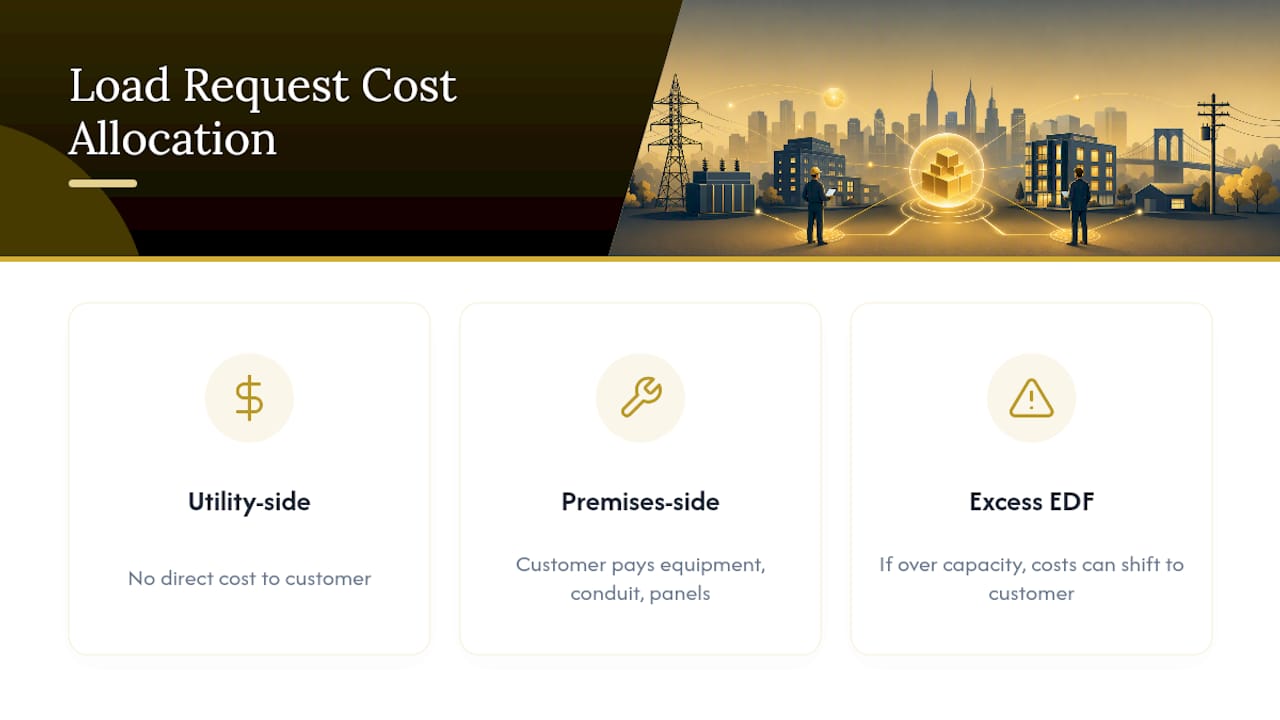
Con Edison verifies the load you're requesting against what the existing distribution infrastructure in your area can support, then issues what it calls a Company Plan: the least-cost path to serve your building's new or modified load. Accept that plan, and Con Edison's own portion of the upgrade work (transformer capacity, distribution feeders, and similar utility-side infrastructure) comes at no direct cost to you.
Premises-side work stays on your ledger regardless. That means service equipment, conduit runs inside your property line, and panel upgrades are your contractor's responsibility to price and install.
There's a wrinkle worth knowing before you get a number back: if your request pushes past what nearby infrastructure can absorb, Con Edison may classify part of the job as Excess Distribution Facilities. That classification can shift costs that would normally sit with the utility over to the customer, so it's worth asking your engineer to flag that risk early rather than discovering it after the Company Plan lands.
Why Do Load Letters Get Rejected?
Most rejections aren't about the concept behind the request. They're about paperwork that doesn't match itself.
- The one-line diagram shows different equipment ratings than the load letter states.
- Cut sheets are missing for equipment listed on the form, or the LOA wasn't included in the original upload.
- The site plan omits the property-line box or shows a final grade that doesn't match current site conditions.
- Access for construction crews is blocked by parked equipment, fencing, or storage that wasn't accounted for.
Con Edison's Project Center FAQ points to site-readiness gaps as a recurring problem even after a load letter gets administrative approval. A team can clear every paperwork hurdle and still stall at the curb because nobody walked the site before construction crews showed up.
Pro Tip: Print the site plan and walk the actual property line with it before submission. A property-line box that looks fine on a CAD drawing sometimes doesn't match a fence, a curb cut, or a utility easement that shifted since the last survey.
What Does Con Edison Need for EV Charger Installations?
EV charging submissions carry their own set of fields, and Con Edison's load-letter form is specific about what has to be filled in for every charger you're installing.
- Charger type: Level 2 or DC fast charging (DCFC), listed separately if you're mixing both.
- Make and model for each charger unit, plus total port count per charger.
- Maximum kW output per charger and a total kW calculation across all chargers by type.
- Phase configuration (single-phase or three-phase) for each circuit.
One detail catches teams off guard: Con Edison doesn't factor software-based load management into its capacity determination. If you're relying on smart charging software to cap output, list any hardware-limiting devices instead. Con Edison evaluates against maximum possible output, not managed output, which means the number on your form should reflect the equipment's ceiling, not your operating plan.
For phased buildouts, add a separate table labeled by phase, with installation dates and per-phase equipment totals, so the reviewer sees the full scope even if only part goes in now.
What Should a Load Letter Entry Actually Look Like?
Vague phrasing is the second most common cause of a bounced submission, right behind missing documents. A few examples of the level of specificity Con Edison expects:
- Service request field: instead of "upgrade service," write "increase existing 400A, 3-phase, 120/208V service to 800A to support new rooftop mechanical load and EV charging infrastructure."
- Meter request field: state the exact count and type, such as "add one new commercial meter socket for EV charging sub-panel, separate from existing building meter."
- Equipment entries: reference the cut sheet directly, e.g., "Panel LP-2, 225A main breaker, see attached Square D cut sheet, Exhibit C."
Reference your one-line diagram by revision number in the narrative section, not just as an attachment. If your engineer issues Revision 3 after submission, Con Edison will flag the mismatch and request a full resubmission rather than accepting a partial update. Keep a simple log: file name, revision date, what changed. It sounds tedious until it saves you a second 20-day wait.
Field Lessons That Cut Down Resubmissions
A few habits separate a load letter that sails through from one that bounces twice. First, get signatures lined up before you submit, not after: the MEP engineer signs the load calculations, the electrician of record signs the one-line diagram, and the owner signs the LOA if anyone else is filing on their behalf.
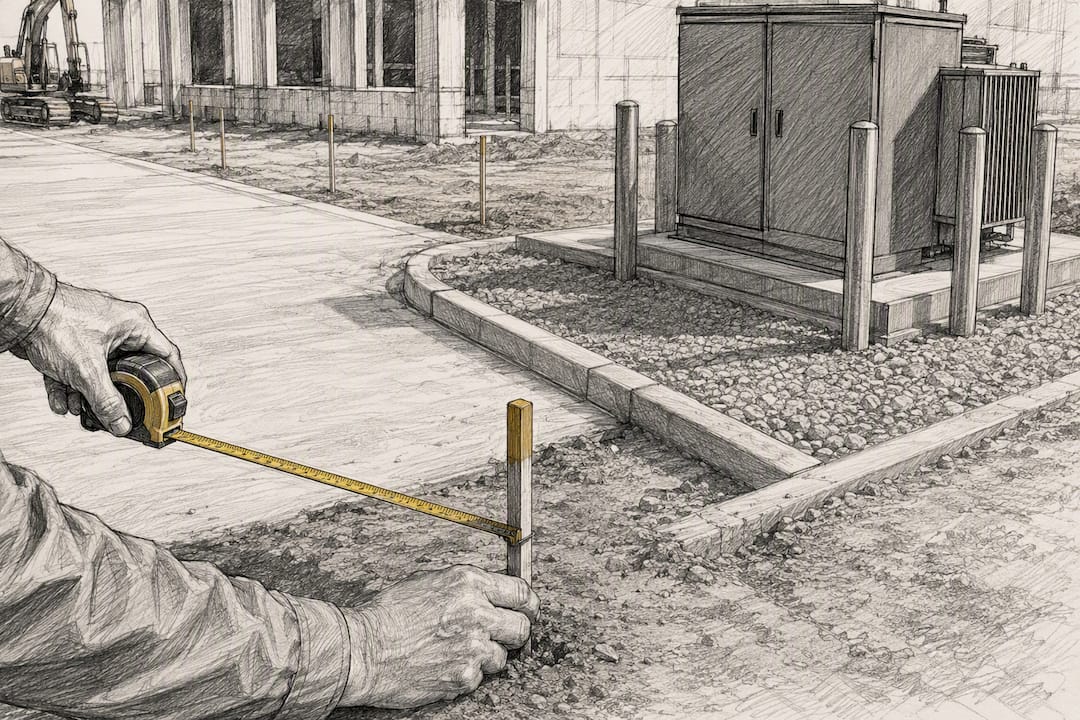
Walk the site in person against the plan set: property-line box location, final grade, conduit route, and clearance around the transformer or switchgear pad. A drawing that looks correct on screen sometimes doesn't match what's actually on the ground.
Name your files with a revision number and date, and note in the load letter narrative exactly which revision you're referencing.
An Editorial Take on Why Most Teams Submit Too Late
The conventional advice treats the Con Edison load letter as a formality to knock out once permit drawings are finished. That sequencing is backward, and it's the single biggest reason projects lose weeks they didn't need to lose. Con Edison's own review clock runs independently of the Department of Buildings, so treating the two as sequential steps rather than parallel ones doubles your exposure to delay for no real benefit.
What's overrated in most guidance on this topic is the emphasis on the form itself. The form is not hard, but what's underrated is document discipline: keeping the one-line diagram, site plan, and load letter narrative in lockstep as revisions happen. Nearly every resubmission story traces back to a mismatch between documents that were each individually correct at some point but drifted out of sync.
If there's one thing a building team should prioritize first, it's this: assign one person to own version control across the whole package before the first submission goes in. Not the engineer, not the GC by default. Whoever it is, that role prevents more delays than any amount of extra detail on the form.
— Joseph
How Bazini Engineering Handles Load Letters for New York Projects
Engineering firms can prepare the load calculations, one-line diagrams, and site plans needed for Con Edison submissions and coordinate the Project Center filing to help ensure the package is complete upon initial submission.

That's the practical advantage over piecing a submission together across an electrical contractor, a separate drafter, and whoever happens to have the LOA that week: one team keeps the load letter, the one-line diagram, and the site plan in sync from the first draft through any Con Edison follow-up questions. For projects layering in Local Law 97 compliance work alongside a service upgrade, that same coordination extends to your Local Law 97 compliance planning, so the electrical scope and the compliance scope don't end up working against each other. If you're planning a service upgrade, an EV charging installation, or a building electrification project in New York City, Long Island, or Westchester County, reach out through Bazini Engineering's services page to get load calculations and diagrams started before your permit set is finalized.
Official Con Edison and NYC Resources Worth Bookmarking
Keep these on hand before you start a submission:
- Load Letter Blank Form, Con Edison's official EV charger load-letter template.
- Interconnection / Make-Ready required documents, the checklist covering one-line diagrams, site plans, cut sheets, and the LOA.
- NYC HPD's load-letter guidance, a pilot resource explaining submission timing for building projects.
- Con Edison's Building & Remodeling FAQ, covering Project Center basics and site-readiness rules.
Sources
- EV Charging Station Install Load Letter Form (Con Edison)
- Interconnection / Make-Ready required documents (Con Edison)
- THE CON EDISON LOAD LETTER: Ensuring that your project can electrify (NYC HPD)
- Building & Remodeling: Frequently Asked Questions (Con Edison)
FAQ
What Is a Load Letter?
A load letter is a formal document submitted to Con Edison describing the electrical or gas load a building intends to add or change, used to confirm whether existing service infrastructure can support the request.
What States Does Con Edison Serve?
Con Edison provides electric, gas, and steam service across New York City and Westchester County; it does not operate outside New York State.
Does a Con Edison Account Show Up on Your Credit Report?
Utility accounts, including Con Edison, can appear on credit reports if the account becomes delinquent and is reported to credit bureaus or sent to collections; routine on-time payment histories are typically not reported the way loans are.
What Goes Into a Con Edison Bill?
A Con Edison bill typically includes delivery charges (for maintaining the grid), supply charges (for the actual electricity or gas used), and various state-mandated fees or taxes, with amounts varying by usage, rate class, and service type.
How Long Does Con Edison Take to Review a Load Letter?
Con Edison generally needs about 20 days to evaluate a completed load letter and confirm available service capacity, provided the submission includes all required documents.
Can Bazini Engineering Prepare My Load Letter Package?
Bazini Engineering prepares load calculations, one-line diagrams, and site plans for New York building projects and coordinates the Project Center submission on the client's behalf.