
The most common building code violations in NYC fall into six categories: boiler and recurring-filing failures, work without a permit, façade/Local Law 11 deficiencies, fire-protection and egress hazards, plumbing and HVAC issues, and expired permits. Your first move is to pull your building's DOB violation search and confirm every recurring Local Law filing deadline is calendared.
Here is what that looks like in practice:
- Boiler and recurring filings (Local Law 62/91, LL11 FISP, LL84, LL97, LL152): missed deadlines auto-generate violations with no inspector visit required.
- Work Without a Permit (VW): often surfaces from a 311 complaint. Once a DOB inspector is on-site, they can inspect beyond the original complaint and cascade into multiple violations.
- Façade/FISP failures: buildings taller than six stories need a hands-on inspection every five years; an "Unsafe" determination requires immediate public protection and corrective work within 90 days.
- Fire protection and egress: FDNY issues violations for sprinkler, standpipe, and alarm deficiencies, typically after structural changes or complaints.
- Plumbing, HVAC, and heat/hot water: HPD enforces heat and hot-water complaints aggressively during the October 1–May 31 heating season.
- Expired or invalid permits: an open permit with no final inspection is a transaction-stopper and a fine risk.
Boiler-related violations account for roughly 58% of active DOB violations citywide, making them the single largest category by far. There are currently roughly 582,000 active DOB violations on record across the city, and every one of them is public, searchable by address, and reviewed by lenders and buyers during due diligence.
Certifiable vs. non-certifiable objections is the distinction that controls your timeline and your wallet. A certifiable objection can be closed with documentary evidence — photos, paid receipts, permit numbers — without a re-inspection. A non-certifiable one requires physical correction plus a DOB re-inspection before it closes. Misclassifying the two is a leading cause of rejected cure submissions and costly delays. Class 1 violations carry fines of $1,000–$25,000 plus up to $1,000 per day; Class 3 violations top out at $500 with no daily accrual and can avoid civil penalties entirely if corrected and certified on time.
Five immediate steps:
- Run a DOB violation search and audit every open Local Law filing.
- Calendar all recurring deadlines: LL11 FISP (five-year cycle), boiler inspections, LL84 benchmarking (May 1 annually), LL97 emissions reporting (May 1 annually), and LL152 gas piping (four-year cycle).
- Engage a licensed PE or permit expeditor to confirm permit status before any renovation work begins.
- Assemble your correction packet: high-res photos, paid receipts, permit and job numbers, and equipment service records.
- Prioritize Class 1 and FISP "Unsafe" conditions first — both carry daily penalty accrual and potential court proceedings.
Table of Contents
- How recent enforcement changes affect NYC building owners
- Baziniengineering helps you close violations before they close your deal
- Key Takeaways
How recent enforcement changes affect NYC building owners
COVID-era inspection slowdowns are largely behind us. DOB has accelerated re-inspection cycles for FISP façade reports as Cycle 10, which began in February 2025, ramps up. LL97 emissions penalties entered their first true enforcement year in 2026 for buildings over 25,000 sq ft that exceeded their 2024 emissions limits, with audit and reporting deadlines tightening. Brooklyn accounts for about 41% of active DOB violations and leads the city on ECB penalties, while Manhattan over-indexes on Local Law non-compliance and penalty exposure because of its dense large-building stock subject to LL97 and LL11. Owners in both boroughs should treat 2026 as a reset point: the grace-period window is closed, and enforcement is running at full pace.
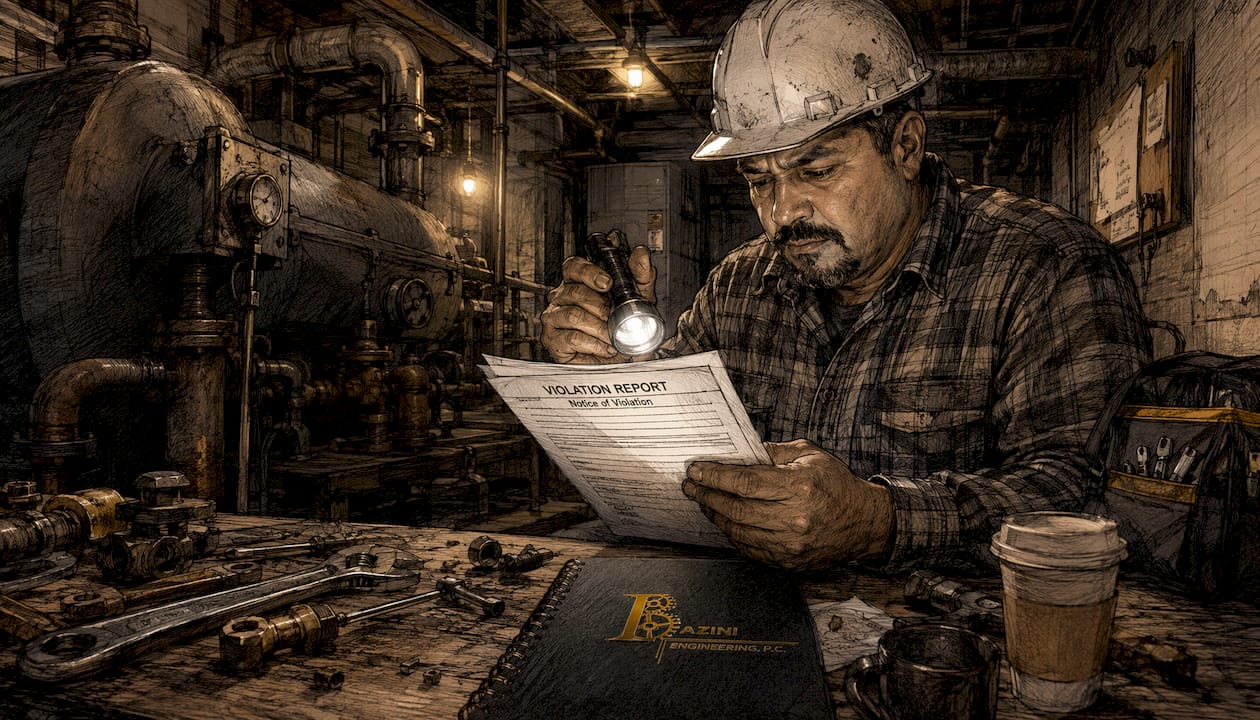
Baziniengineering helps you close violations before they close your deal
When a DOB notice lands or a transaction due-diligence search flags open violations, the fastest path forward is a licensed MEP/FP engineer who already knows the filing system. Baziniengineering, founded in 2010 and licensed in New York and Florida, handles the full stack: MEP and plumbing engineering, fire suppression design, LL97 compliance planning, FISP coordination, boiler and elevator filing review, and permit expediting across NYC, Long Island, and Westchester County.
Pro Tip: A properly organized certificate-of-correction packet — high-res photos, paid receipts, and the exact permit reference numbers — dramatically reduces rejection risk at the Administrative Enforcement Unit and speeds ECB closing. Incomplete submissions are the single most common reason corrections get kicked back.
Before your first consult, have your DOB violation numbers, open permit/job numbers, past filing receipts, and equipment service records ready. Request a consultation and get your violations on a clear remediation path.
Key Takeaways
NYC building code compliance requires proactive filing management, licensed professional oversight, and fast action on certifiable corrections to avoid daily penalty accrual.
| Point | Details |
|---|---|
| Boilers lead violations | Boiler-related filings account for roughly 58% of active DOB violations citywide. |
| Certifiable vs. non-certifiable | Certifiable objections close with documents alone; non-certifiable ones require physical correction and re-inspection. |
| LL97 penalties are live | Buildings over 25,000 sq ft face real emissions penalties in 2026 for exceeding 2024 limits. |
| Public-record risk | Roughly 582,000 active DOB violations are searchable by address and reviewed during every financing or sale. |
| Baziniengineering | Provides licensed MEP/FP engineering, permit expediting, and LL97 and FISP compliance support across NYC. |