
Size to the building's peak hot-water demand: calculate peak gpm and gph, determine the required temperature rise, and then confirm the heater's usable storage plus recovery rate meets that peak. Build the demand profile first. Everything else, including which unit to buy, follows from that number.
TL;DR:
- Peak demand in gallons per minute or hour must be accurately calculated from fixture usage and demand profiles, not just tank size.
- The size of a commercial water heater depends on demand duration, with storage prioritized for short peaks and recovery capacity for longer events.
- Safety and code requirements, including minimum storage temperatures and tempering valves, significantly influence sizing decisions.
- Using multiple sizing tools and verifying actual conditions like inlet temperature and pipe layout prevents undersized or oversized systems.
- Modular redundancy is essential for critical facilities, while efficient distribution design minimizes standby loss and relies less on oversized tanks.
Table of Contents
- What Metrics Actually Drive Commercial Water Heater Sizing?
- How Do You Calculate Commercial Water Heater Capacity?
- Fixture Tables, Time Profiles, or Flow-Based Sizing: Which Method Fits?
- What Code and Health Rules Constrain Your Sizing Decisions?
- Which Calculators and Tools Actually Improve Sizing Accuracy?
- What Do Practitioners See That Calculators Miss?
- Balancing Reliability, Redundancy, and Efficiency
- How Bazini Engineering Supports Commercial Water Heater Projects
- Where to Verify These Numbers Yourself
- Sources
- FAQ
What Metrics Actually Drive Commercial Water Heater Sizing?
Commercial water heater sizing starts with three numbers, not a tank gallon rating. Get these wrong and no amount of vendor spec-sheet shopping saves the project.
Peak demand is the highest simultaneous hot-water draw the building generates, expressed in gallons per minute for short bursts and gallons per hour for sustained loads. The demand profile maps out when that peak happens and how long it lasts. Duration matters because a five-minute morning shower rush at a gym calls for a different design than a four-hour laundry cycle at a hotel. Short, sharp peaks favor stored volume. Long, steady peaks favor recovery capacity.
First Hour Rating (FHR) and recovery rate describe how a water heater performs once the tap opens. FHR estimates how many gallons of hot water a unit delivers in the first hour from a full tank; recovery rate tells you how fast it reheats afterward, usually in gallons per hour. A tank with a low FHR but high recovery survives a marathon demand period; a tank with high FHR but weak recovery gets crushed the second time the peak repeats.
- Peak demand: the maximum simultaneous draw, in gpm or gph
- FHR: usable hot water delivered in the first hour of a demand event
- Recovery rate: how quickly the unit reheats stored water, in gph
- Temperature rise: the gap between incoming water temperature and design output temperature, which drives the BTU or kW input needed to hit that recovery rate
How Do You Calculate Commercial Water Heater Capacity?
This is the water heater capacity calculation that actually holds up under a plan review, not a shortcut based on square footage.
- Build the demand profile. List every fixture group (guest bathrooms, kitchen, laundry, locker rooms) with expected simultaneous use and how long each demand period lasts.
- Convert fixture counts to peak gpm and gph. Add a conservative allowance, usually 10 to 20 percent, for future tenant changes or peak-on-peak overlap you didn't anticipate.
- Determine the required temperature rise. Subtract expected incoming cold-water temperature (varies seasonally, often 40°F to 60°F depending on region) from the design storage temperature.
- Calculate usable storage and required recovery. Usable storage covers the front end of the peak; recovery rate has to cover whatever the peak demand exceeds beyond that stored volume.
Design guides that focus on energy-efficient commercial water heater design put it plainly: sizing starts with the demand timeline, and whether you lean on storage or recovery depends entirely on how long that demand period runs.
Pro Tip: If your peak demand period runs under 20 minutes, oversize storage before you oversize recovery. If it runs longer than an hour, the reverse is almost always cheaper and more reliable.
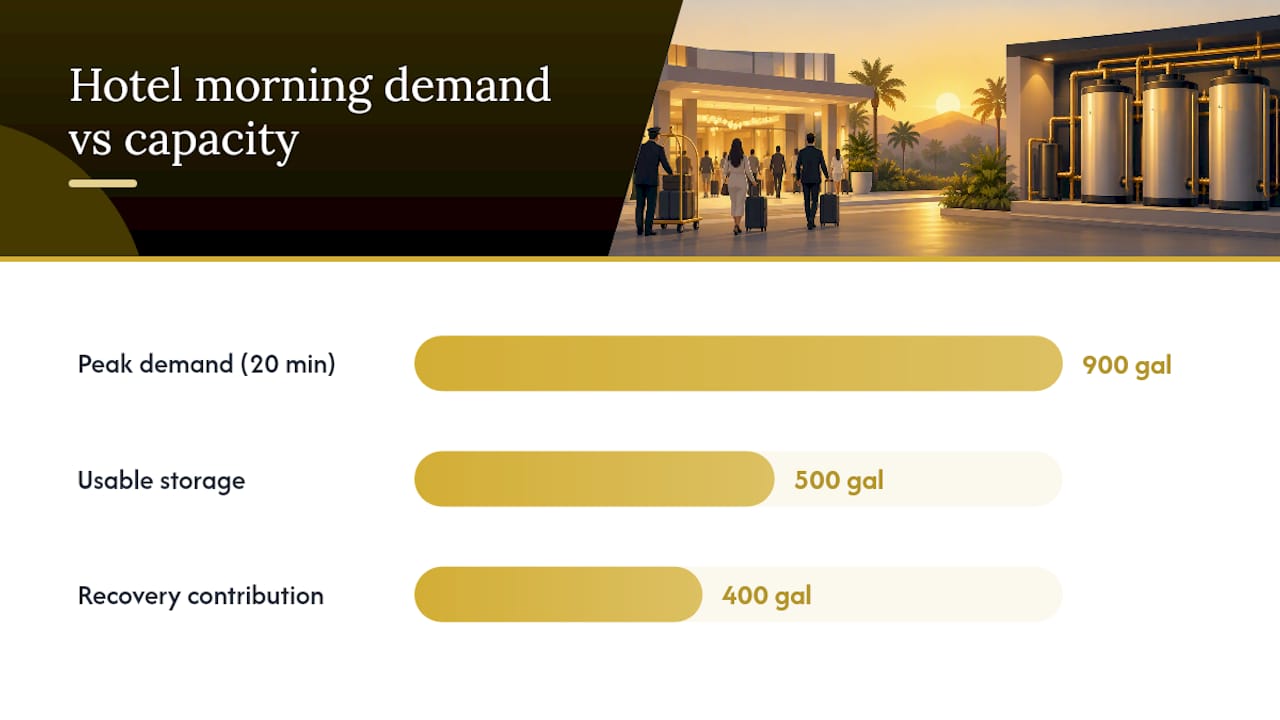
Here's a compact worked example for a 60-room hotel with a morning peak between 6:30 and 8:00 AM. Fixture counts and average shower flow put peak demand at roughly 45 gpm for a 20-minute window, translating to about 900 gallons needed inside that window. Incoming water runs 50°F and the design storage temperature is 140°F, a 90°F rise. A system combining 500 gallons of usable storage with a recovery rate of 400 gph covers the remaining 400 gallons across the demand window with margin to spare. That's the kind of math a plumbing engineering review checks before a permit ever gets filed.
Local plan review authorities frequently formalize this math directly. Maricopa County's plumbing guidance, for instance, requires storage and recovery sized to meet calculated hourly demand, with some conventional storage heaters needing to hit 100 percent recovery of that calculated hourly load.
Fixture Tables, Time Profiles, or Flow-Based Sizing: Which Method Fits?
Three sizing methods dominate commercial hot water system design, and picking the wrong one is how projects end up with an undersized recovery rate discovered six months after occupancy.
ASHRAE fixture-count tables work well for predictable building types like offices, schools, and standard multifamily housing, where demand patterns are well documented and don't cluster unpredictably. The ASHRAE Handbook chapter on service water heating remains the standard reference for these demand-per-fixture values.
Time-profile modeling becomes necessary once demand clusters irregularly, think hotels with variable occupancy, hospitals with shift changes, or mixed-use buildings stacking a gym, a restaurant, and residential units on one system. Tables assume typical patterns; a time profile captures your actual peak.
Tankless flow-based sizing shifts the question entirely, from "how much can we store" to "how much continuous gpm can we deliver." That works well where space is tight, but continuous-flow units need careful attention to simultaneous draw and often require multiple units in parallel for redundancy.
- Fixture tables: fast, code-recognized, best for standard occupancy types
- Time-profile modeling: required for clustered or variable peaks
- Tankless: good for space-constrained sites, but redundancy and simultaneous flow become the design constraint instead of storage
Pro Tip: Never size off nominal tank gallons alone. A 100-gallon tank with weak recovery can underperform a 60-gallon tank paired with high-output recovery. That gap between advertised tank size and actual delivered performance is one of the most common selection mistakes in commercial water heater specification, and it's exactly why FHR and recovery rate belong on every spec sheet you review.
What Code and Health Rules Constrain Your Sizing Decisions?
Sizing isn't just a math problem, it's a compliance problem the moment Legionella risk and scald protection enter the picture.
Storage temperature has to sit high enough to suppress bacterial growth without cooking someone at the tap. Guidance built around ASHRAE's service water heating recommendations calls for storing water at a minimum of 140°F, with mixing valves such as ASSE 1017 downstream to bring fixture delivery temperatures back down to a safe range.
- Design storage temperature: typically 140°F minimum for Legionella mitigation
- Mixing/tempering valves: required downstream to protect occupants from scald risk
- Recirculation loops: often need to maintain a minimum return temperature, which adds load to your recovery calculation
- Local permitting: check jurisdiction-specific rules before finalizing storage and recovery numbers, since some authorities mandate specific recovery percentages
Every one of these constraints needs documentation in the design package. Skipping that step is how a project stalls at plan review instead of moving to construction.
Which Calculators and Tools Actually Improve Sizing Accuracy?
Vendor sizing tools, public calculators, and a simple spreadsheet all have a place, but only if you feed them the right inputs.
Manufacturer sizing tools take fixture counts, flow rates, inlet temperature, and demand duration, then spit out suggested storage-and-recovery combinations. The IAPMO Water Demand Calculator is a step up from older fixture-unit methods, and it shows why: it typically estimates peak demand at two to six times observed flow, compared to five to 27 times for older calculation methods, meaning it produces a far more realistic peak than the numbers many legacy tables assume.
- Vendor sizing tools: fast, but only as accurate as the fixture and duration data entered
- IAPMO Water Demand Calculator: better peak-demand realism for complex or clustered profiles
- EPA's distribution-volume tool: focused on piping, not the heater itself, but critical for the next section
- Spreadsheet sanity-check: a manual cross-check against a second method catches input errors before they reach a permit set
Cross-check any tool output against a second method on critical projects. A hospital or high-occupancy hotel is not the place to trust a single black-box number.
What Do Practitioners See That Calculators Miss?
Calculators model demand. They don't model bad pipe layout, seasonal inlet temperature swings, or a recovery rate that looked fine on paper but never got verified in the field.
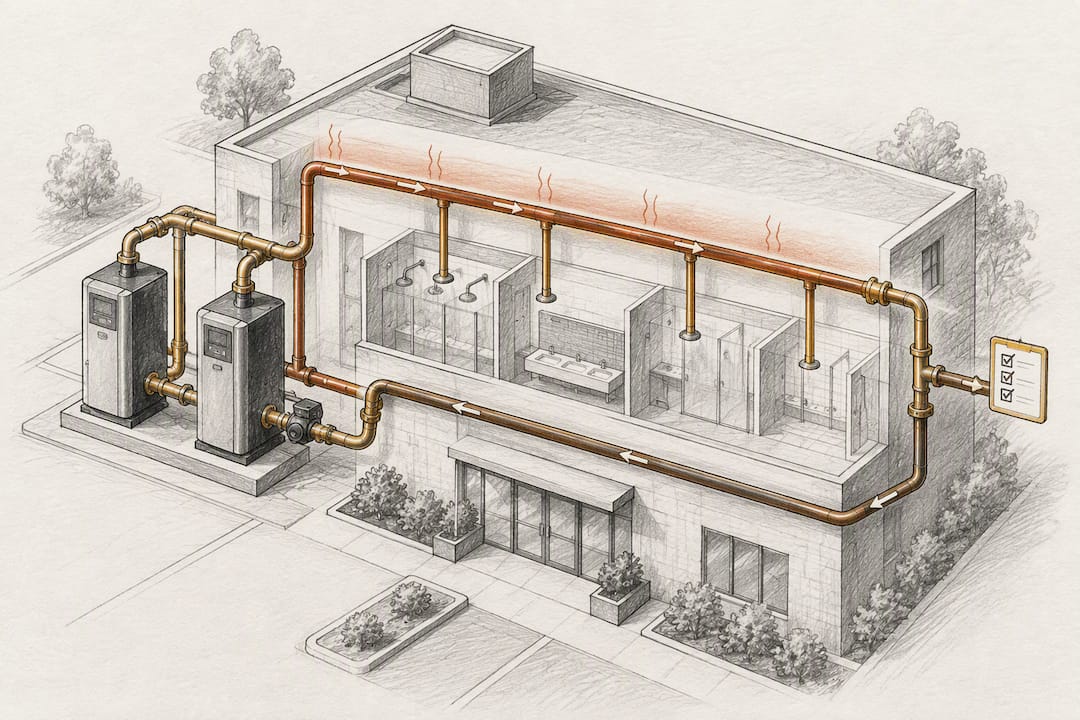
The recurring pitfalls: oversized distribution piping that quietly inflates stored volume and heat loss, recovery rates specified from a catalog number instead of the actual cut sheet, and inlet temperature assumptions that ignore winter groundwater drops. Long pipe runs between the heater and end use compound all three, which is why EPA guidance recommends keeping stored water in piping under roughly 0.5 gallons per run wherever the layout allows it.
- Verify actual seasonal inlet temperature, not a generic assumption
- Model the real peak profile, including overlap between fixture groups
- Size recirculation loops and tempering valves to the recirculation-adjusted load, not just the peak
- Confirm recovery gph directly from the manufacturer's cut sheet, not marketing copy
- Plan for redundancy on critical systems before construction, not after a failure
Pro Tip: During commissioning, measure actual drawdown and recovery at representative fixtures and compare the results against the design profile. Adjust mixing valve settings and recirculation controls on the spot if delivered temperatures drift from design intent, a step Maricopa County's plan review guidance treats as standard practice, not optional polish.
— Joseph
Balancing Reliability, Redundancy, and Efficiency
Size to the peak, then add modular redundancy where failure carries real consequences, hospitals, hotels, senior housing. That's not over-engineering; it's matching risk to design. For everything else, put the engineering effort into distribution design instead of a bigger tank. Shorter pipe runs and tighter recirculation loops cut standby loss more reliably than a marginally larger recovery rate ever will. Commissioning is the step that turns a good spec into a system that actually performs, so don't treat it as paperwork.
How Bazini Engineering Supports Commercial Water Heater Projects
Bazini Engineering is the alternative to piecing sizing decisions together from vendor brochures and generic online calculators. When you bring plumbing engineering in early, the demand profile, temperature rise calculations, and code constraints get resolved before equipment gets ordered, not after a failed inspection sends the project back to the drawing board.

Early involvement can reduce change orders and help produce a design package that meets Department of Buildings review requirements. Bazini's in-house team handles the plumbing engineering work directly, alongside the mechanical coordination and permit filing that keeps a hot-water system moving from design to occupancy without stalling at plan review. For building owners managing an aging boiler plant or planning a capital upgrade, the building owner services team can evaluate existing equipment condition before you commit to a new sizing plan.
Start by reviewing the full range of services at Baziniengineering and request a project consultation before your next hot-water system goes out to bid.
Where to Verify These Numbers Yourself
- ASHRAE Handbook, Service Water Heating chapter: the standard for fixture-based demand tables and storage-temperature guidance
- EPA's hot-water distribution guidance: for checking stored piping volume against the 0.5-gallon benchmark
- IAPMO Water Demand Calculator resources: for peak-demand modeling on complex or clustered occupancy types
- Energy-efficient commercial water heater design guides: for the underlying logic behind storage versus recovery trade-offs
Consult ASHRAE for code-recognized tables, EPA for distribution-side piping decisions, and IAPMO's tool when a building's demand pattern doesn't fit a standard occupancy category.
Sources
- Efficient hot water distribution in homes (EPA)
- IAPMO Peak Water Demand Study
- Energy-efficient commercial water heater design (technical guide)
FAQ
Is There a Difference Between Commercial and Residential Water Heaters?
Yes. Commercial units are built for higher continuous recovery rates, larger or modular storage configurations, and heavier-duty components rated for near-constant cycling that residential tanks aren't designed to handle. Commercial systems also face stricter code requirements around storage temperature, mixing valves, and recirculation.
What Are Some Examples of 50-Gallon Commercial Water Heaters?
A 50-gallon commercial unit typically serves smaller applications like a compact office break room, a small retail location, or a single-tenant restaurant with modest peak demand. At that size, recovery rate matters more than storage volume, since a short-duration peak can drain 50 gallons quickly if recovery is undersized.
How Many Gallons Is a Commercial Water Heater?
Commercial water heaters range widely, from around 50 gallons for small facilities up to several thousand gallons in multi-tank configurations for hotels, hospitals, or industrial plants. The right gallon count depends entirely on your calculated peak demand and demand duration, not a standard size chart.
How Do You Calculate What Size Water Heater You Need?
Build a demand profile listing fixture counts and simultaneous use, convert that to peak gpm and gph, then determine the temperature rise between incoming and design output temperature. From there, confirm that usable storage plus the unit's recovery rate, checked against its First Hour Rating, covers that peak, cross-checking with a tool like the IAPMO Water Demand Calculator for complex occupancy types.