
If your New York City property has in-ground irrigation, a swimming pool, more than one water service line, or falls into a category like healthcare, food processing, laundries, or auto repair, you need a DEP-approved backflow preventer. There is no gray area here: the New York City Department of Environmental Protection requires these property types to install and maintain the devices, and skipping it risks fines or a shutoff of your water service.
Your single next move is straightforward:
- Hire a Licensed Professional Engineer (PE) or Registered Architect (RA) to determine whether your property triggers the requirement and to prepare or file the necessary plans or exemption.
- Budget for two hard deadlines once a device goes in: the initial test report has to reach DEP within a month of installation, and every device after that needs annual testing without exception.
Key Takeaways
Backflow preventer compliance in NYC succeeds when owners combine a PE/RA plan determination, correct assembly selection, and disciplined testing timelines from installation through every annual cycle.
| Point | Details |
|---|---|
| Confirm requirement first | Hire a PE or RA to determine if your property needs a device before doing anything else. |
| Match device to hazard | RPZ, DCV, air gap, and detector assemblies each serve a different hazard level and use case. |
| Meet the 30-day window | File the GEN215B initial test report within 30 days of installation, with required seals. |
| Retest every 12 months | Annual testing by a NYS certified tester is mandatory for every device, with no exceptions. |
| Document everything | Keep maintenance logs and test records to speed up DEP reviews and reduce enforcement risk. |
Table of Contents
- Which NYC Properties Need a Backflow Preventer
- What Backflow Preventer Types Does DEP Approve?
- How Do You Get a Backflow Preventer Installed and Permitted?
- Who Can Test a Backflow Preventer and When
- Exemptions and What Happens if You Ignore DEP
- A Practical Compliance Checklist and Timeline
- How Bazini Engineering Supports NYC Backflow Compliance
- Keeping Your Backflow Preventer Working Long-Term
- Common Backflow Preventer Problems in NYC Buildings
- DEP Inspections Beyond the Annual Test
- Where Bazini Engineering Fits Into Your Compliance Plan
- Sources
Which NYC Properties Need a Backflow Preventer
DEP does not leave this to guesswork. The agency maintains a defined list of property types that carry elevated cross-connection risk, meaning water from your plumbing could siphon or push backward into the city's public supply and contaminate it.
Properties commonly flagged include:
- Buildings with in-ground irrigation systems
- Swimming pools and spas connected to the water supply
- Properties with multiple water service connections
- Healthcare facilities, including hospitals and dialysis centers
- Food and beverage processing plants, including breweries
- Commercial laundries and dry cleaners
- Auto repair shops and car washes
DEP evaluates each connection based on its "degree of health hazard," which means a single building with several service lines might need a device on each one, not just one for the whole property. If you're not sure where your building lands, DEP's own guidance recommends calling 311 for a preliminary read, but the only determination that actually protects you legally comes from a PE or RA reviewing your specific plumbing layout.
What Backflow Preventer Types Does DEP Approve?
Not every backflow device fits every building. DEP recognizes a handful of assembly types, and which one you need depends on the hazard level and how water could travel backward through your system.
- Air gap: a physical, visible space between a water outlet and the highest point of a fixture. It's the simplest form of protection, typically used for low-risk domestic fixtures.
- Reduced Pressure Zone (RPZ) assembly: the strongest mechanical barrier DEP approves, required where a high health hazard exists, such as at food processing plants or healthcare facilities. RPZ assemblies guard against both backpressure (water pushed backward by higher downstream pressure) and backsiphonage (water pulled backward by a vacuum).
- Double Check Valve (DCV) assembly: two independent check valves in series, used for lower-hazard applications like irrigation systems or fire sprinkler lines with no chemical additives.
- Detector assemblies: variants of RPZ or DCV devices fitted with a bypass meter, used specifically on fire service lines to detect unauthorized water use.
Selection depends on more than hazard level alone. Freeze exposure matters if the device sits outdoors or in an unheated vault, and available space around the meter room often rules out bulkier RPZ assemblies in tight NYC basements. DEP's regulations tie assembly type directly to the hazard the connection presents, not to owner preference.
Pro Tip: If your property has both a domestic water line and a separate fire service connection, expect DEP to require different assembly types on each. Don't assume one device covers your whole building.
How Do You Get a Backflow Preventer Installed and Permitted?
The paperwork trail matters as much as the physical installation. DEP won't approve a device that shows up without proper documentation, and a Licensed Master Plumber (LMP) can't legally install one until DEP signs off on the plans.
Here's the sequence:
- A PE or RA prepares plans and submits the GEN236 application, which requires the device manufacturer and model, its exact location, and hydrant flow and pressure data for the connection.
- DEP reviews the application; instructions for GEN236 note that incomplete submissions cause delays, so accuracy on the first pass saves weeks.
- Once DEP approves the plans, an LMP performs the physical installation and files for a Department of Buildings (DOB) permit where the work triggers one.
- For certain plan types, a Letter of Approval Application (LAA) form may also be required before installation proceeds.
The most common holdup owners run into isn't the installation itself. It's the paperwork ahead of it: missing pressure data, an unsigned original seal, or an incomplete manufacturer field on the GEN236 form. DEP application processing routinely stalls on these details, and a single missing signature can push your timeline back by another full review cycle. Bringing in a PE early, one who has filed this exact form dozens of times, tends to cut that risk substantially.
Who Can Test a Backflow Preventer and When
Testing isn't a one-time event. DEP splits it into two distinct obligations, and mixing them up is one of the more expensive mistakes an owner can make.
Initial testing:
- Must be performed by a tester certified by the New York State Department of Health.
- The test report, filed on form GEN215B, has to reach DEP within 30 days of installation.
- The report needs the required professional signatures and seals, including the PE or RA where applicable.
Annual testing:
- Every device gets retested every 12 months by a NYS certified tester, no exceptions for age or apparent good condition.
- Annual reports carry a required LMP stamp and follow a set submission cadence tied to your original test date.
- If a device fails, the fix is repair, retest, and resubmission. There's no partial credit for a failed test that never gets corrected.
Before hiring anyone, confirm their name appears on the NYSDOH certified tester list. An uncertified tester's report gets rejected outright, and you'll be back at square one with a missed deadline on the books.
Exemptions and What Happens if You Ignore DEP
Not every connection needs a device. DEP allows a self-certification exemption for a property with a single domestic water service and no elevated hazard, but only a PE or RA can submit that exemption on your behalf.
Documentation DEP typically expects for an exemption includes:
- Confirmation of a single service connection with no irrigation, pool, or hazardous process on-site
- A signed and sealed statement from the PE or RA making the determination
- Property identifiers (block and lot) matching DEP's records
Ignore the requirement entirely, and enforcement escalates fast. DEP can issue a summons, levy fines, and in persistent cases, terminate water service until an LMP certifies the hazard is eliminated and a compliant device is installed and tested. Owners who document a good-faith submission in progress, rather than doing nothing, generally fare far better than those who wait for a violation notice to act.
A Practical Compliance Checklist and Timeline
Compliance moves in a fixed order, and skipping a step just means redoing it later. This is the sequence that actually works:
- Confirm whether your property triggers the requirement (PE/RA determination).
- Hire a PE or RA to prepare plans or an exemption filing.
- Submit the GEN236 application to DEP.
- Wait for DEP plan approval before any physical work begins.
- Hire a Licensed Master Plumber to install the device and pull DOB permits as needed.
- Schedule the initial test with a NYS certified tester and file GEN215B within 30 days.
- Calendar the annual retest for 12 months out and repeat every year after.
Budget for several distinct cost lines: the DEP application fee, PE/RA design fees, LMP labor for installation, and the recurring testing fee each year. None of these are optional line items you can defer.
Pro Tip: Before signing a contract, ask any prospective tester three questions directly: Are you NYS certified? Do you provide sealed reports DEP will accept without kickback? Can you help with the DEP submission itself, or just the physical test?
How Bazini Engineering Supports NYC Backflow Compliance
Baziniengineering works this process from the design side, the part that determines whether your filing sails through DEP or bounces back for corrections. That starts with a hazard assessment on your specific connections, moves through PE-stamped plan preparation, and continues through DEP coordination and DOB permit expediting.
The issues Baziniengineering catches early are the same ones that stall other projects for weeks:
- Incomplete GEN236 fields, especially missing hydrant flow and pressure data
- Plans that don't match the manufacturer specifications DEP expects to see
- Test filings that miss the 30-day window because no one tracked the clock
Getting a licensed engineering firm involved before you submit anything, rather than after DEP kicks back a rejection, is usually the difference between a six-week timeline and a three-month one. Property owners handling irrigation systems, commercial kitchens, or multiple service lines can find plan preparation support through Bazini Engineering's plumbing engineering services, which cover exactly this kind of DEP filing work.
Keeping Your Backflow Preventer Working Long-Term
Installation and the initial test are the beginning, not the finish line. A backflow preventer is a mechanical assembly with rubber seats, springs, and check valves, and all of that wears down under constant water pressure and NYC's mineral-heavy water supply.
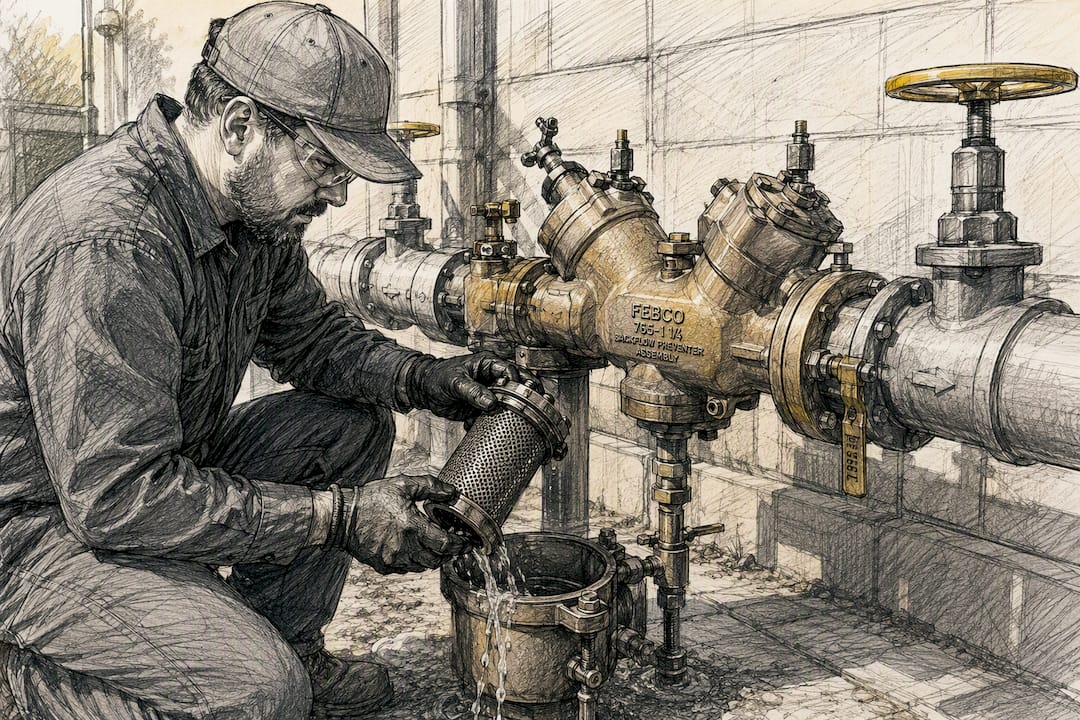
Sediment buildup is the most common culprit behind a failed annual test. It fouls check valve seats and prevents a tight seal, which is exactly what the assembly exists to maintain. Flushing the line periodically and keeping the strainer ahead of the device clean cuts down on this significantly.
Freeze exposure is a distinctly New York problem for any device installed outdoors or in an unheated vault, common with irrigation system backflow preventers. A single hard freeze can crack the housing, and that damage often isn't visible until the next test cycle fails. Insulating exposed piping or draining irrigation-line devices before winter avoids a costly mid-season replacement.
Keep a maintenance log for every device on your property, noting test dates, any repairs, and part replacements. When DEP or your NYS certified tester asks for history on a device that's underperforming, a paper trail speeds up the conversation considerably. Most manufacturers also recommend replacing internal rubber components on a set schedule, generally every five to ten years depending on usage, well before they fail outright. Waiting for a test failure to trigger a repair is the expensive way to run this program; scheduled maintenance is the cheap way.
Common Backflow Preventer Problems in NYC Buildings
New York's older building stock and hard water create a specific set of recurring headaches that don't show up as often in newer construction elsewhere.
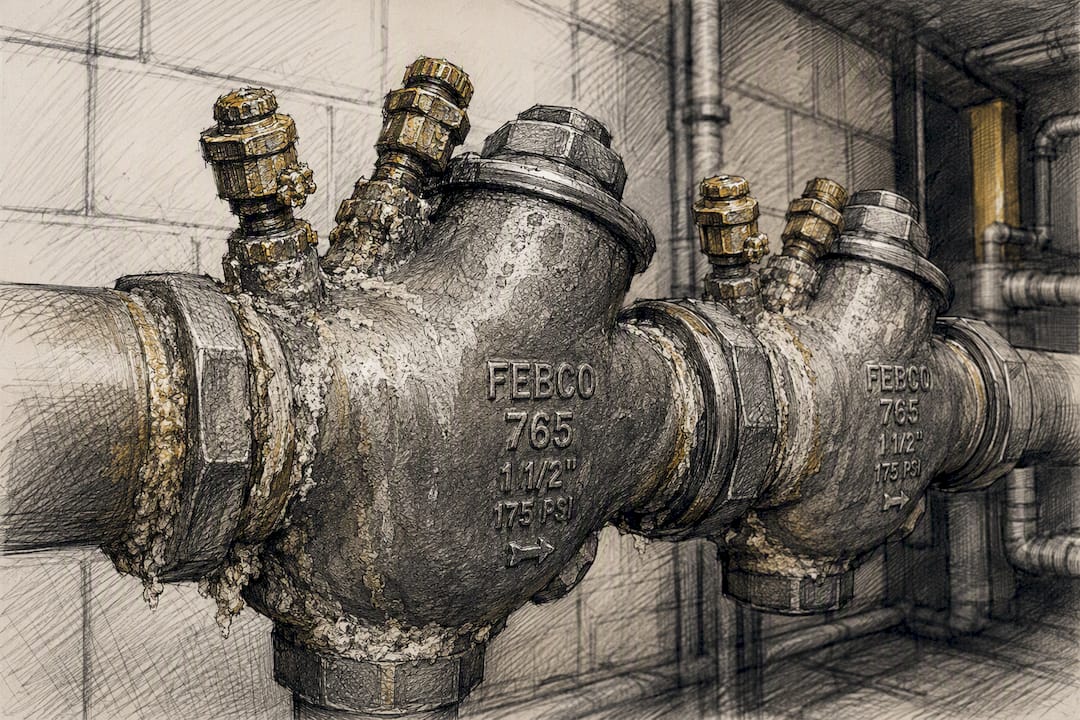
Continuous discharge from the relief valve on an RPZ assembly is the complaint Baziniengineering hears most. It usually means the first check valve has fouled with debris or worn out, letting pressure differential build until the relief valve opens to protect the system. The fix is cleaning or replacing that check valve, not replacing the whole assembly.
Water hammer is a close second in older buildings with abrupt valve closures. It stresses the backflow assembly's internal components over time and can loosen fittings that were torqued correctly at installation. A water hammer arrester upstream of the device solves this at the source instead of treating the symptom repeatedly.
Corrosion on the test cocks shows up on devices installed in damp basements or exterior vaults exposed to road salt runoff during winter. Corroded test cocks make the annual test itself difficult to perform accurately, sometimes producing a false failure reading that costs you an unnecessary retest.
Undersized devices on buildings that added service connections after the original installation is a mistake that surfaces years later, usually as unexplained pressure drops throughout the building. This one isn't a repair issue. It requires a PE to reassess the hydraulic demand and likely resize the assembly, which is exactly the kind of oversight early engineering involvement is designed to prevent.
DEP Inspections Beyond the Annual Test
The initial test and the annual retest are the compliance floor, not the whole picture. DEP treats backflow prevention as an ongoing program tied to federal Safe Drinking Water Act requirements filtered through local rules, which means the agency reserves the right to check in outside the standard testing calendar.
DEP can conduct field inspections tied to complaints, following a reported cross-connection incident nearby, or as part of broader compliance sweeps in a given neighborhood or property category. Properties flagged for a prior violation typically see closer follow-up scrutiny for several testing cycles afterward, not just a one-time correction check.
Renovation or a change in water service also triggers a fresh DEP review independent of your annual test schedule. Adding a new service connection, converting a property to a use category with a higher hazard rating (a commercial kitchen replacing retail space, for instance), or expanding an irrigation system all reopen the compliance question DEP already answered once for your building.
The practical takeaway is that treating your GEN215B filing as a box checked for the year is a mistake. Keep your device maintenance log current, keep your LMP's contact information handy, and respond quickly to any DEP notice, since delayed responses tend to escalate faster than the underlying issue actually warrants.
Where Bazini Engineering Fits Into Your Compliance Plan
Baziniengineering's editorial view on this topic is simple: most owners lose time and money on this process not because the rules are unclear, but because they treat backflow compliance as a single event instead of a recurring regulatory relationship with DEP. The conventional advice, hire a plumber, get it installed, file the paperwork, undersells how much the plan preparation stage actually determines your timeline.
The PE stamp on your GEN236 submission is where most delays either get prevented or get baked in. An engineer who has filed this exact form repeatedly knows which fields DEP scrutinizes and which hydrant pressure figures trigger a second look. That's not a minor efficiency. It's often the entire difference between a six-week approval and a three-month one.
If there's one habit worth prioritizing above the others, it's building your maintenance log from day one rather than starting it after your first annual test flags a problem. Owners who document consistently rarely face the enforcement escalation that catches everyone else off guard.
— Joseph
Sources
- Backflow Prevention Frequently Asked Questions - DEP
- New York State Department of Health — Certified backflow testers
Baziniengineering supports NYC property owners navigating exactly this filing sequence, from hazard assessment through DEP-approved plan preparation. Explore Bazini Engineering's plumbing engineering services or the firm's mechanical engineering services for support coordinating your backflow prevention project from design through DOB permit approval.